
Free Printable Sunflower Worksheets make it easy to bring the science of sunflowers into your classroom. Download and print these PDF sunflower activities to cover the parts of a sunflower, life cycle stages, heliotropism, seed dispersal, fun facts, and a hands-on science experiment. These printable sunflower resources work beautifully in science centers, small group instruction, and homeschool lesson plans. Students will build science vocabulary, observation skills, and research habits as they explore every stage of this remarkable plant’s life.
Parts of a Sunflower Printables
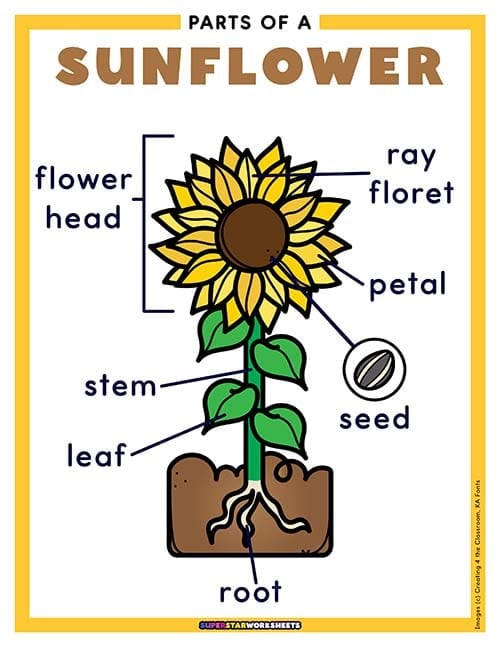
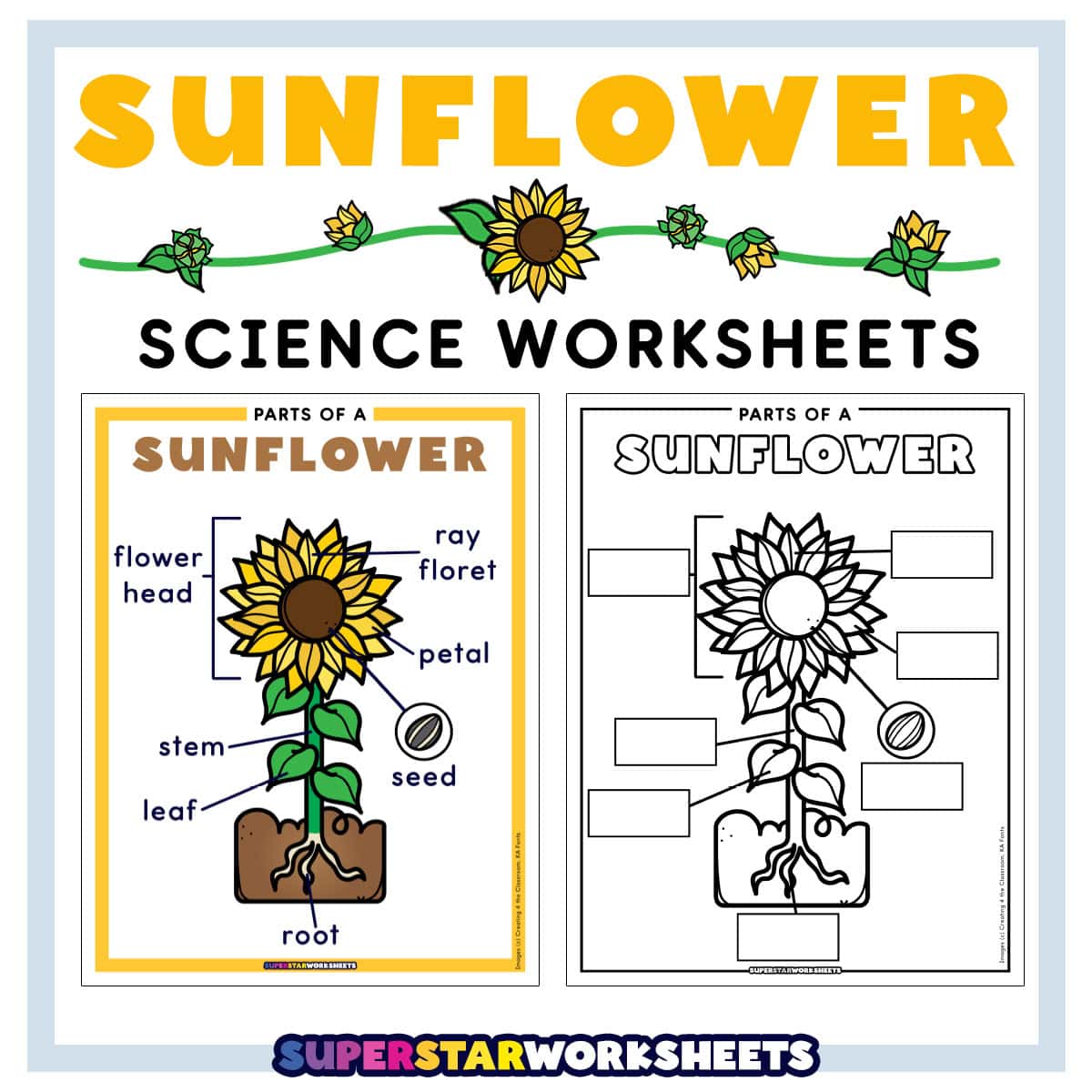
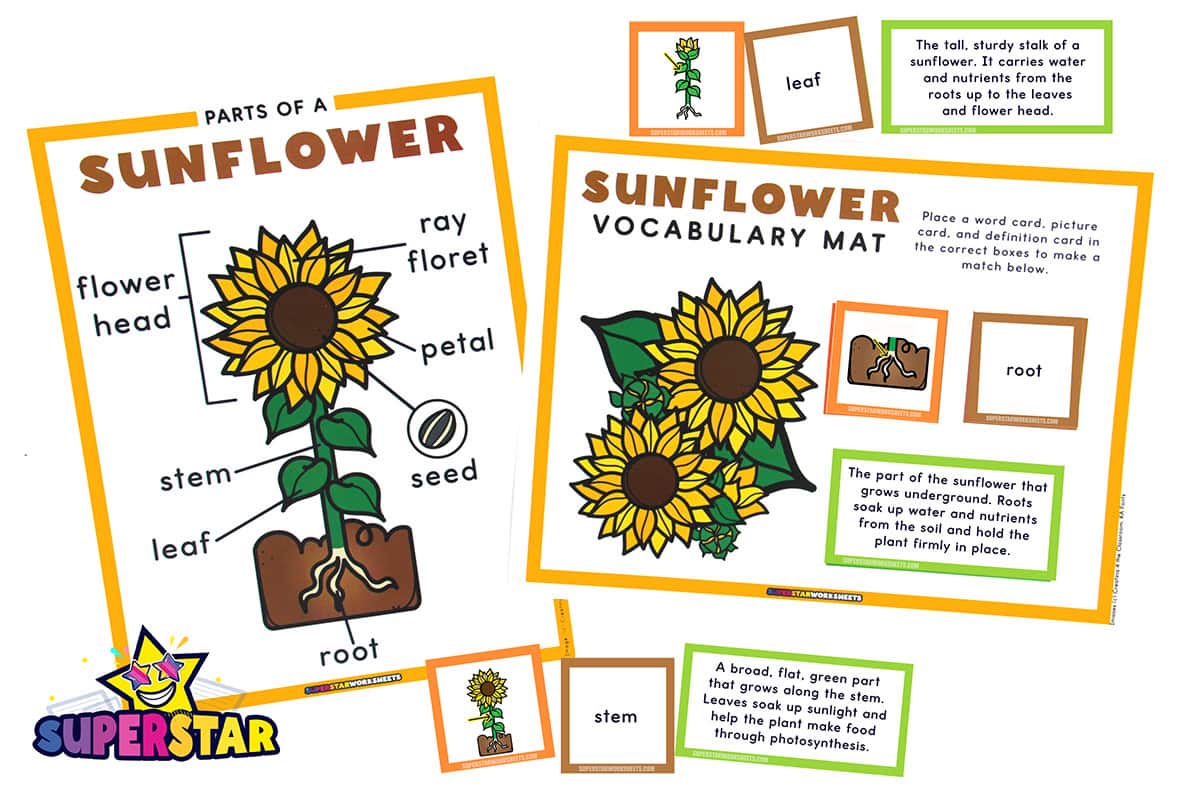
This colorful anchor chart introduces the external parts of a sunflower with a clearly labeled diagram and thin black callout lines. A beautiful reference poster for science walls, student notebooks, and whole-class instruction.
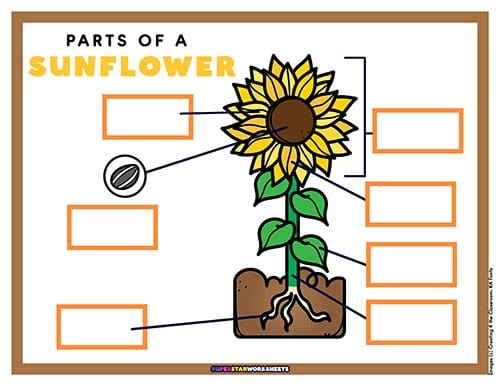
Parts of a Sunflower Learning Mat
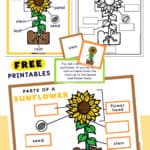
This reusable learning mat pairs with a set of label cards for a hands-on matching activity. Students place each word card next to the correct part of the sunflower diagram, reinforcing all seven part names in a tactile, low-prep center format.
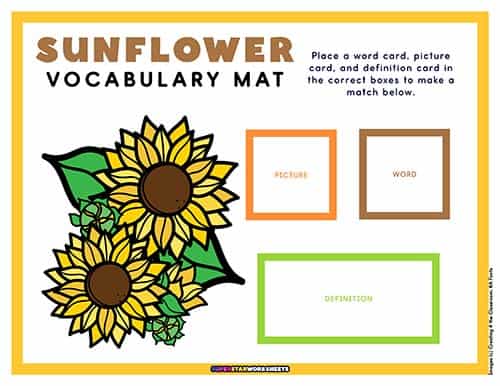
This vocabulary matching mat invites students to place picture, word, and definition cards into the correct spaces on the mat. Built for repeated use, it reinforces sunflower science vocabulary in a hands-on format that works equally well for independent practice and small group review.
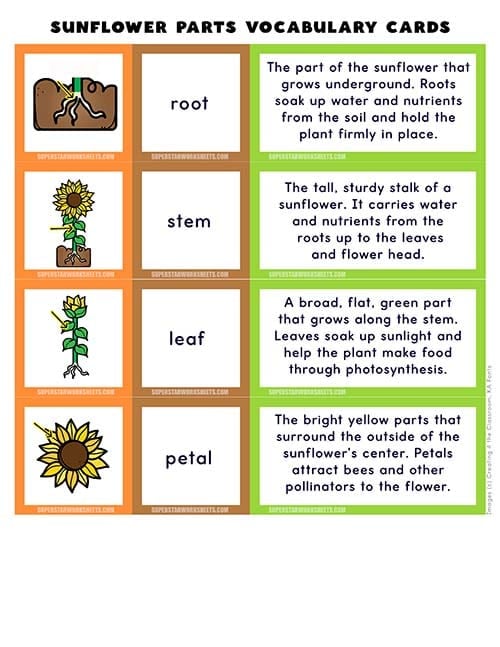
Sunflower Parts Vocabulary Cards
These three-part vocabulary cards feature a picture, word, and definition for each of the seven sunflower parts. Students match the cards independently or in pairs, building both science content knowledge and early reading skills. For more free sunflower printables check out our Sunflower Templates!
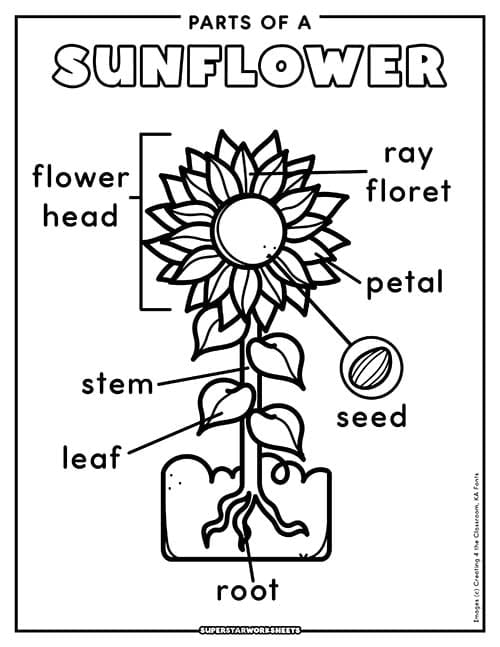
Parts of a Sunflower Worksheet
This printable set includes two variations: a labeled black-and-white diagram for students to color, and a cut-and-paste version where students trim the word labels and place each one on the correct part of the sunflower. Both versions actively reinforce the seven external parts.
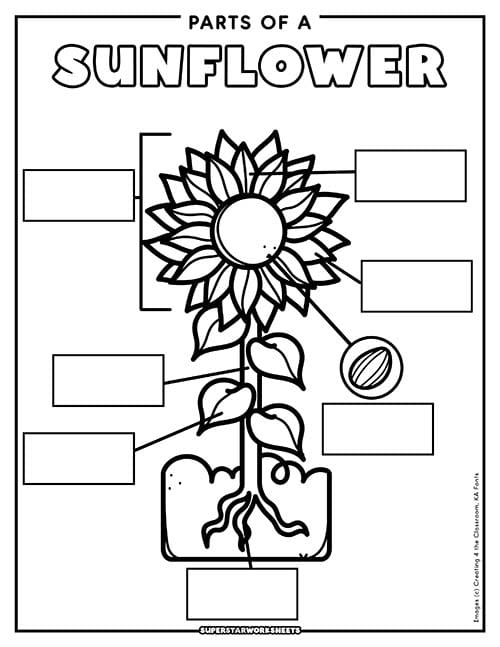
Parts of a Sunflower Chart Cut Paste
Here is a parts of a sunflower cut and past diagram. Included are labels for students to cut out and paste in the correct boxes.
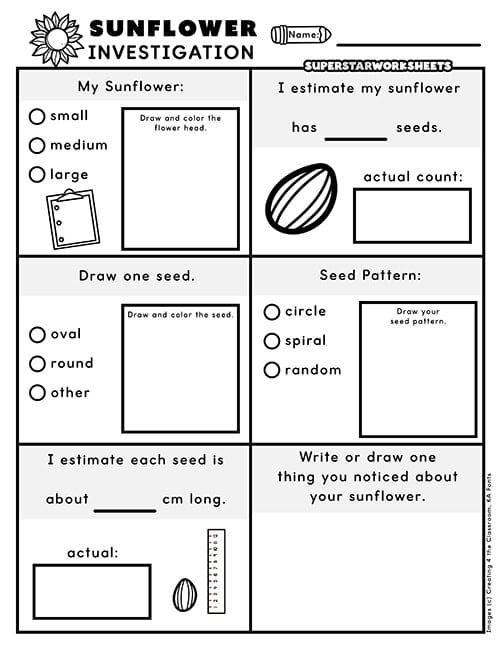
Students get up close with a real sunflower in this hands-on observation sheet. They estimate and count seeds, sketch and describe the seed’s shape and size, identify the spiral seed arrangement, and record one surprising observation. It is a perfect introduction to scientific measurement and estimation skills.
Teaching the Parts of a Sunflower
A sunflower is one of the most recognizable plants in the world. Each of its external parts plays a specific role in the plant’s survival, growth, and reproduction. When students can name and describe each part, they build a foundation for understanding all flowering plants.
Roots grow underground and anchor the sunflower firmly in the soil. They absorb water and nutrients and send them up through the stem to the rest of the plant. Without strong roots, even a tall sunflower could not stand upright.
The stem is the sunflower’s highway. It carries water and nutrients from the roots up to the leaves and flower head. Sunflower stems are thick and sturdy, sometimes growing more than ten feet tall.
Leaves are broad and flat, covered in tiny hairs that help the plant absorb sunlight. Inside each leaf, a process called photosynthesis converts sunlight, water, and carbon dioxide into food for the plant.
Petals (also called ray florets) form the bright yellow outer ring that makes a sunflower instantly recognizable. Their vivid color attracts bees, butterflies, and other pollinators to the flower.
The flower head is the large circular center of the sunflower. It looks like a single flower, but it is actually made up of hundreds, sometimes thousands of tiny individual flowers called florets packed tightly together.
Ray florets are the petal-like flowers along the outer edge of the flower head. They are usually bright yellow and sterile, meaning they do not produce seeds. Their job is to attract pollinators.
Seeds develop in the center of the flower head as the disk florets are pollinated. A single large sunflower can produce between 1,000 and 2,000 seeds, arranged in a beautiful spiral pattern.
“A sunflower’s “flower” is actually hundreds of tiny flowers working together.”
💡Teaching Tip: Use a real or printed sunflower image alongside the labeled chart. Point to each part as you introduce it. For older students, ask: “What would happen if a sunflower had no roots? No leaves? No petals?” Connecting structure to function deepens understanding.
Sunflower Life Cycle Printables
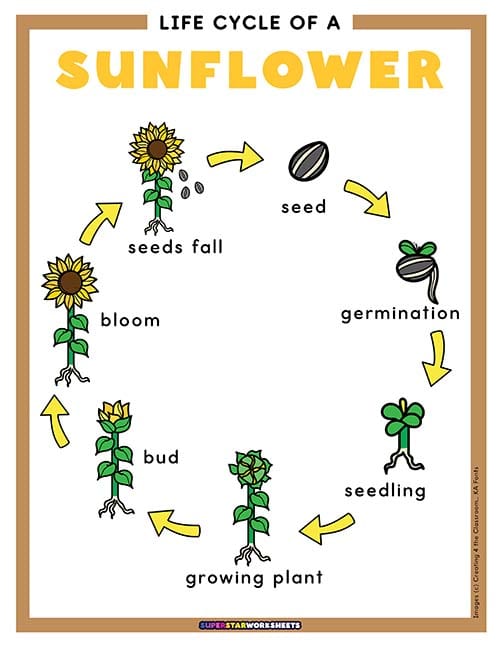
Life Cycle of a Sunflower Chart
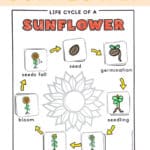
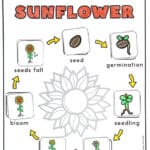
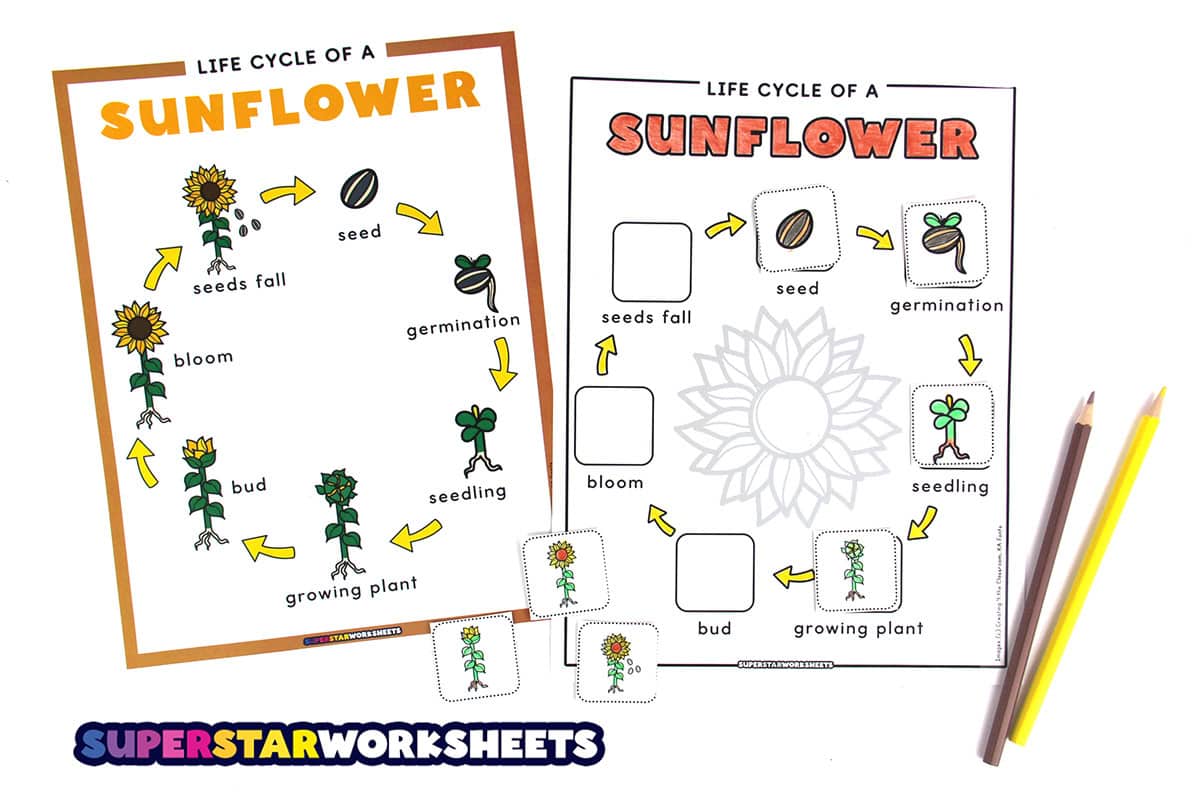
This full-color circular diagram walks students through all seven stages of the sunflower life cycle connected by bright yellow arrows. A beautiful reference chart for science walls, student notebooks, and life cycle discussions.
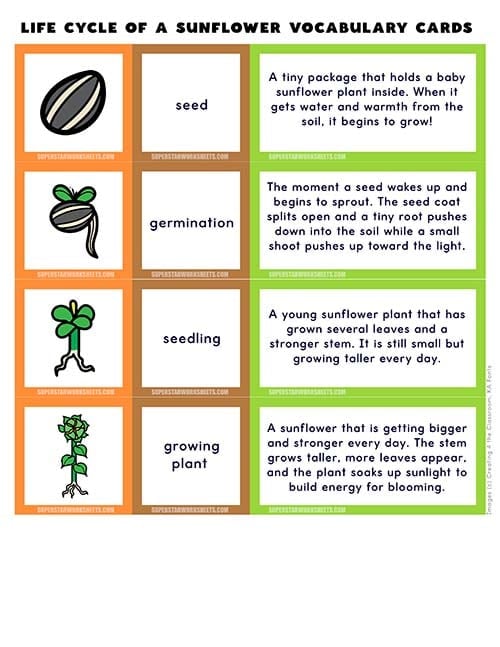
Life Cycle of a Sunflower Vocabulary Cards
These three-part cards introduce each of the seven life cycle stages with a picture, word, and definition. Students match or sequence the cards to build a complete understanding of the sunflower cycle from seed to seeds fall.
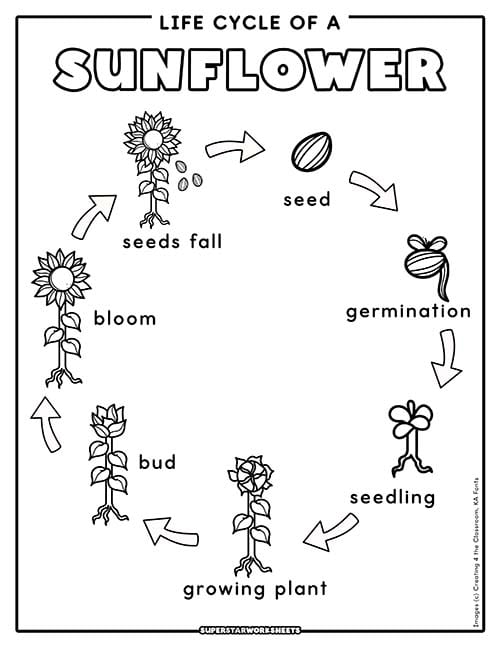
Life Cycle of a Sunflower Worksheet
This printable set includes two variations: a black-and-white life cycle diagram with all seven stages labeled for students to color, and a blank-label version where students fill in each stage name from memory or using the reference chart. Both versions work well for formative assessment and science journals.
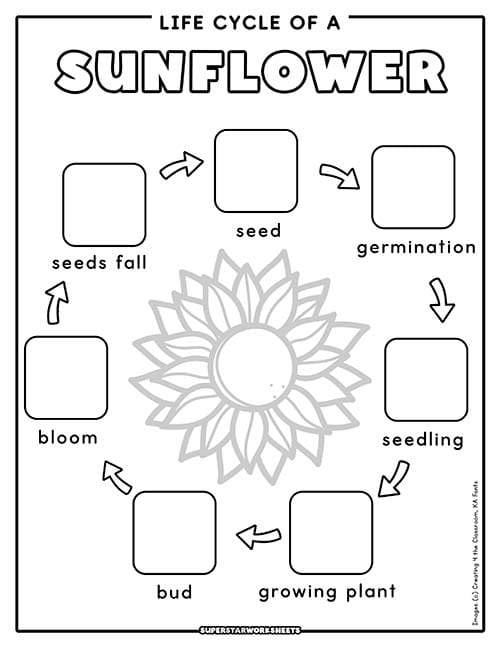
Life Cycle of a Sunflower Cut and Paste
Students cut out seven illustrated stage cards and paste them into the correct spots on a blank circular diagram. This hands-on sequencing activity reinforces the complete sunflower life cycle in an engaging, low-prep format.
Teaching the Sunflower Life Cycle
Sunflowers complete their full life cycle in a single growing season which makes them one of the most observable and teachable plants in elementary science. Walking students through each stage builds understanding of how all living things grow, reproduce, and continue their species.
Seed: Every sunflower begins as a small, oval-shaped seed. Protected by a tough seed coat, the seed holds everything the new plant needs to begin growing, it just needs warmth, water, and soil.
Germination: When a seed absorbs water and warmth from the soil, it “wakes up” and begins to sprout. The seed coat splits open, a tiny root pushes down, and a small shoot pushes up toward the light. This is germination.
Seedling: Once the shoot breaks through the soil, the plant becomes a seedling. It has a small stem and its first tiny leaves called seed leaves or cotyledons, these begin capturing sunlight right away.
Growing plant: As the seedling grows, its stem thickens, more leaves appear, and the plant gets taller and stronger every day. During this stage, the sunflower can grow up to one foot per week under ideal conditions.
Bud: A tight green cluster forms at the top of the stem. The petals and florets are protected inside, waiting for the right moment to open. Young sunflowers at this stage still practice heliotropism, tracking the sun from east to west each day.
Bloom: The bud opens into a fully bloomed sunflower with bright petals and a center disk full of florets. Pollinators visit the bloom to collect nectar and pollen, which allows the disk florets to be fertilized and begin forming seeds.
Seeds fall: After the bloom, petals dry and drop away. The center disk fills with mature seeds. Eventually the seeds loosen and fall to the ground or are carried away by birds, squirrels, and the wind beginning the cycle again.
“From a tiny seed to a towering bloom in a single summer — the sunflower life cycle is science you can watch happen.”
💡Teaching Tip: Plant a sunflower seed in a clear cup so students can observe germination up close. Mark stages on a simple class calendar as the plant grows. When it blooms, revisit the life cycle chart and have students point to each stage they watched happen.
Heliotropism Worksheets
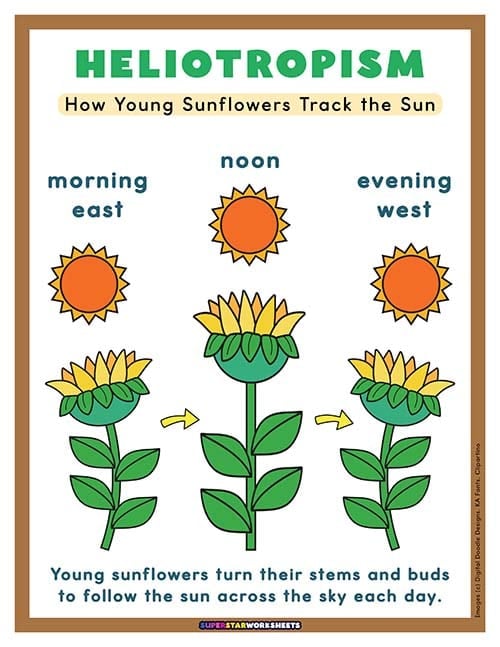
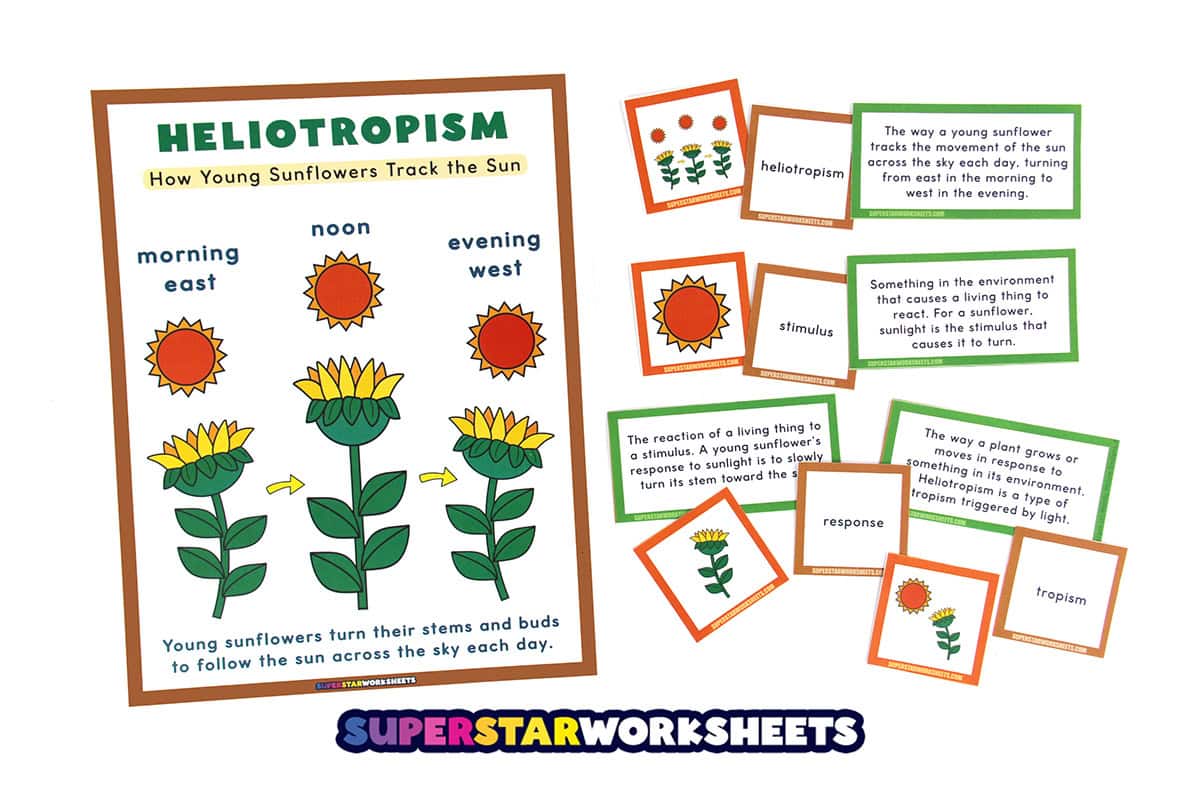
This science anchor chart explains how young sunflowers track the movement of the sun from east to west across the sky each day. The diagram labels the stimulus (sunlight) and the plant’s response, introducing key science vocabulary in a clear visual format for upper elementary learners.
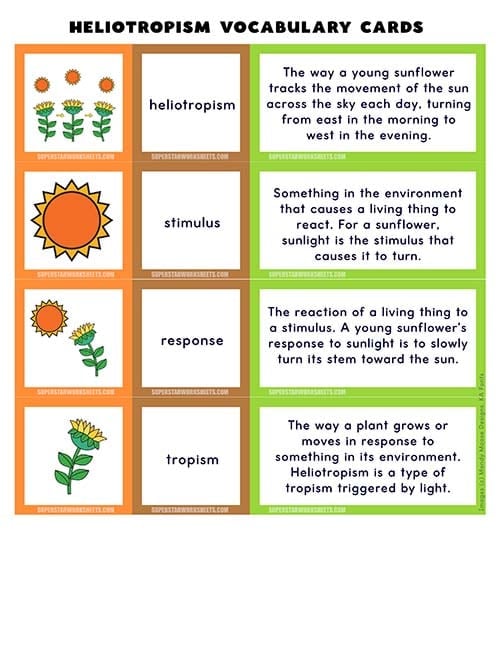
These three-part cards cover four essential vocabulary terms with a picture, word, and definition. Students match or sort the cards to build a solid foundation in plant behavior and stimulus-response science concepts. Teachers! If you are needing more science related worksheets, take a look at our Plant Worksheets!
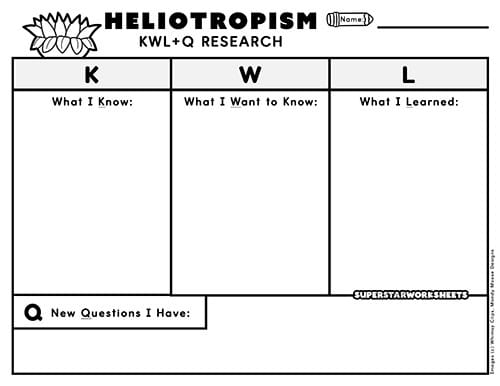
This printable graphic organizer guides students through a structured research process as they explore heliotropism. Students record what they know, what they want to learn, what they discovered, and new questions they still have.
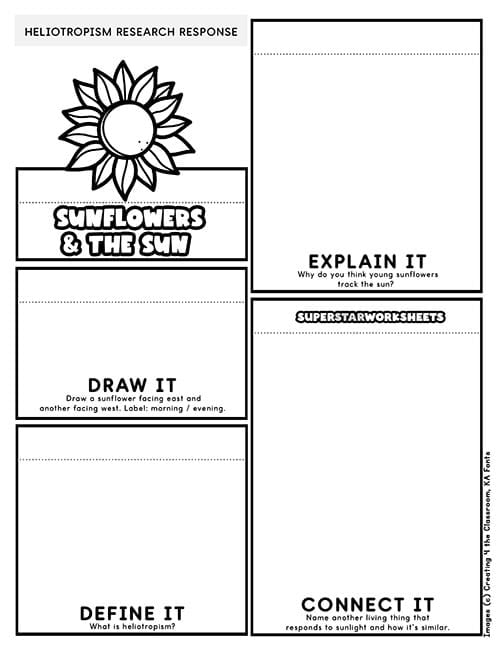
Sunflowers and the Sun Research Response
This four-section research and drawing response page deepens student understanding of heliotropism. Students draw a sunflower facing east and west, define heliotropism in their own words, explain why sun-tracking helps the plant grow, and connect the behavior to another living thing that responds to sunlight.
Teaching Heliotropism
One of the most fascinating behaviors in the plant world happens quietly in sunflower fields every morning. Young sunflowers slowly turn their stems to face the rising sun in the east and by evening, they have tracked all the way west. This behavior is called heliotropism, and it is a perfect entry point for teaching students about stimulus and response in living things.
Heliotropism is the movement of a plant in response to sunlight. The word comes from the Greek words helios (sun) and trope (turning). Only young, actively growing sunflowers practice heliotropism. Once a sunflower matures and stops growing, it permanently faces east.
A stimulus is something in the environment that causes a living thing to react. For a young sunflower, the stimulus is sunlight, specifically, the direction it is coming from.
The response is the plant’s reaction to that stimulus. The sunflower’s stem slowly bends and turns toward the light source throughout the day, following the sun from east to west.
Tropism is the broader term for any growth or movement in a plant triggered by an environmental factor. Heliotropism is triggered by light. Other types of tropism include gravitropism (roots growing downward in response to gravity) and hydrotropism (roots growing toward water). Scientists believe heliotropism benefits young sunflowers in two key ways: the warmth from facing the sun helps the plant grow faster, and a warm flower attracts more pollinators, especially bees, which prefer warmer flowers in the early morning.
“Young sunflowers don’t just grow toward the sun — they follow it, hour by hour, across the sky.”
💡Teaching Tip: Place a potted sunflower seedling on a sunny windowsill and observe it over several days. Mark which direction it faces each morning with a small sticky note. Students will see heliotropism in action. Ask: “What is the stimulus? What is the response?” to anchor the vocabulary in a real observation.
Sunflower Seeds and Wildlife Printables
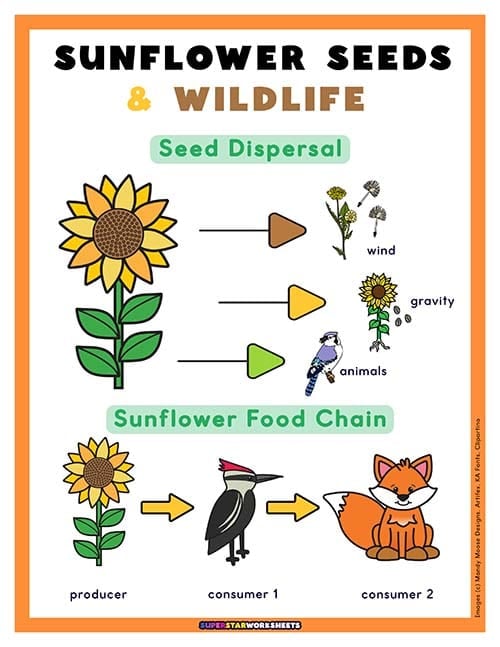
Sunflower Seeds and Wildlife Chart
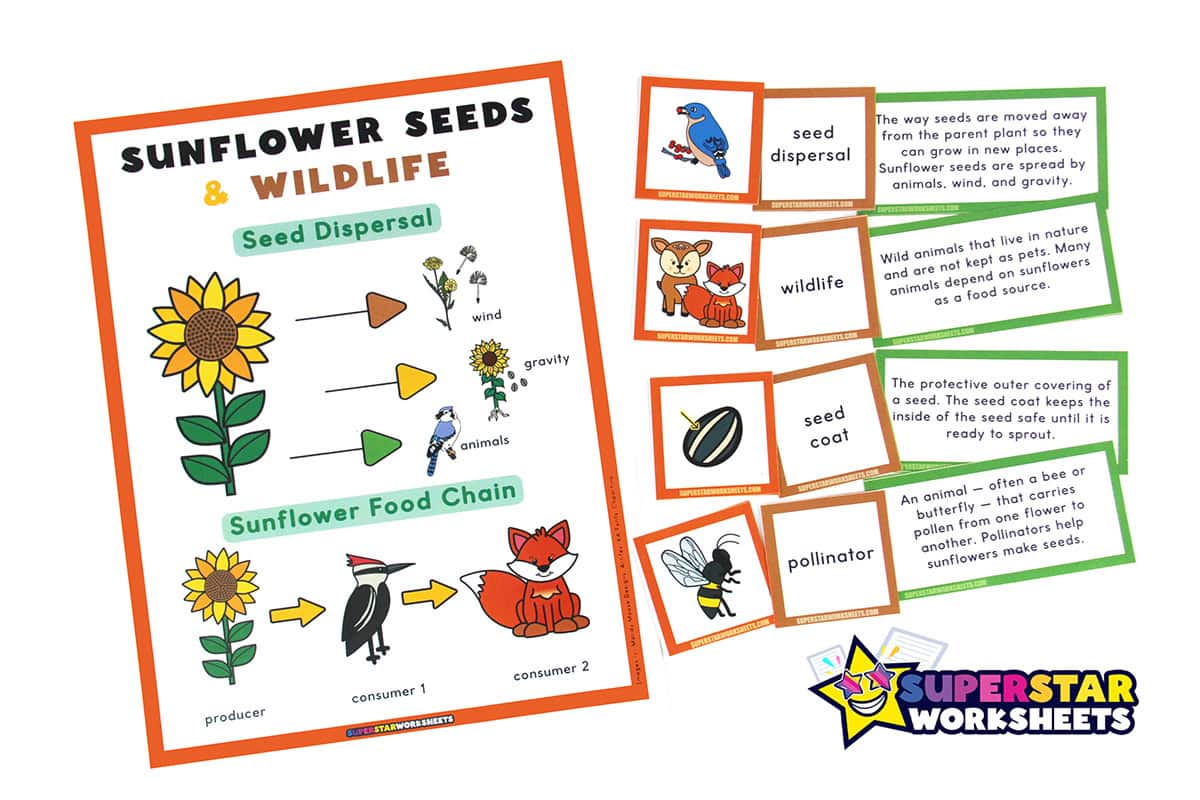
This two-section anchor chart introduces seed dispersal and the sunflower food chain. The top section diagrams three dispersal methods with labeled illustrations. The bottom section maps a simple food chain from sunflower producer to animal consumers, including birds, squirrels, and humans.
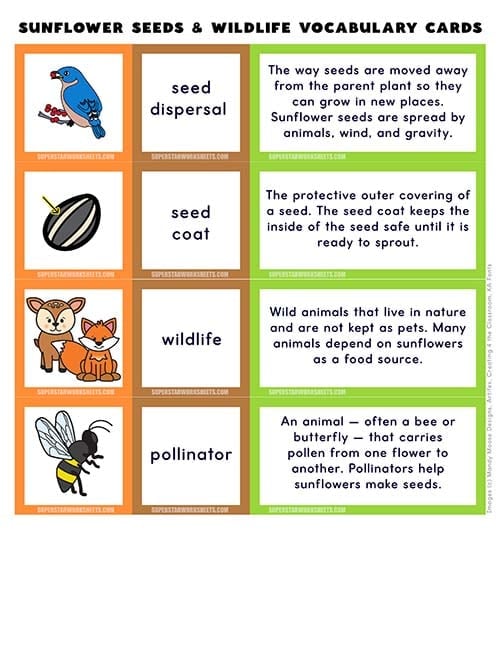
Sunflower Seeds and Wildlife Vocabulary Cards
Seven vocabulary terms are presented as three-part matching cards with a picture, word, and definition. These cards support both science content and academic vocabulary development for grades one through three.
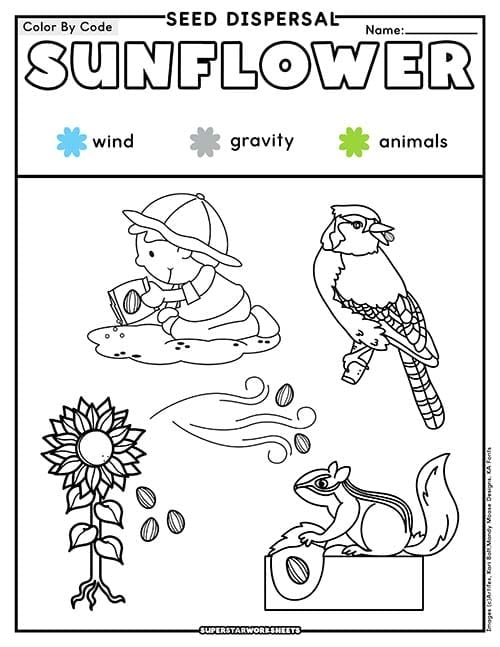
Sunflower Seed Dispersal Color by Code
Students color six illustrated scenes using a simple three-color code to classify each method of sunflower seed dispersal. This engaging activity reinforces the three dispersal pathways in a low-prep, visually interactive format.
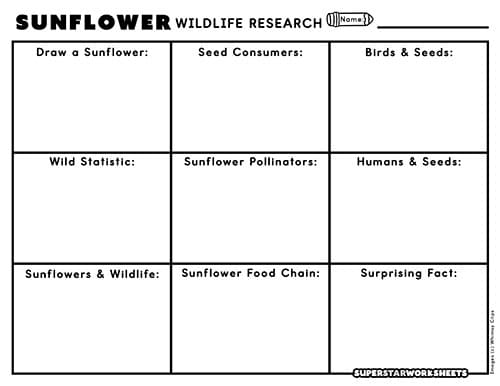
This nine-cell research grid guides students as they investigate the relationship between sunflowers and the animals that depend on them. Prompts include identifying seed consumers, pollinators, human uses of sunflower seeds, and a draw-your-own food chain activity.
Teaching Sunflower Seeds and Wildlife
When a sunflower’s bloom fades and its petals fall away, a new chapter begins. The flower head fills with hundreds of ripening seeds, and the sunflower becomes one of the most important food sources in its ecosystem. Understanding how seeds travel and which animals depend on sunflowers connects students to the bigger picture of interdependence in nature.
Seed dispersal is the process by which seeds are moved away from the parent plant to new locations where they can grow. Sunflowers disperse seeds in three main ways: by animals, by wind, and by gravity.
Animal dispersal happens when birds, squirrels, and other wildlife eat sunflower seeds and drop or bury them elsewhere. Goldfinches and chickadees are among the most common seed-eaters, often clinging to the seed head and pulling seeds free one by one.
Wind dispersal can carry lightweight seeds short distances from the parent plant, though sunflower seeds are heavier than dandelion or maple seeds and typically do not travel far by wind alone.
Gravity causes heavy, ripe seeds to fall straight down from the seed head to the ground below. These seeds may germinate right at the base of the parent plant or be carried further by animals or water.
The seed coat is the tough protective outer layer of each seed. It keeps the embryo inside safe until warmth and moisture signal that conditions are right for germination.
In the sunflower food chain, the sunflower is a producer so it makes its own food using sunlight, water, and air. Animals that eat the seeds, such as birds and squirrels, are consumers. Humans are consumers too because sunflower seeds are harvested and pressed to produce sunflower oil used for cooking around the world. Pollinators like bees and butterflies also play a critical role, visiting the bloom to collect nectar and transferring pollen that allows the seeds to form.
“Every seed a bird carries away is a new sunflower waiting to happen.”
💡Teaching Tip: Bring in a real dried sunflower head or a bag of unshelled sunflower seeds. Ask students: “How did this seed get here?” Walk through the three dispersal methods together. For an extension activity, have students design their own seed dispersal method and explain which animals or conditions would help their imaginary seed travel furthest.
Sunflower Facts and Research Printables
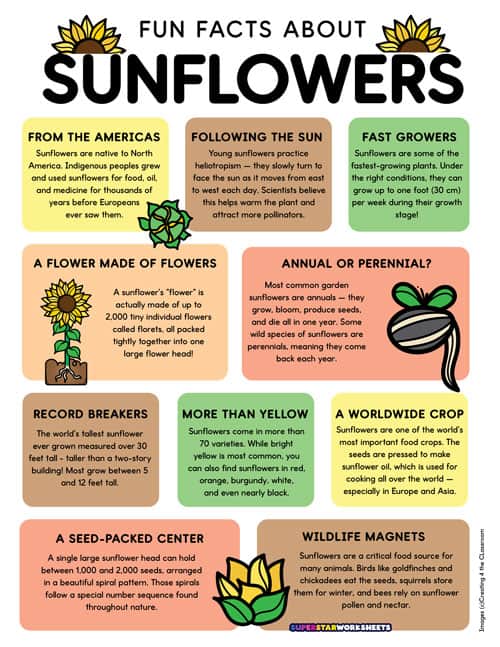
Download this colorful printable poster and share ten engaging sunflower science facts with your students. Topics include sunflower records, native origins, seed counts, annual versus perennial varieties, wildlife connections, global oil production, and more. Perfect for hanging near science centers or using as a read-aloud reference.
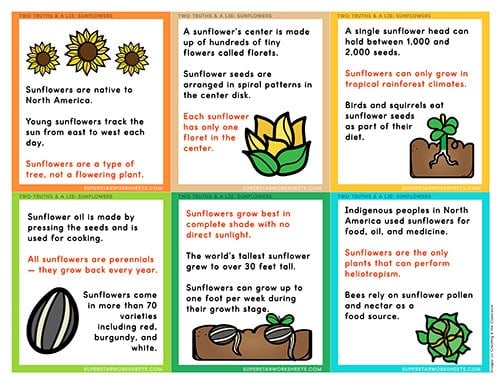
Two Truths and a Lie: Sunflower Science
Six illustrated cards each present two true sunflower facts and one sneaky lie. The lie is printed in red, making this a teacher-directed game that works beautifully for science centers, morning meeting, and small group review.
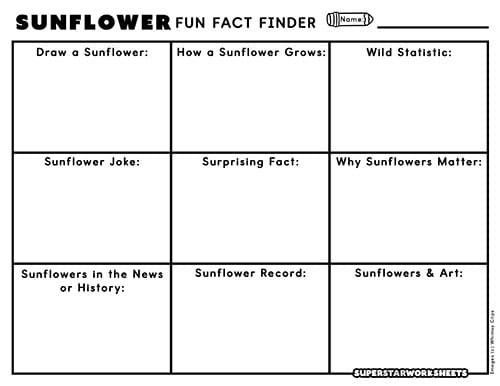
This nine-cell research grid sends students on a guided fact-finding mission about sunflowers. Prompts encourage students to research how sunflowers grow, discover wild statistics and records, explore sunflower history, and make connections to art and culture. A great independent research activity for grades two and three.
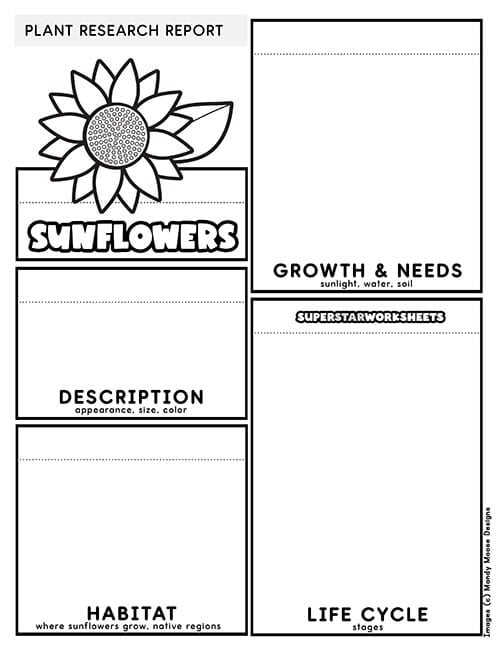
Sunflower Plant Research Report
Students organize and record their sunflower knowledge in this structured four-section research report booklet covering description, habitat, growth needs, and life cycle stages. A meaningful end-of-unit writing project that combines science content with informational writing skills for early elementary students.
Sunflower Science Experiment
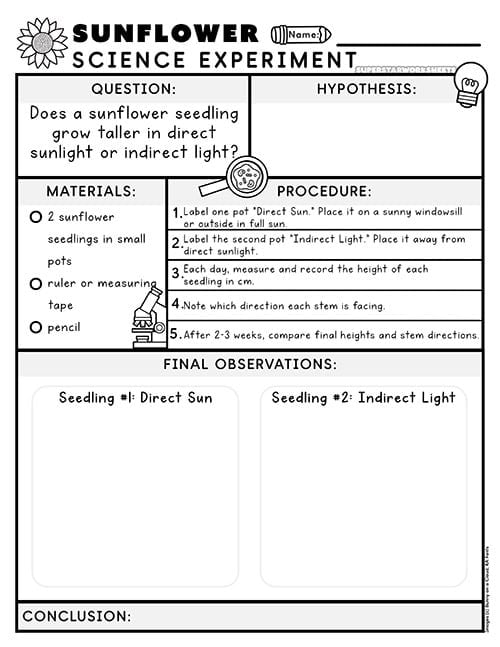
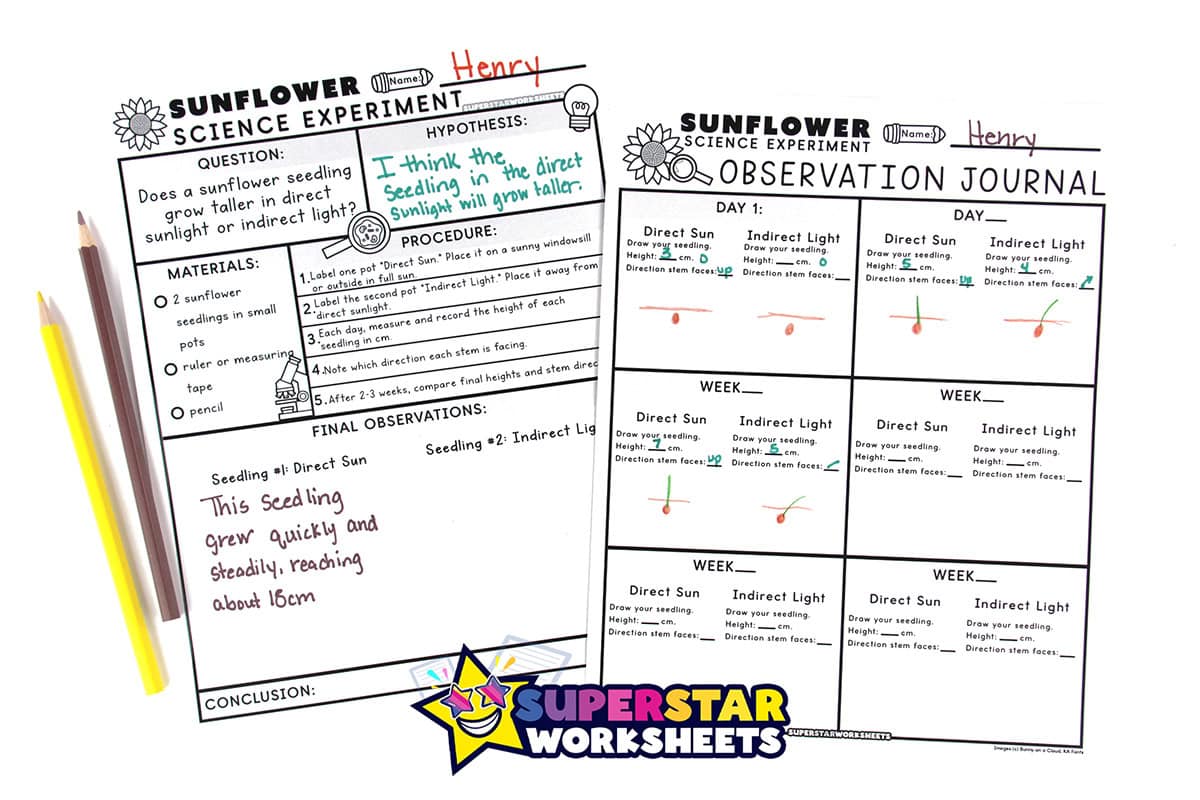
This printable experiment sheet walks students through a structured investigation testing whether sunflower seedlings grow taller in direct sunlight versus indirect light. Students record their hypothesis, follow a step-by-step procedure, make final observations, and write a conclusion.
Sunflower Science Observation Journal
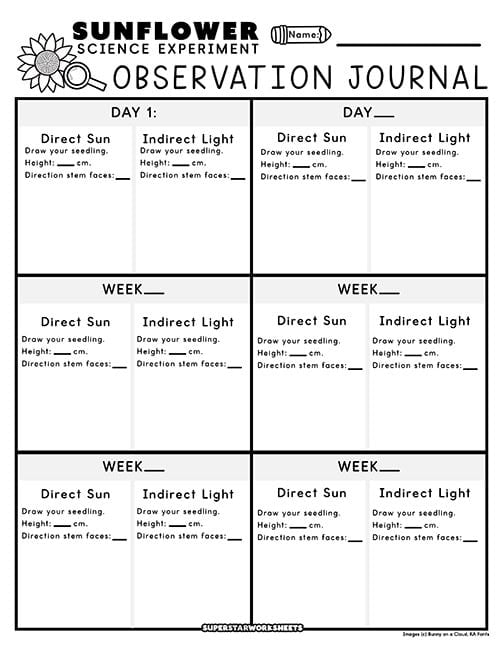
Pair this observation journal with the experiment sheet to track seedling growth over two to three weeks. Students draw their seedlings, record heights in centimeters, and note stem direction at six checkpoints which builds measurement, data recording, and scientific observation skills throughout the investigation.
Teaching the Sunflower Science Experiment
This hands-on sunflower science experiment is designed for students in grades two through four. Students investigate whether sunflower seedlings grow taller and track the sun more actively in direct sunlight versus indirect light, connecting the scientific method to the real plant behaviors they have already studied.
Question:
Does a sunflower seedling grow taller in direct sunlight or indirect light?
Materials:
- 2 sunflower seedlings in small pots with soil
- Ruler or measuring tape
- Pencil
- Experiment sheet
- Observation journal
Procedure:
- Label one pot “Direct Sun.” Place it on a sunny windowsill or outside in full sunlight each day.
- Label the second pot “Indirect Light.” Place it in a location that receives limited or filtered light.
- Each day, measure the height of each seedling in centimeters and record it on the experiment sheet. Note which direction each stem is facing.
- Continue for 2–3 weeks. Record all measurements and sketches in the Observation Journal.
- Compare the final heights and stem directions of both seedlings. Write your conclusion: What did you observe? Was your hypothesis correct?
Expected Results:
The seedling in direct sunlight will grow taller and will visibly turn toward the light source, demonstrating heliotropism. The seedling in indirect light will grow more slowly and show less directional movement.
Science Connection:
Sunflowers use sunlight to produce food through photosynthesis. More sunlight means more energy and faster growth. Young sunflowers also practice heliotropism, slowly turning their stems to follow the sun throughout the day. This experiment gives students a firsthand look at both processes in action, connecting classroom vocabulary to real, measurable results.
“More sunlight means more energy — and more energy means a taller, stronger sunflower.”
💡Teaching Tip: Before starting, review the vocabulary from the heliotropism unit: stimulus, response, heliotropism. Ask students to predict what they will see in each pot before beginning. After week one, have students share their data and compare predictions. This is a great opportunity to discuss why scientists repeat experiments and collect data over time.
Leave a Reply