
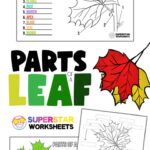
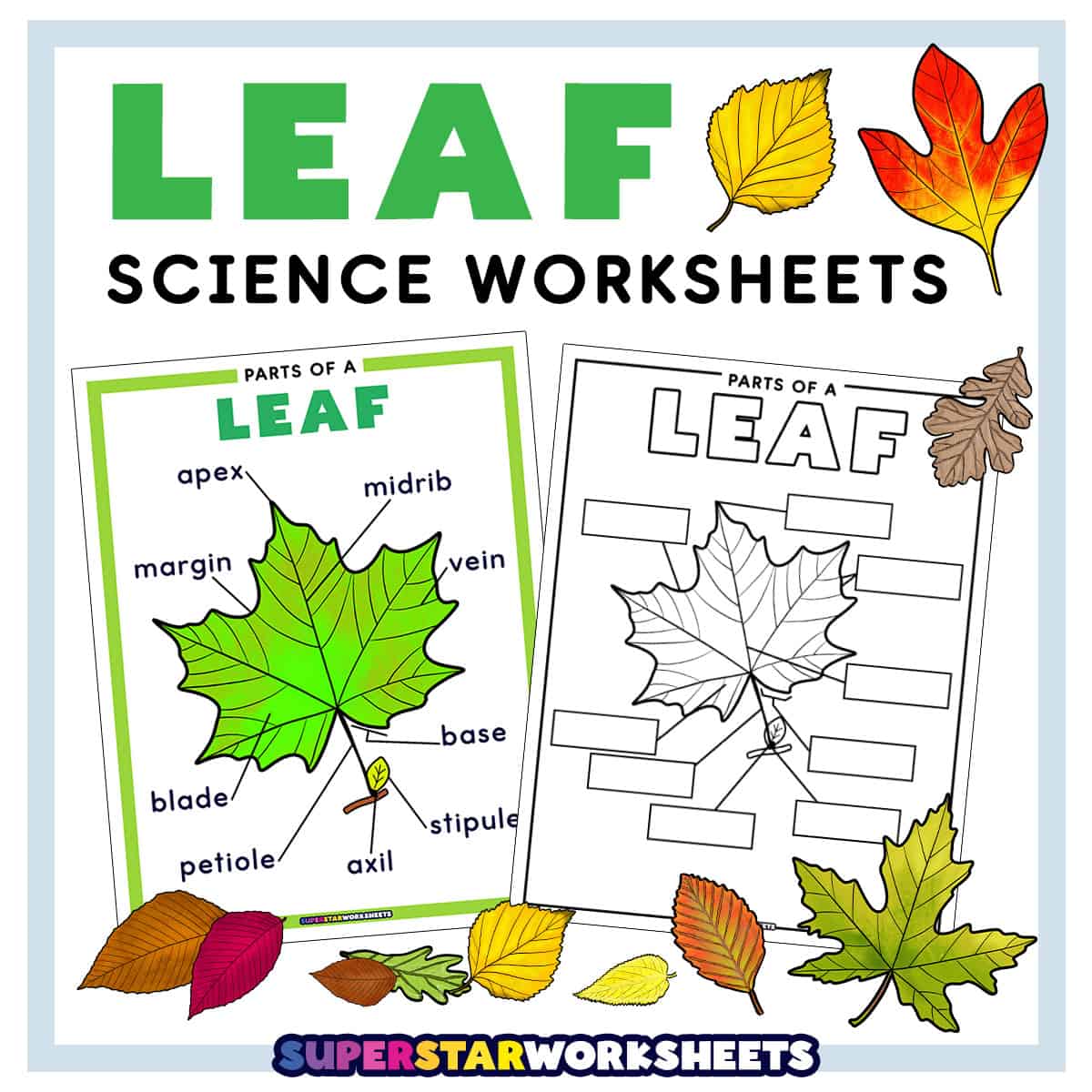
Free printable Leaf Worksheets for kids cover everything from labeling the parts of a leaf to exploring why leaves change color in fall. Download and print PDF activities including labeled diagrams, cross-section charts, sorting mats, vocabulary cards, coloring pages, and a hands-on chromatography science experiment. These leaf printables are perfect for elementary science units, homeschool nature studies, and classroom plant science centers. Students build observation skills, scientific vocabulary, and research skills while exploring one of nature’s most recognizable structures.
Parts of a Leaf Printables
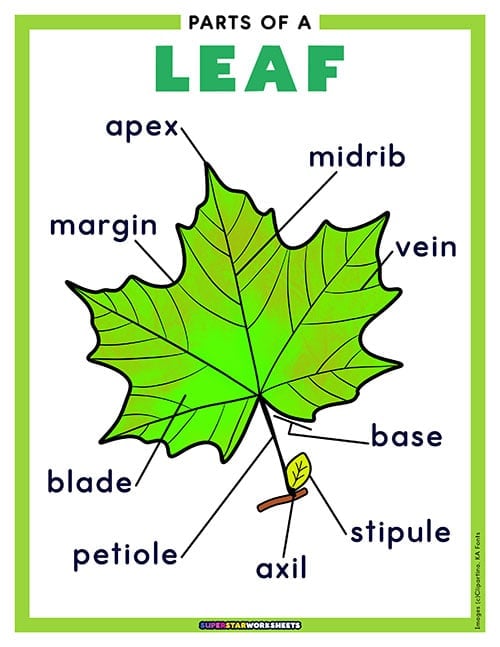
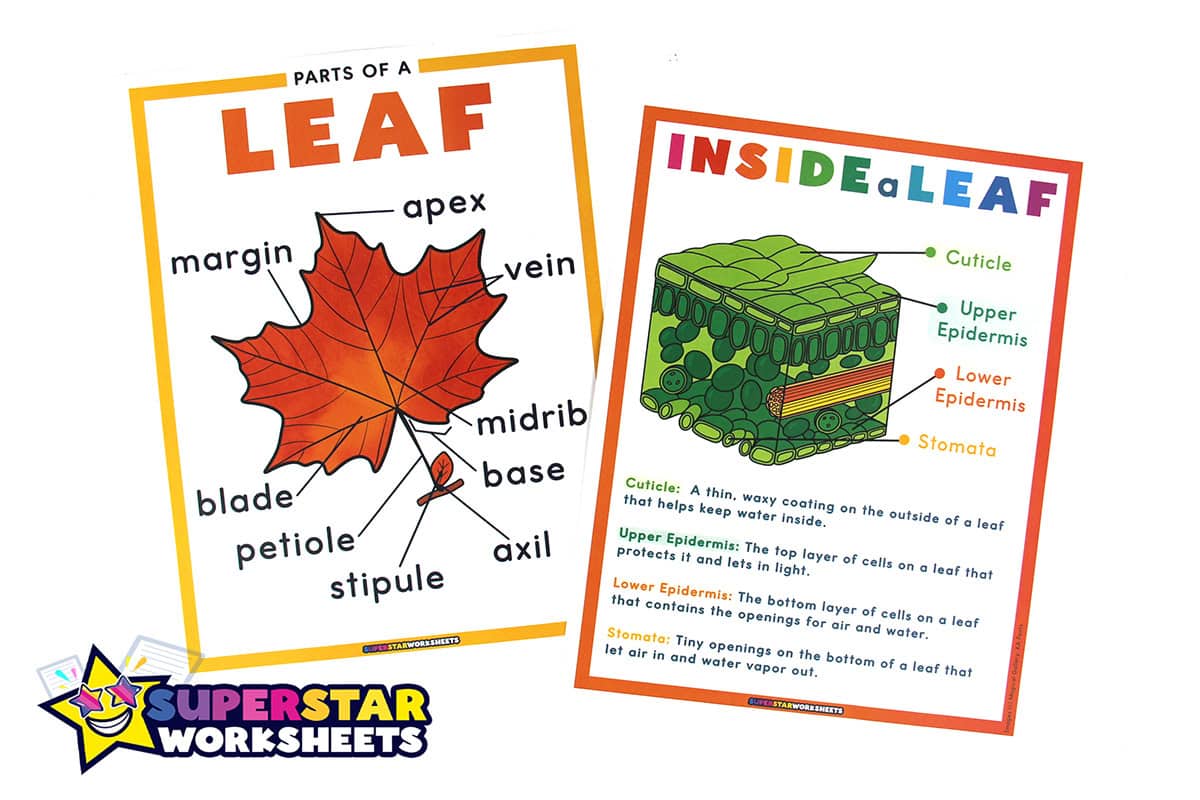
This full-color parts of a leaf chart introduces students to all nine external structures of a leaf, including the blade, midrib, veins, margin, apex, base, petiole, stipule, and axil. Each part is labeled with a callout line on a detailed leaf diagram, making it a perfect anchor chart for a plant science unit or science word wall.
Inside a Leaf: Cross-Section Chart
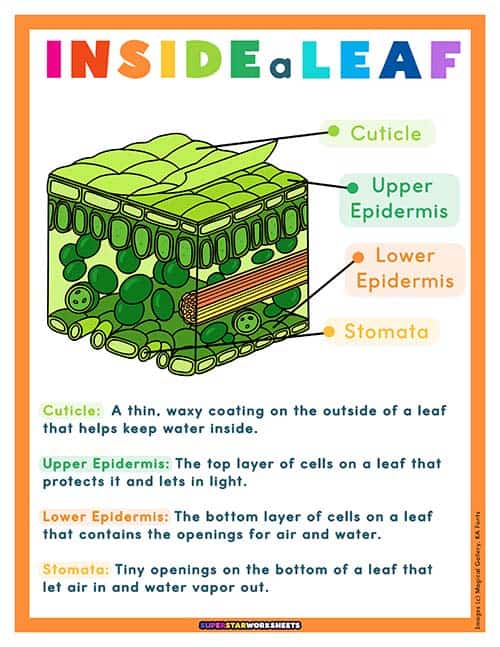
Take a closer look at what is inside a leaf with this cross-section reference chart. Students learn about the cuticle, upper epidermis, lower epidermis, and stomata through a color-coded diagram with matching definitions. This chart supports upper elementary lessons on plant structures and how leaves support photosynthesis.
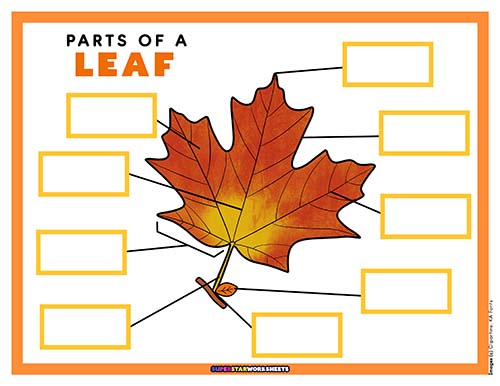
Parts of a Leaf Label Learning Mat
This reusable Parts of a Leaf learning mat is a hands-on activity for early learners. Students place cut-and-laminate label cards onto the correct callout lines on a large leaf diagram. The two-page set includes the mat and a full set of lowercase label cards for all nine external parts.
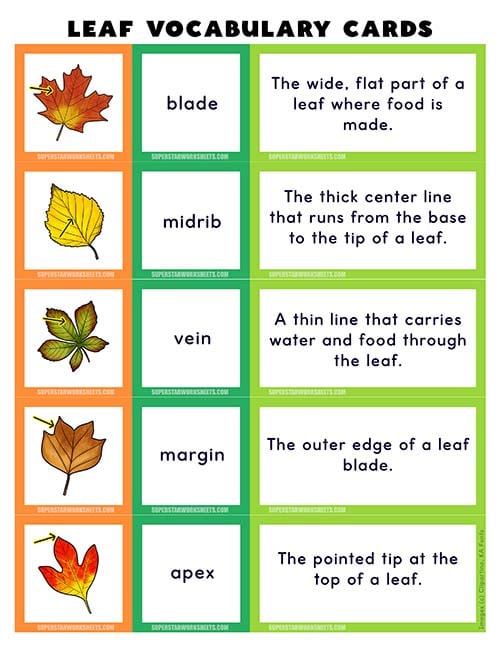
These three-part Leaf Vocabulary Cards help students connect the word, picture, and definition for 13 key leaf vocabulary terms. Use them for matching games, concentration, or science vocabulary centers.
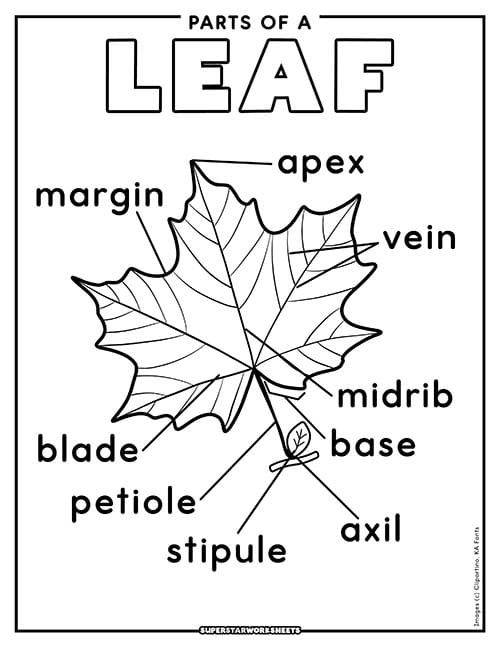
Parts of a Leaf Worksheet (Black and White)
This black and white Parts of a Leaf worksheet gives students a labeled reference diagram to color and study. All nine external parts are identified with callout lines on the same leaf image used in the color chart, making it a low-ink companion to the full-color anchor chart. For more FREE science worksheets check out our Plant Worksheets!
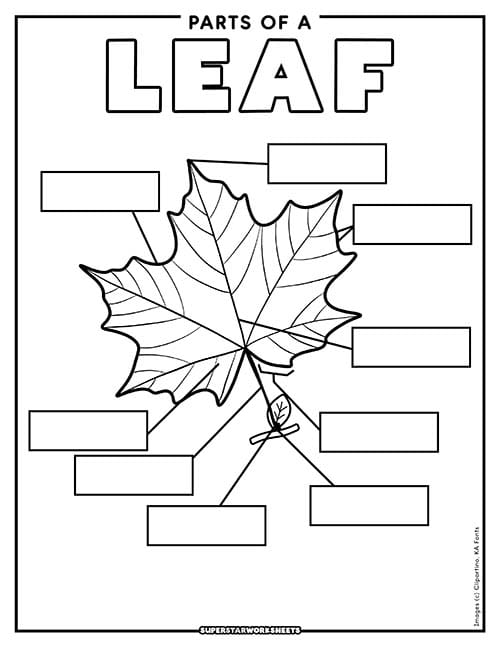
Parts of a Leaf Labeling Worksheet
Students label the nine external parts of a leaf using this cut-and-paste labeling activity. The two-page set includes a diagram page with nine blank callout boxes and a second page of cut-out labels. An ideal assessment or practice activity to follow the color chart and learning mat.
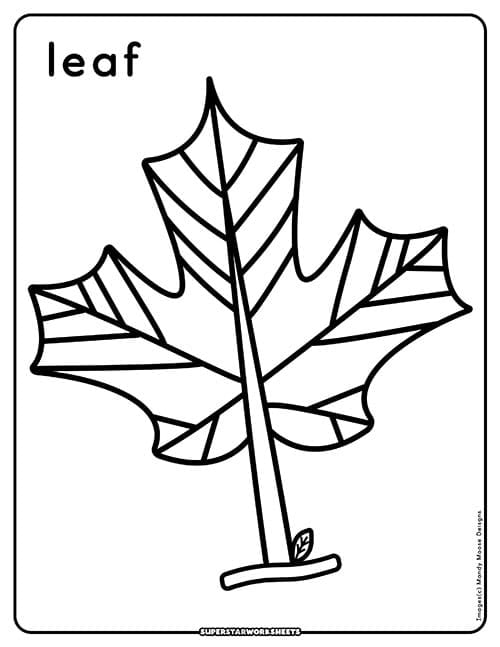
This nature journal-style leaf coloring page invites young learners to color a detailed leaf illustration with grey part labels included directly on the image. Designed for early elementary students, the simple bold lines are easy to color with crayons or colored pencils.
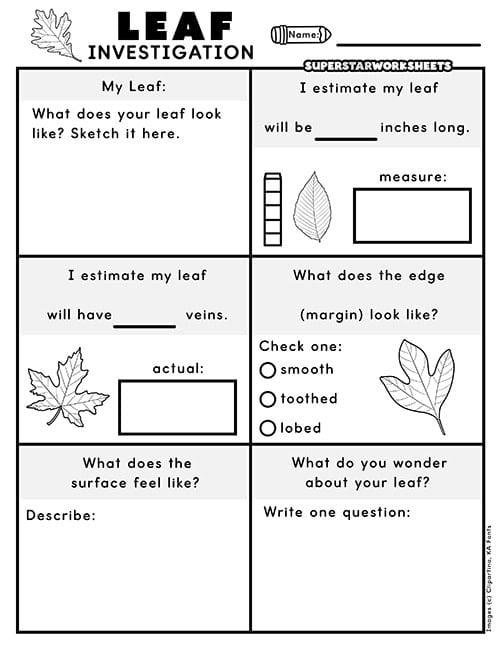
Students use a real leaf and a hand lens to complete this six-section science investigation. They sketch their leaf, estimate and measure its length, count veins, identify the margin type, describe the surface texture, and record one question they still have. A great hands-on expand activity for a parts of a leaf unit.
Teaching the Parts of a Leaf
Every leaf has a set of external structures that work together to help the plant survive. The blade is the wide, flat part of the leaf where photosynthesis takes place. Running down the center is the midrib, the thick central line that supports the leaf and carries water and nutrients. Branching out from the midrib are the veins, which distribute those resources to every part of the blade. The margin refers to the outer edge of the leaf, it can be smooth, toothed, or lobed depending on the plant. The apex is the pointed tip of the leaf, and the base is where the blade connects to the leaf stalk, called the petiole. At the base of the petiole, small leaf-like growths called stipules may appear, and the axil is the angle between the petiole and the main plant stem where new growth often emerges.
Looking inside a leaf reveals four important structures. The cuticle is a thin waxy layer on the leaf surface that prevents water loss. Beneath it sits the upper epidermis, a protective layer of cells that lets light through to the food-making layers below. On the underside of the leaf is the lower epidermis, which houses tiny openings called stomata. Stomata act like microscopic doors, opening and closing to allow carbon dioxide in and release oxygen and water vapor. This is a process essential to photosynthesis. Together, these internal structures make the leaf one of the most efficient food-producing structures in nature.
Teaching Tip: Have students examine a real leaf with a hand lens before introducing the diagram. Ask them to describe what they observe before using vocabulary, this builds curiosity and gives the labels more meaning.
Types of Leaves Worksheets
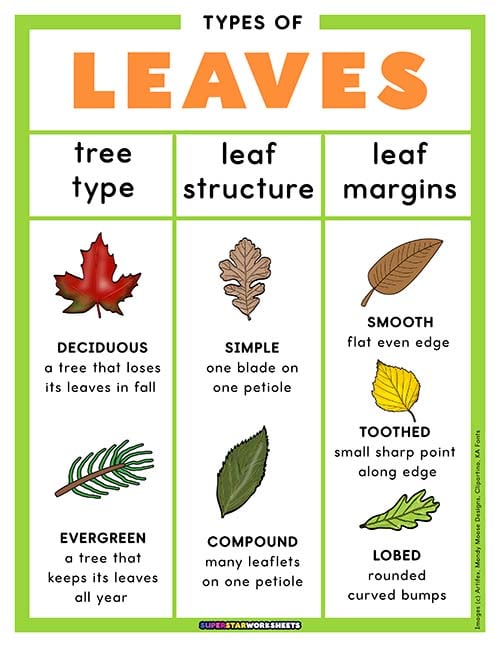
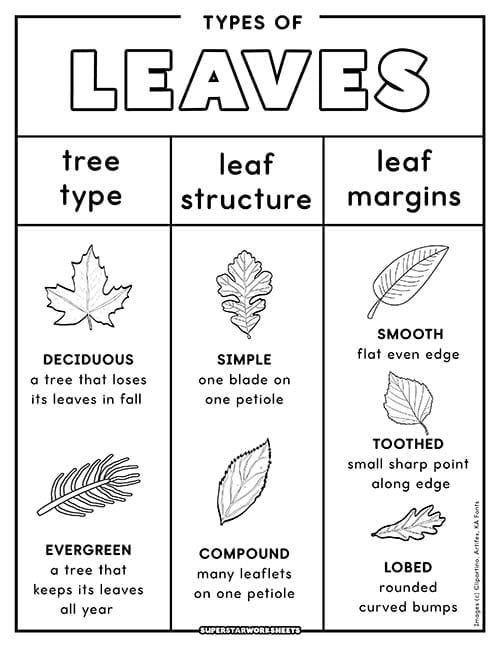
This colorful Types of Leaves reference chart organizes leaf classification into three categories: tree type (deciduous vs. evergreen), leaf structure (simple vs. compound), and margin type (smooth, toothed, and lobed). Named tree leaf clipart accompanies each category so students can connect real leaves to the vocabulary.
Types of Leaves Vocabulary Mat and Cards
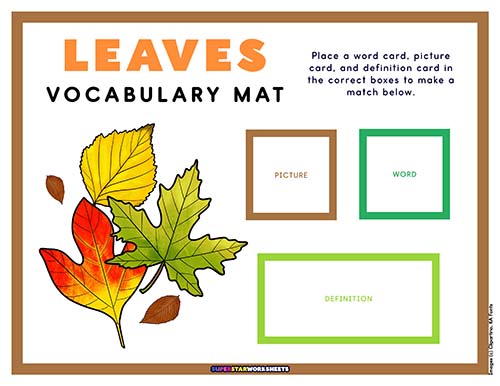
This reusable Montessori-style vocabulary mat pairs with two pages of three-part cards for seven key leaf type terms. Students match the picture card, word card, and definition card for terms including deciduous, evergreen, simple leaf, compound leaf, and all three margin types. Use the mat at a science center or for partner practice.
This three-page set walks students through classifying seven named leaves. Page one provides a labeled study sheet with the leaf name and classification for each. Page two replaces labels with blank boxes for students to fill in, and page three provides cut-out labels for a hands-on sorting option.
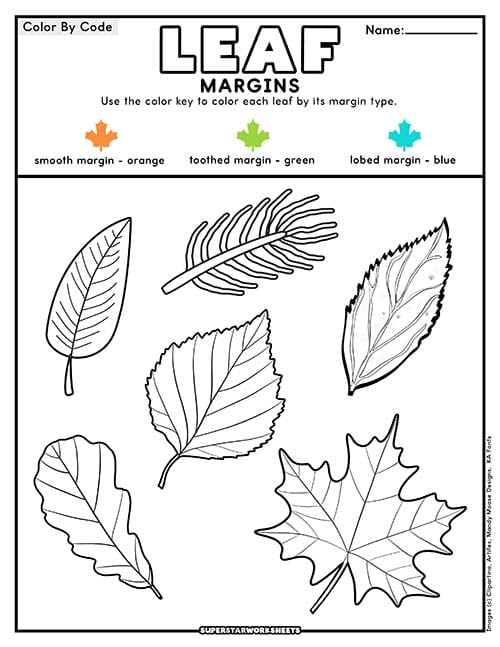
Students color six leaf outlines according to their margin type using this color-by-code activity. Smooth margins are colored orange, toothed margins blue, and lobed margins green, reinforcing the three margin categories through visual discrimination. The same named leaf clipart from the Types of Leaves chart is used throughout.
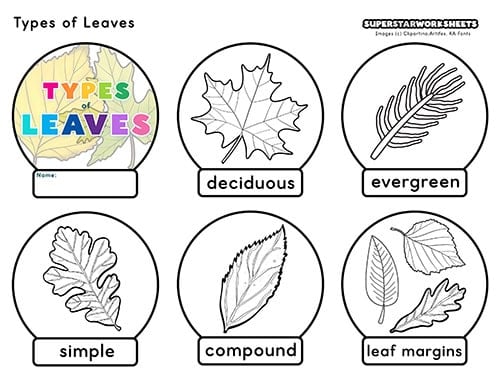
Students color, cut, and assemble this five-panel circle book to create a personal reference for leaf classification. Each panel features a different leaf type to color and is a fun take-home project for any leaf science unit. Teachers! Take a look at our FREE Tree Worksheets!
Teaching Types of Leaves
Not all leaves look the same and those differences tell us a great deal about the trees they come from. One of the most fundamental distinctions is between deciduous and evergreen trees. Deciduous trees, such as maple, oak, birch, and ash, lose all of their leaves each fall and grow new ones in spring. Evergreen trees, like pine and spruce, keep their leaves year-round. Their needle-shaped leaves are specially adapted to survive cold temperatures and reduce water loss in winter.
Leaves are also classified by their structure. A simple leaf has a single blade attached to one petiole, oak and maple leaves are good examples. A compound leaf is made up of multiple smaller leaflets all attached to a single petiole, like the leaves of an ash or walnut tree. At first glance, a compound leaf can look like a branch with many leaves, but the key is that all the leaflets share one petiole.
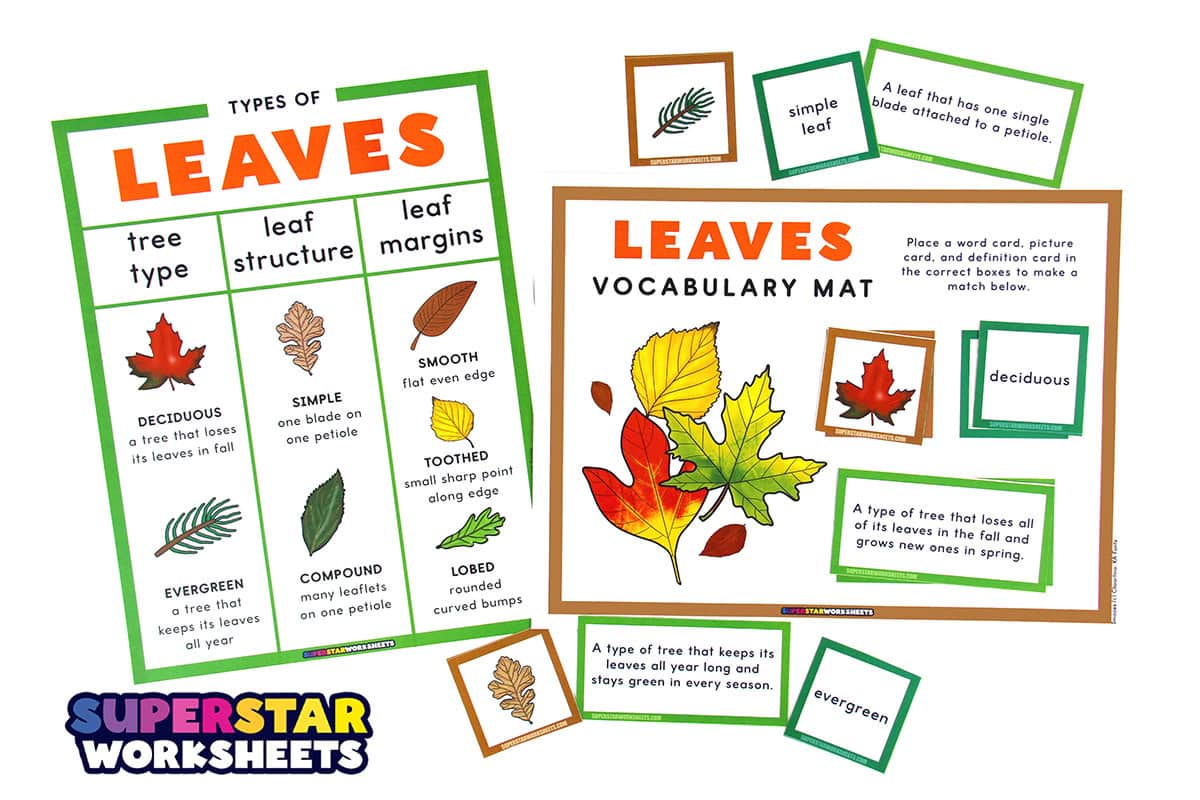
Finally, leaves are distinguished by the shape of their margin, the outer edge of the blade. A smooth margin has a flat, even edge with no points or bumps, like a magnolia leaf. A toothed margin has small, sharp points along the edge like the teeth of a saw, as seen on birch leaves. A lobed margin has rounded or pointed bumps that curve in and out like fingers, a familiar pattern on oak and maple leaves.
Teaching Tip: Collect a variety of real leaves before this lesson and have students sort them into categories before introducing the chart. Real leaves from your schoolyard or neighborhood make the classification concepts concrete and memorable.
Leaf Facts Worksheets
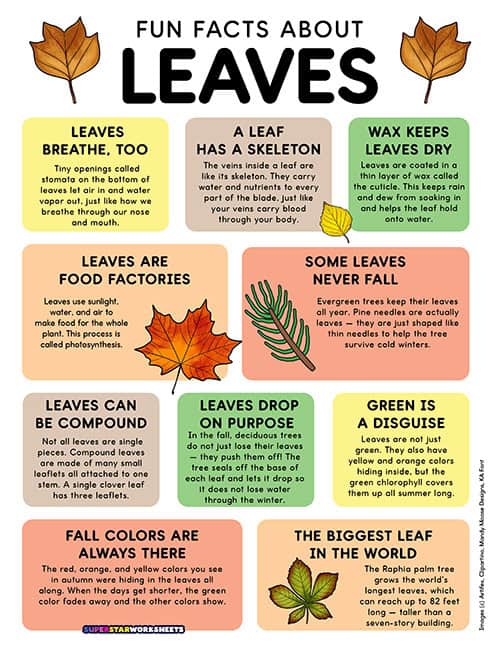
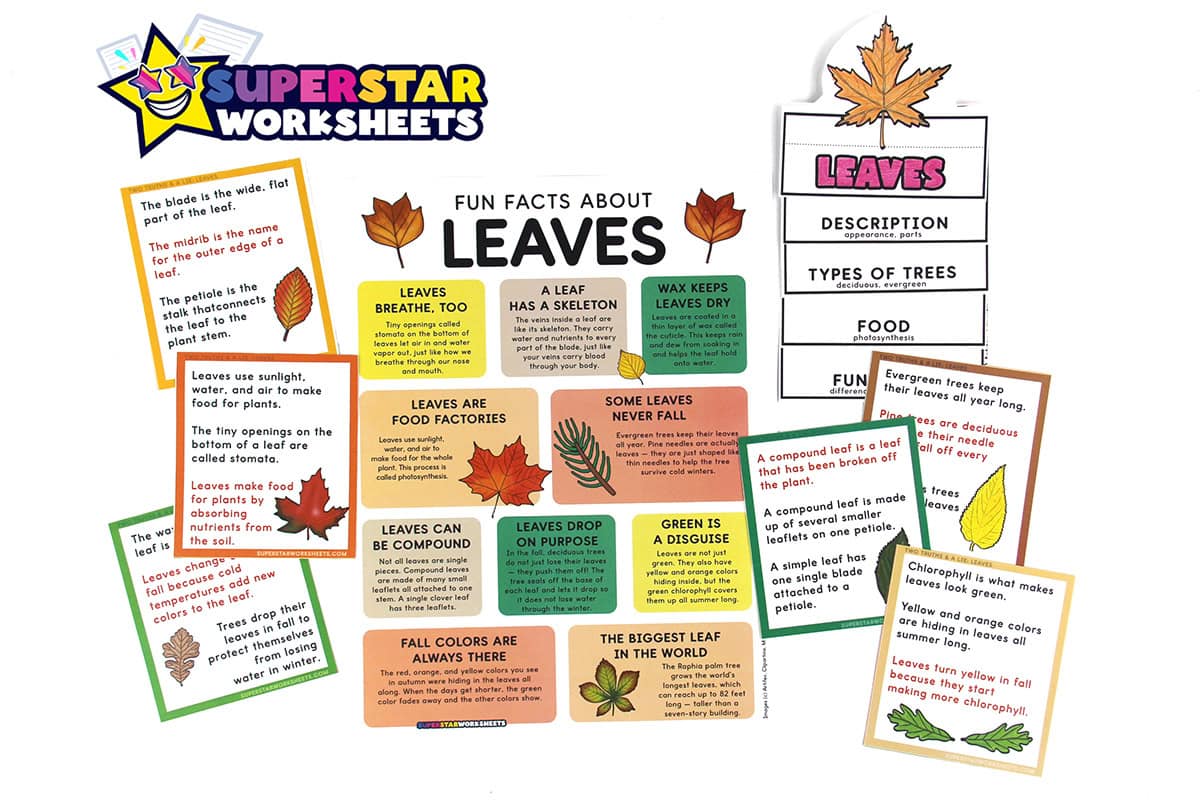
This colorful Leaf Fun Facts chart shares 10 engaging facts about leaves, from how photosynthesis works to why leaves change color in fall. Each fact is presented in a muted color block with a bold title and easy-to-read sentences, making it an ideal read-aloud anchor chart or independent reading activity for a leaf science unit.
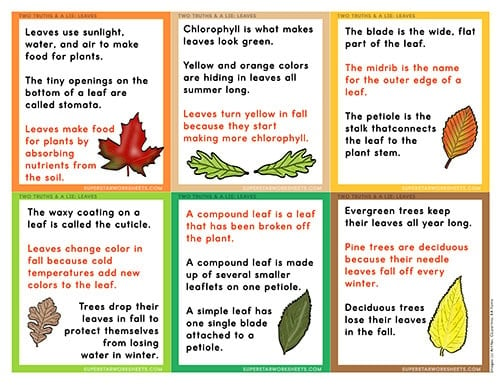
This six-card Two Truths and a Lie game gets students thinking critically about leaf science facts. Teachers read each statement and students determine if it’s a lie or truth. Each card presents two true statements and one false statement printed in red. Topics range from photosynthesis and stomata to chlorophyll, leaf types, and fall color changes. Great for small groups, science centers, or whole-class discussion.
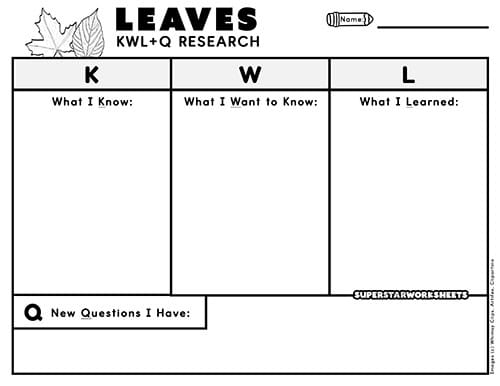
This KWLQ research organizer guides students through a complete leaf inquiry cycle. Students begin by recording what they already know and what they want to learn, then return after research to document what they learned and any new questions they have. A flexible tool that works alongside any leaf science resource or nonfiction text.
Teaching Why Leaves Change Color
One of the most-asked questions in fall science is: why do leaves change color? The answer begins with chlorophyll, the green pigment inside leaves that captures sunlight for photosynthesis. Chlorophyll is so abundant during spring and summer that it masks every other color in the leaf.
As days grow shorter in autumn, deciduous trees begin preparing to drop their leaves. Chlorophyll breaks down and its green color fades away, revealing the yellow and orange pigments called carotenoids that were present in the leaf all along. Some trees also produce anthocyanins. These are the pigments responsible for red and purple fall colors that appear in response to cooler temperatures and shorter days.
The process of a tree actively dropping its leaves is called abscission. The tree forms a special layer of cells at the base of each leaf stem that gradually cuts off the flow of water and nutrients to the leaf. Once disconnected, the leaf dries and falls. This is not simply the leaf dying, it is a deliberate process the tree uses to conserve water through the cold winter months.
Teaching Tip: Before discussing pigments, show students a green leaf and a yellow fall leaf side by side and ask: where did the yellow come from? Most students assume the color was added. Let them discover that the yellow was already there, just hidden!
Leaf Research Activities
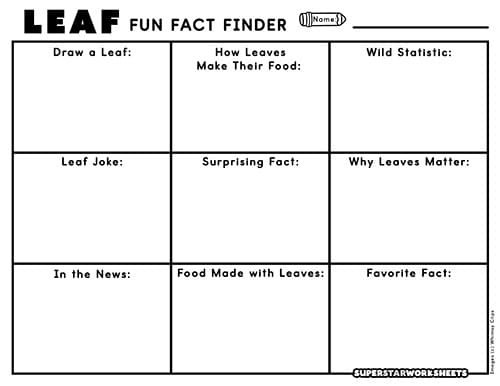
This creative research activity sends students on a leaf fact-finding mission with nine engaging prompts. Each prompt encourages a different research and thinking skill, making this a flexible tool for independent research projects or guided science inquiry.
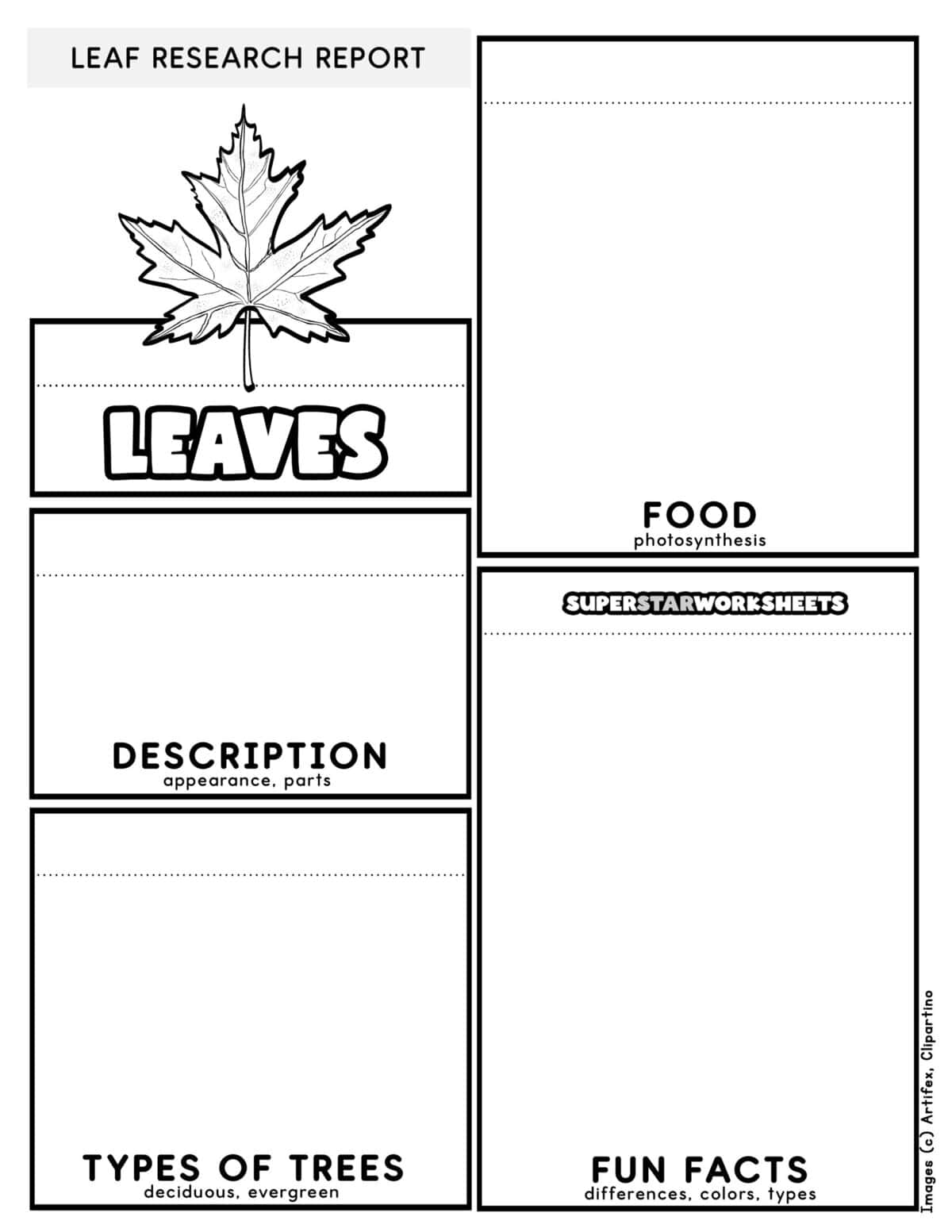
Students create a four-flap layered research report all about leaves. Each flap covers a different topic: leaf appearance and parts, types of trees (deciduous and evergreen), how leaves make food through photosynthesis, and interesting facts about leaf color and diversity. The smallest flap layers on top and reveals each section as students flip through, making it a great take-home project.
Leaf Science Experiment
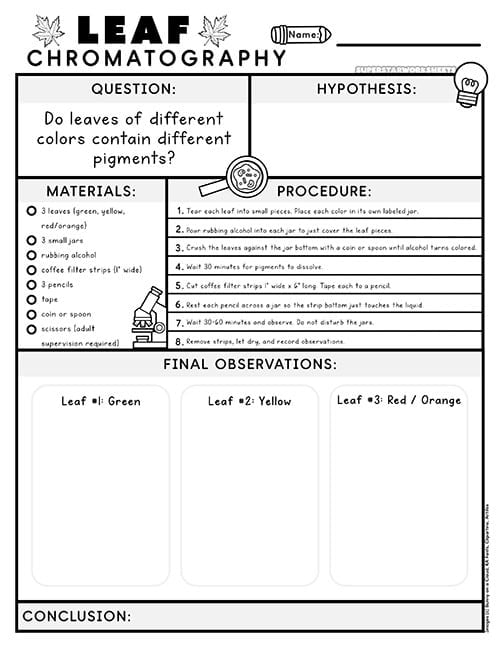
Leaf Color Chromatography Experiment
Students investigate whether leaves of different colors contain different pigments in this hands-on chromatography experiment. Using rubbing alcohol, coffee filter strips, and green, yellow, and red or orange leaves, students separate hidden pigments and observe the color bands that appear on each strip. The experiment sheet guides students through the question, materials, procedure, observations, and conclusion.
Leaf Chromatography Observation Journal
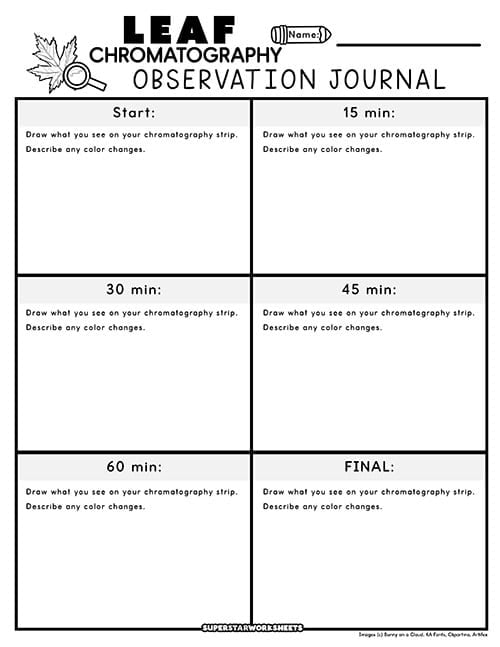
This companion observation journal pairs with the chromatography experiment and gives students six timed check-in periods to draw and describe what they observe on their chromatography strips. From the start of the experiment through the final results, students track how the pigment bands develop and record their conclusions about leaf color and pigments.
Teaching Leaf Chromatography
Leaf chromatography is a visually dramatic experiment that reveals the hidden pigments inside leaves of different colors. It works because rubbing alcohol acts as a solvent, dissolving the pigments in the leaf and carrying them up a paper strip at different speeds is a technique called chromatography. Because each pigment travels at a different rate, they separate into distinct color bands.
Materials needed (per student or group): 3 leaves of different colors (green, yellow, and red or orange) / 3 small glass jars or cups / Rubbing alcohol (isopropyl, 70% or higher) / Coffee filter or chromatography paper strips (1 inch wide) / 3 pencils or chopsticks / Tape / Scissors / A coin or spoon for crushing / Adult supervision required.
Procedure overview: Students tear each leaf into small pieces and place each color in its own labeled jar. After adding rubbing alcohol and crushing the leaf pieces to release the pigment, they wait 30 minutes for the pigments to dissolve into the alcohol. A coffee filter strip is taped to a pencil and suspended in each jar so it just touches the liquid. Over 30–60 minutes, students observe the alcohol travel up the strip, carrying pigments with it.
Expected results: The green leaf strip will show a green chlorophyll band and may reveal faint yellow or orange bands beneath. The yellow leaf strip will show yellow and orange bands from carotenoids. The red or orange leaf strip will show orange, yellow, and possibly pink or red bands from carotenoids and anthocyanins. Students should notice that all leaves contain more than one pigment.
Science connection: This experiment provides direct evidence for why leaves change color in fall. The hidden yellow and orange pigments are present all summer long, masked by green chlorophyll. When chlorophyll breaks down in autumn, those pigments are finally revealed — just as the chromatography strips reveal them here.
Teaching Tip: Run this experiment in fall when colored leaves are easy to collect. If fall leaves are not available, yellow leaves from houseplants or red cabbage can substitute for the yellow and red color categories.
Leave a Reply