
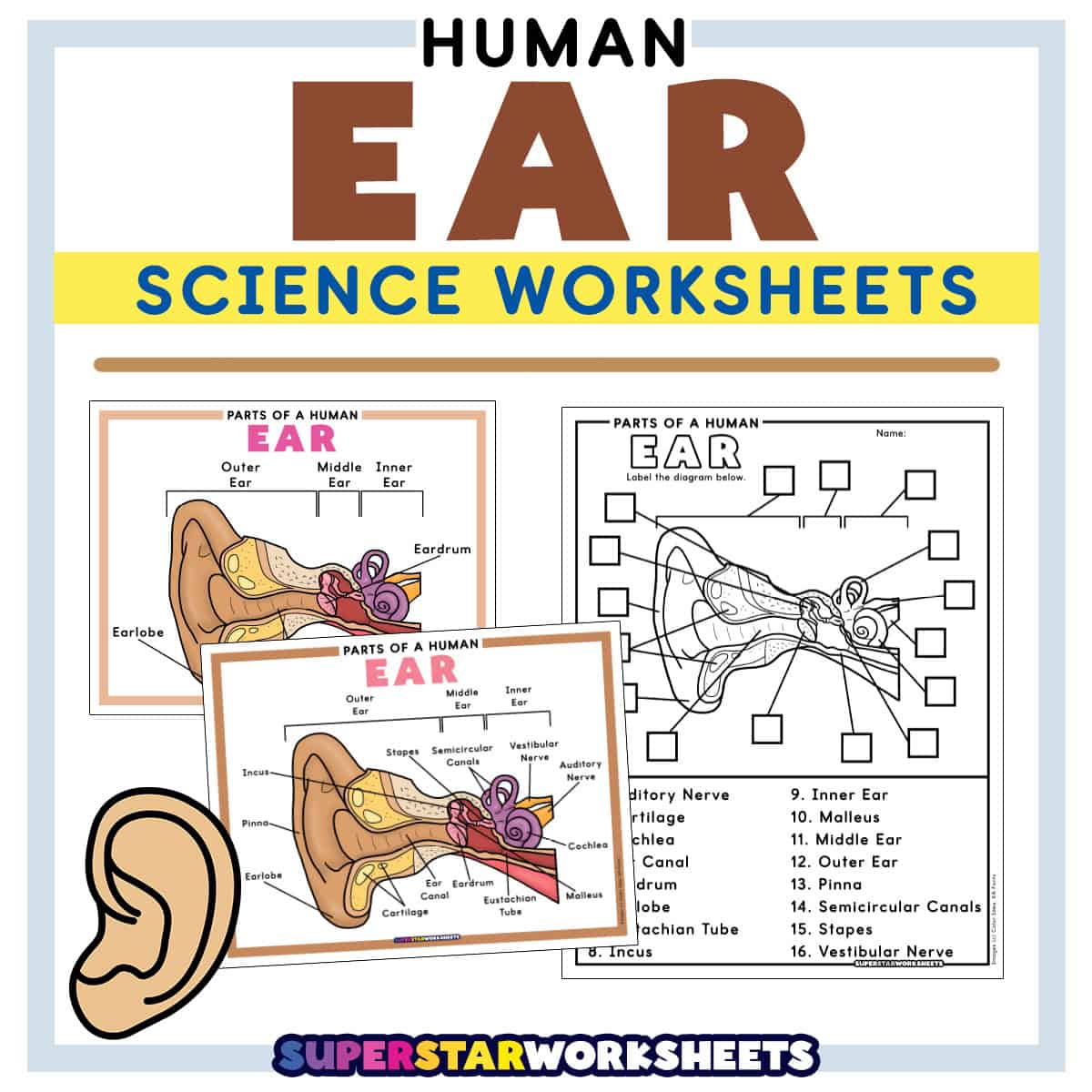
Free Printable Human Ear Diagram worksheets help kids explore how the ear works through labeling activities, coloring pages, quizzes, and hands-on crafts. Download and print PDF ear anatomy diagrams, hearing pathway charts, and fun fact posters designed for elementary and middle school science. These worksheets build vocabulary and comprehension skills while showing how sound travels from the outer ear all the way to the brain. They are perfect for science centers, homeschool lessons, or small group review, giving teachers and parents an easy way to bring ear anatomy to life.
Simple Human Ear Diagrams for Kids
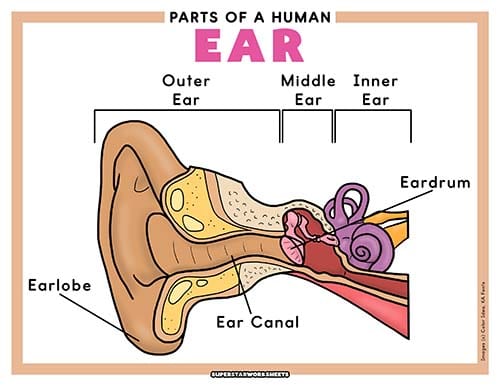
Download and print this simple, easy ear diagram for kids. This colorful chart labels 6 basic parts of the human ear, perfect for introducing young learners to how hearing begins.
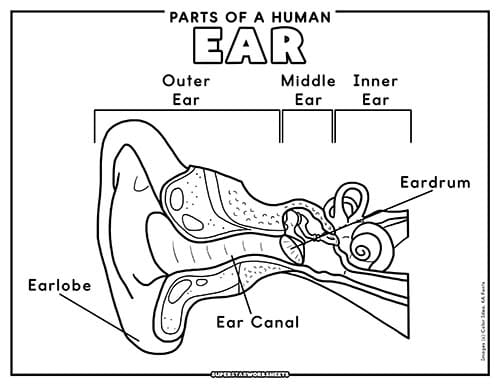
Simple Ear Diagram Black & White Coloring Page
This labeled ear diagram is a black-and-white version of our simplified chart above, covering the same six basic parts. Students can color each section while reviewing the outer, middle, and inner ear.
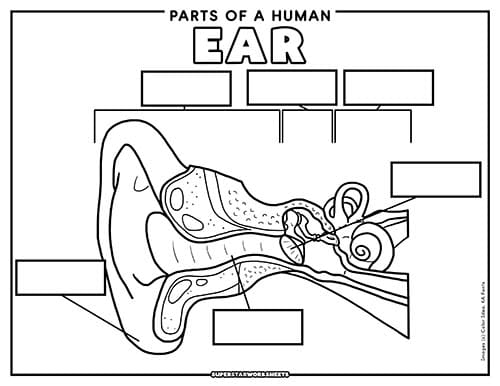
Download and print this simple blank labeling diagram of the human ear. Students write the name of each of the six basic parts in the boxes provided, reinforcing early vocabulary.
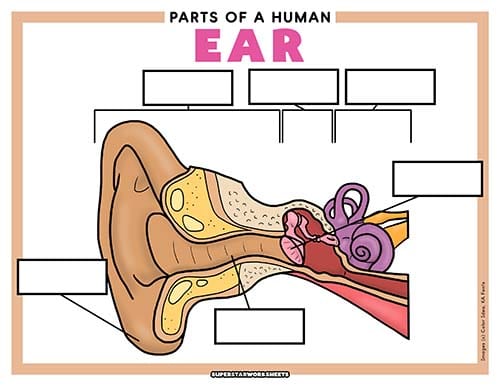
Simple Ear Diagram Labeling Activity
This matching activity mat and label card set helps young students place the correct word on each part of a simple ear diagram. It is a hands-on way to practice foundational ear vocabulary before moving to the extended diagram.
Printable Human Ear Diagrams
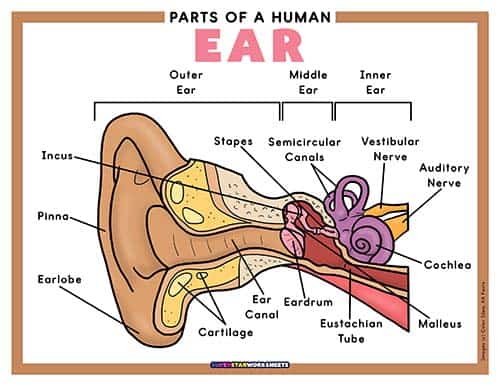
Download and print this free Parts of a Human Ear diagram for your students. Featuring a large, color-coded anatomical illustration of the ear with all 16 labeled parts, from the outer ear to the inner ear.
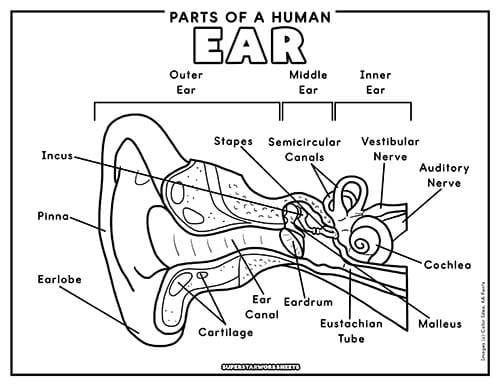
Human Ear Diagram Black & White
Free printable human ear diagram with a simple outline illustration. This PDF is labeled with all 16 parts of the ear and works well as a cross-section coloring page for learning ear anatomy.
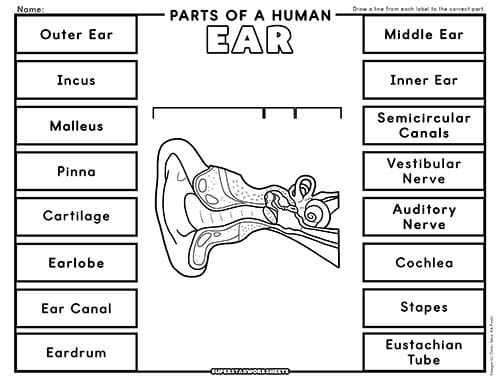
Students begin learning part names and locations with this printable human ear labeling worksheet. They draw a line from each label to the correct part on a detailed cross-section diagram.
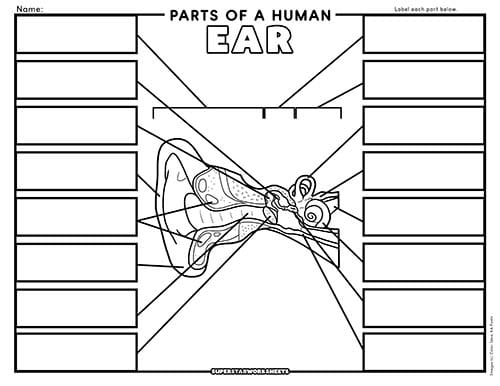
Blank Human Ear Labeling Diagram
Students must recall the names of all 16 main parts of the human ear and write them in the blank labeled boxes. This is a good way to assess retention, and a word bank can be provided for differentiation.
Ear Anatomy Quiz
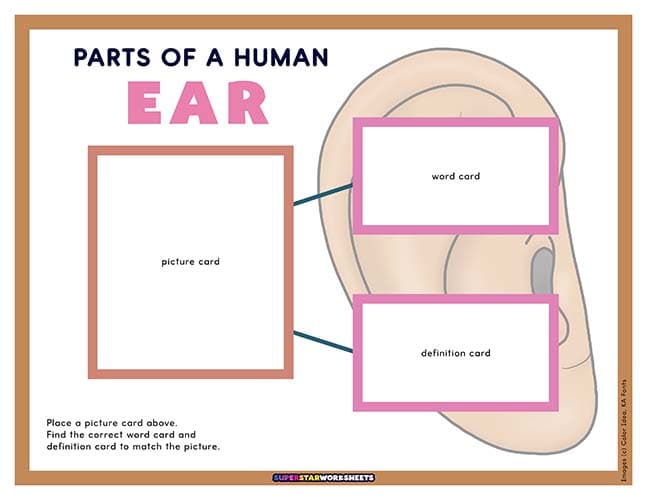
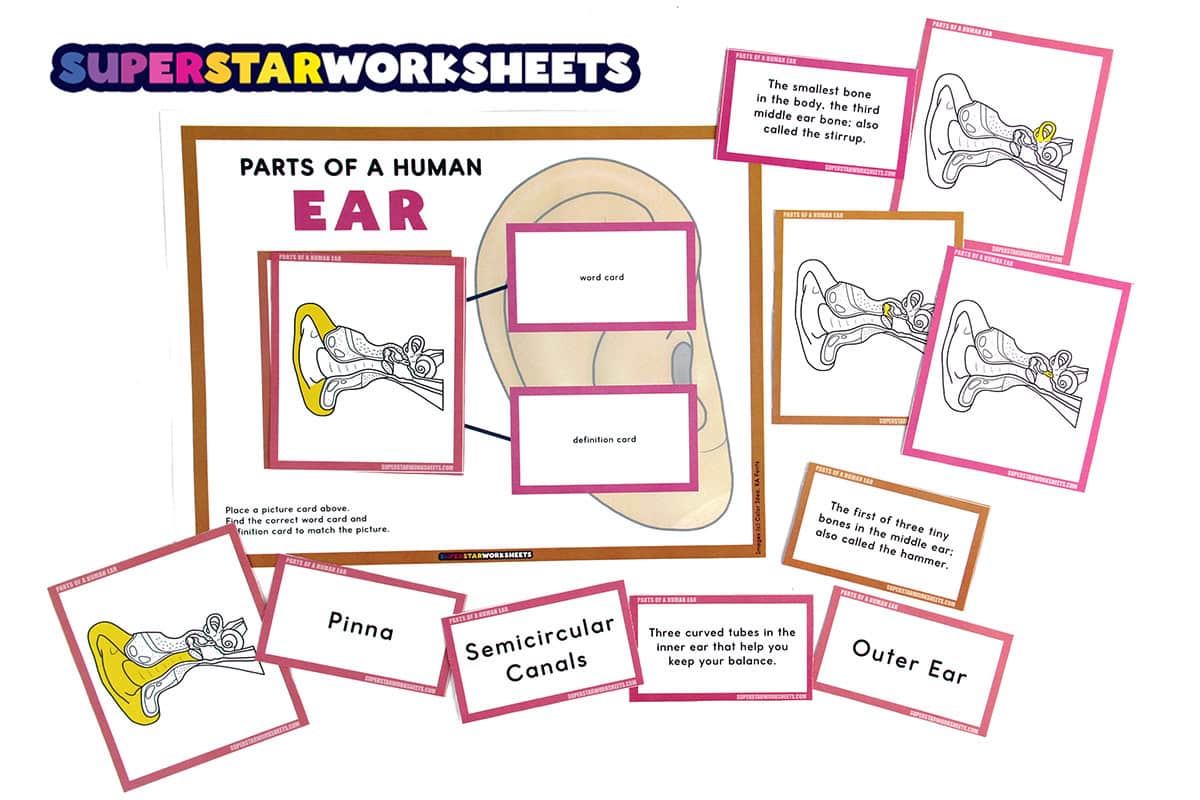
Our take on traditional Montessori nomenclature cards will optimize your learning centers with simple visual illustrations, highlighted individual parts, and self-checking picture, word, and definition sets covering all 16 ear parts.
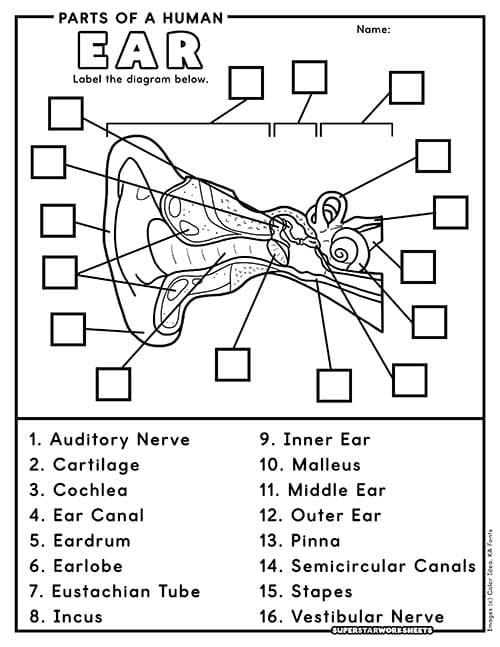
This printable ear diagram provides students with a word bank to reference and asks them to number each part shown on the diagram. It is a great follow-up practice worksheet after the main labeling activities.
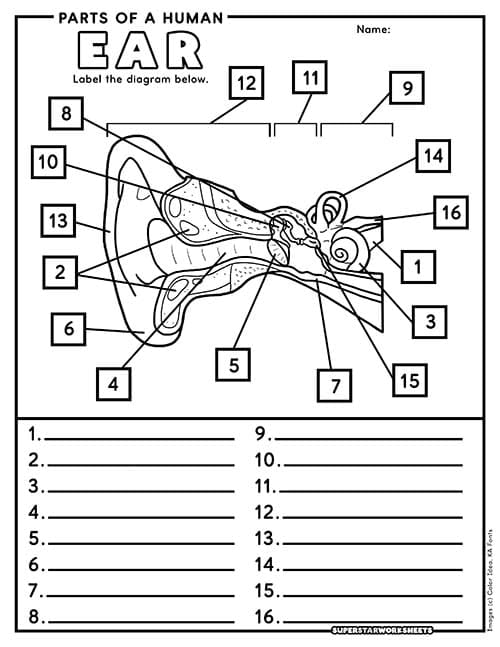
Assess student knowledge with this free printable human ear labeling quiz. Featuring 16 numbered parts, students write the correct term on each line, and an answer key is included.
Human Ear Anatomy Printables
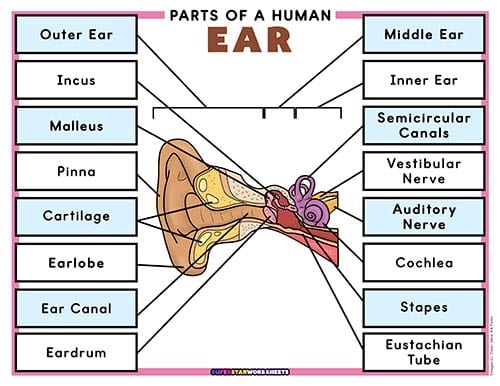
Here is a full-color labeled human ear diagram that makes a great reference chart or poster for your science classroom. All 16 parts are pointed to and labeled in alternating color boxes.
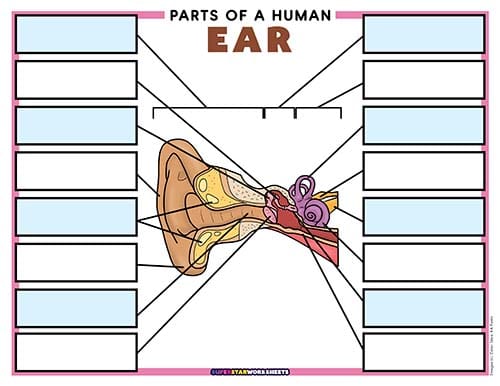
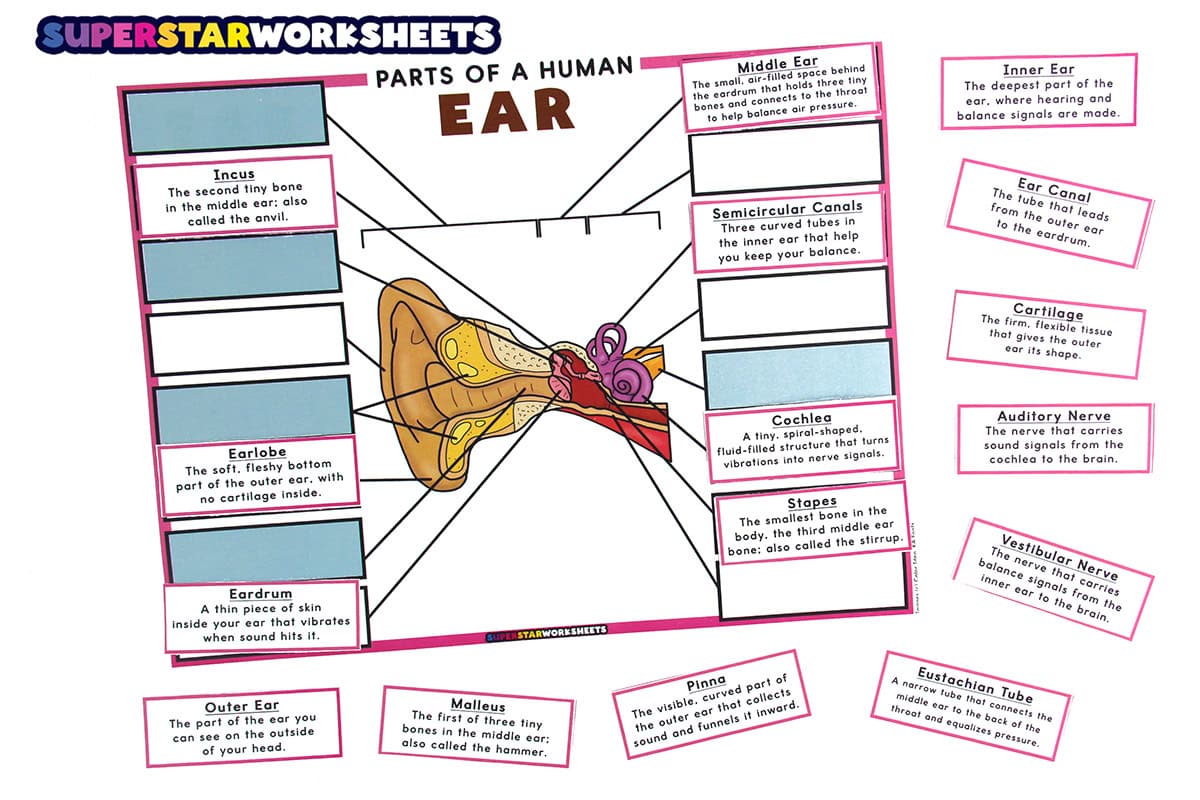
Download this printable learning center activity mat for students who are learning the location and function of the parts of the human ear. This set includes printable label cards as well as vocabulary definition cards.
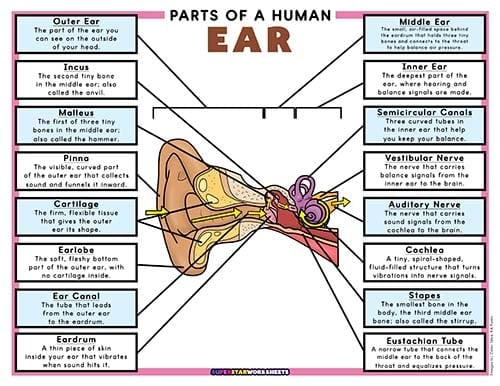
Here is a full-color labeled human ear diagram with definition labels attached, plus arrows tracing how sound moves through each structure. It connects vocabulary directly to the hearing process.
Parts of the Human Ear
Auditory Nerve: The nerve that carries sound signals from the cochlea to the brain.
Cartilage: The firm, flexible tissue that gives the outer ear its shape.
Cochlea: A tiny, spiral-shaped, fluid-filled structure that turns vibrations into nerve signals.
Ear Canal: The tube that leads from the outer ear to the eardrum.
Eardrum: A thin piece of skin inside the ear that vibrates when sound hits it. Also called the tympanic membrane.
Earlobe: The soft, fleshy bottom part of the outer ear, with no cartilage inside.
Eustachian Tube: A narrow tube that connects the middle ear to the back of the throat and equalizes pressure.
Incus: The second tiny bone in the middle ear, also called the anvil.
Inner Ear: The deepest part of the ear, where hearing and balance signals are made.
Malleus: The first of three tiny bones in the middle ear, also called the hammer.
Middle Ear: The small, air-filled space behind the eardrum that holds three tiny bones and connects to the throat.
Outer Ear: The part of the ear you can see on the outside of the head.
Pinna: The visible, curved part of the outer ear that collects sound and funnels it inward. Also called the auricle.
Semicircular Canals: Three curved tubes in the inner ear that help you keep your balance.
Stapes: The smallest bone in the body, the third middle ear bone, also called the stirrup.
Vestibular Nerve: The nerve that carries balance signals from the inner ear to the brain.
Printable Ear Hearing Diagrams
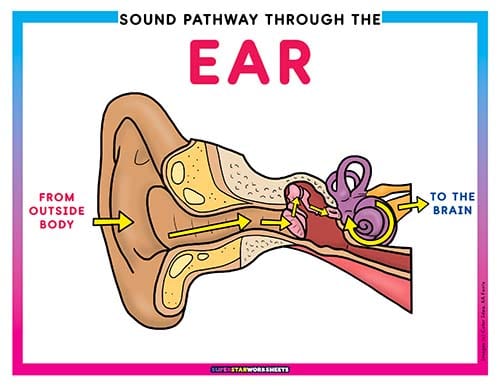
This large diagram traces the sound pathway through the ear using color-coded arrows, from the outer ear all the way to the brain. It is an ideal anchor chart for teaching how hearing actually works.
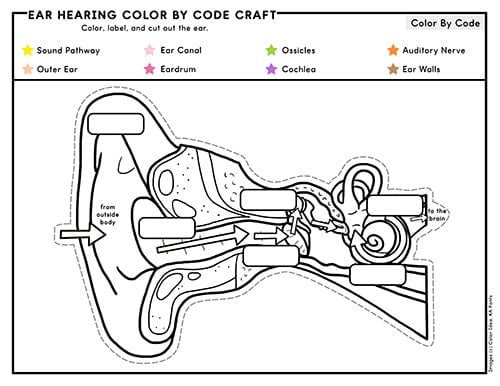
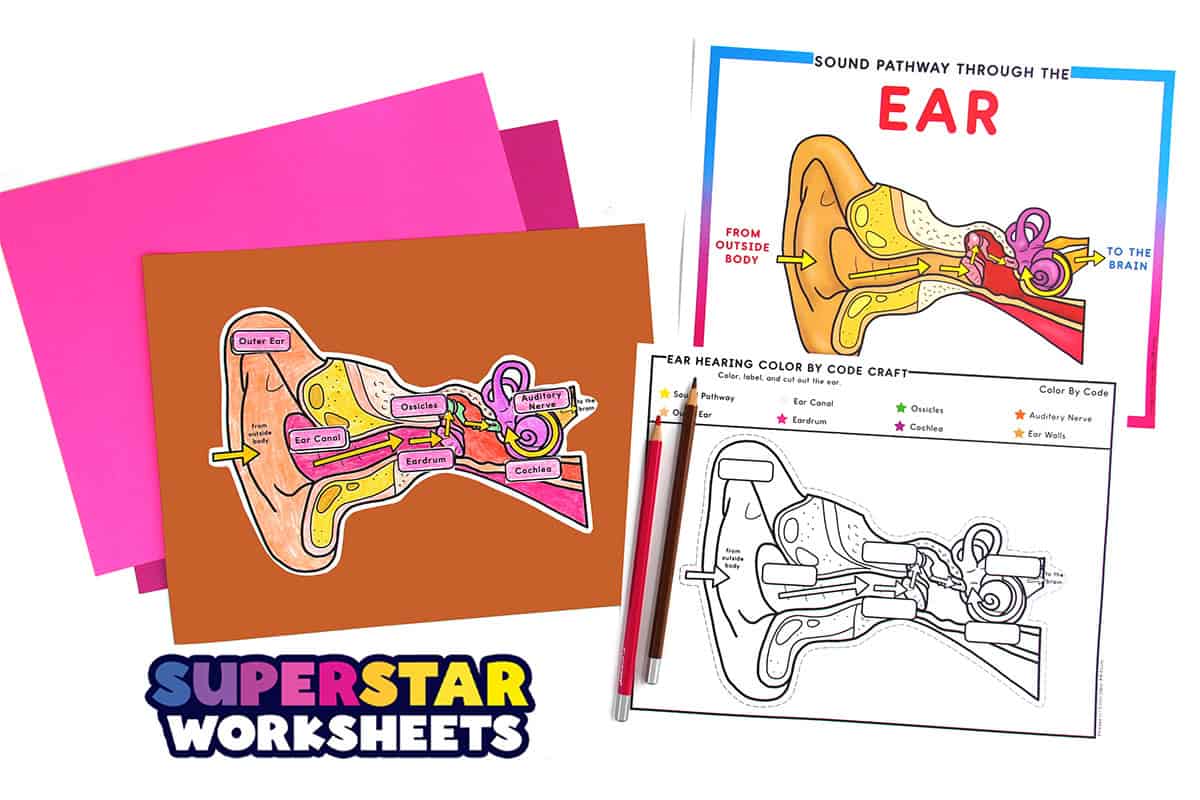
Ear Hearing Color by Code Craft
Students color and assemble this hands-on craft using a color code that matches the sound pathway diagram. It turns the hearing process into a memorable, tactile project.
Teachers! Take a look at these FREE Brain Worksheets!
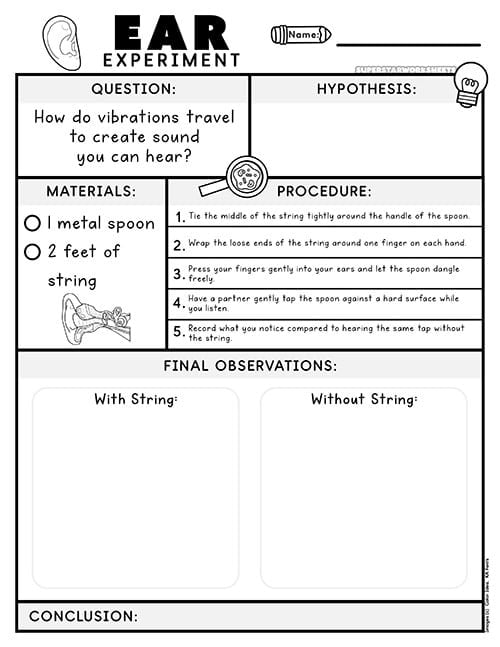
Ear Science Experiment for Kids
This simple spoon and string experiment lets kids observe how vibrations travel to create the sound we hear. It is a quick, low-mess way to explore sound and hearing at home or in the classroom.
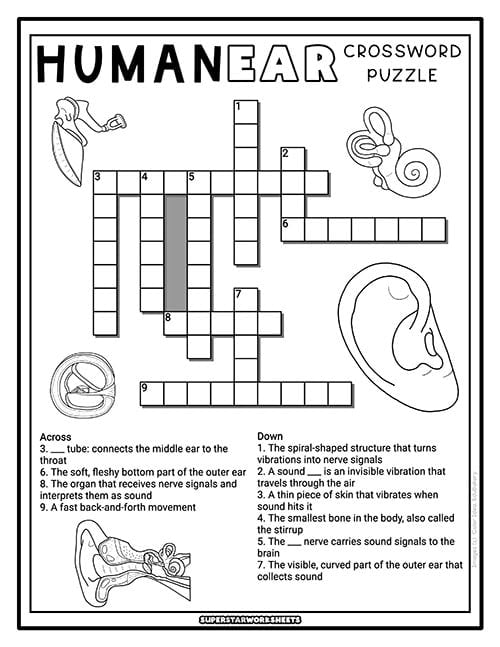
This crossword puzzle reinforces ear vocabulary using clues pulled from the anatomy and hearing vocabulary banks. It makes a great review activity after an ear unit.
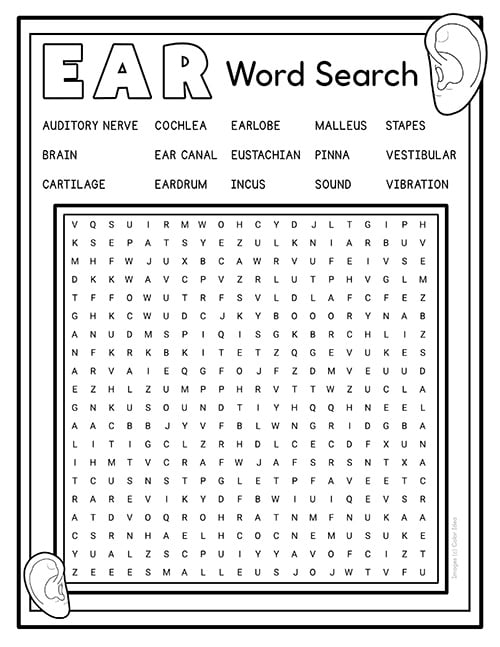
This word search gives students a fun, low-pressure way to recognize key ear and hearing vocabulary. It works well as an early finisher or homework activity.
How We Hear
Sound is an invisible vibration that begins outside the body and ends as a signal your brain can understand. The pinna collects sound waves and funnels them down the ear canal until they reach the eardrum, causing it to vibrate. Those vibrations pass through three tiny bones called the ossicles, the malleus, incus, and stapes, which amplify the signal and push it into the fluid-filled cochlea. Inside the cochlea, tiny hair cells convert the vibrations into nerve signals that travel along the auditory nerve to the brain, where they are finally interpreted as sound.
Human Ear Facts for Kids
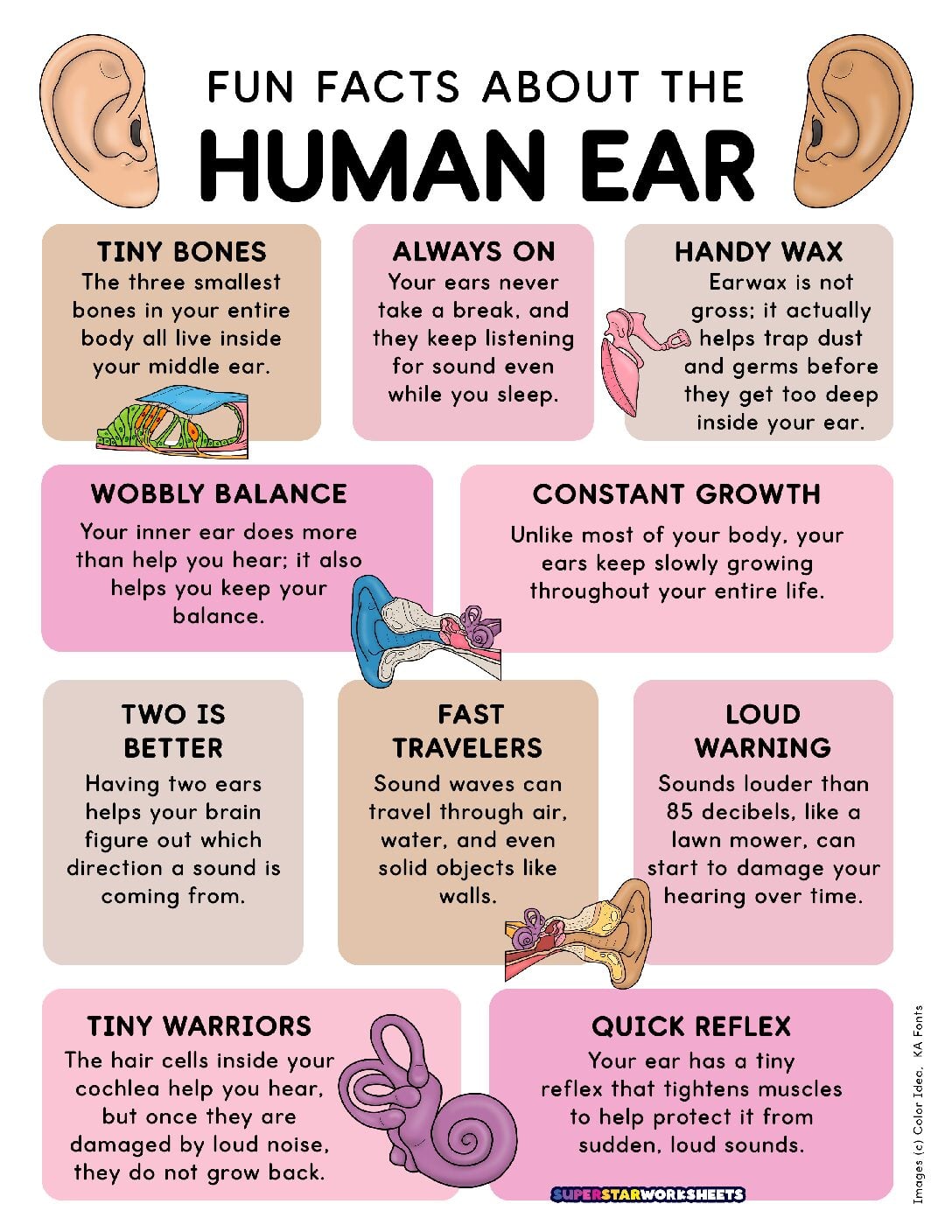
Fun Facts About the Human Ear for Kids
Download and print this fun facts poster with amazing information about the human ear. These are great charts to keep near your science learning centers for quick reads and classroom discussion.
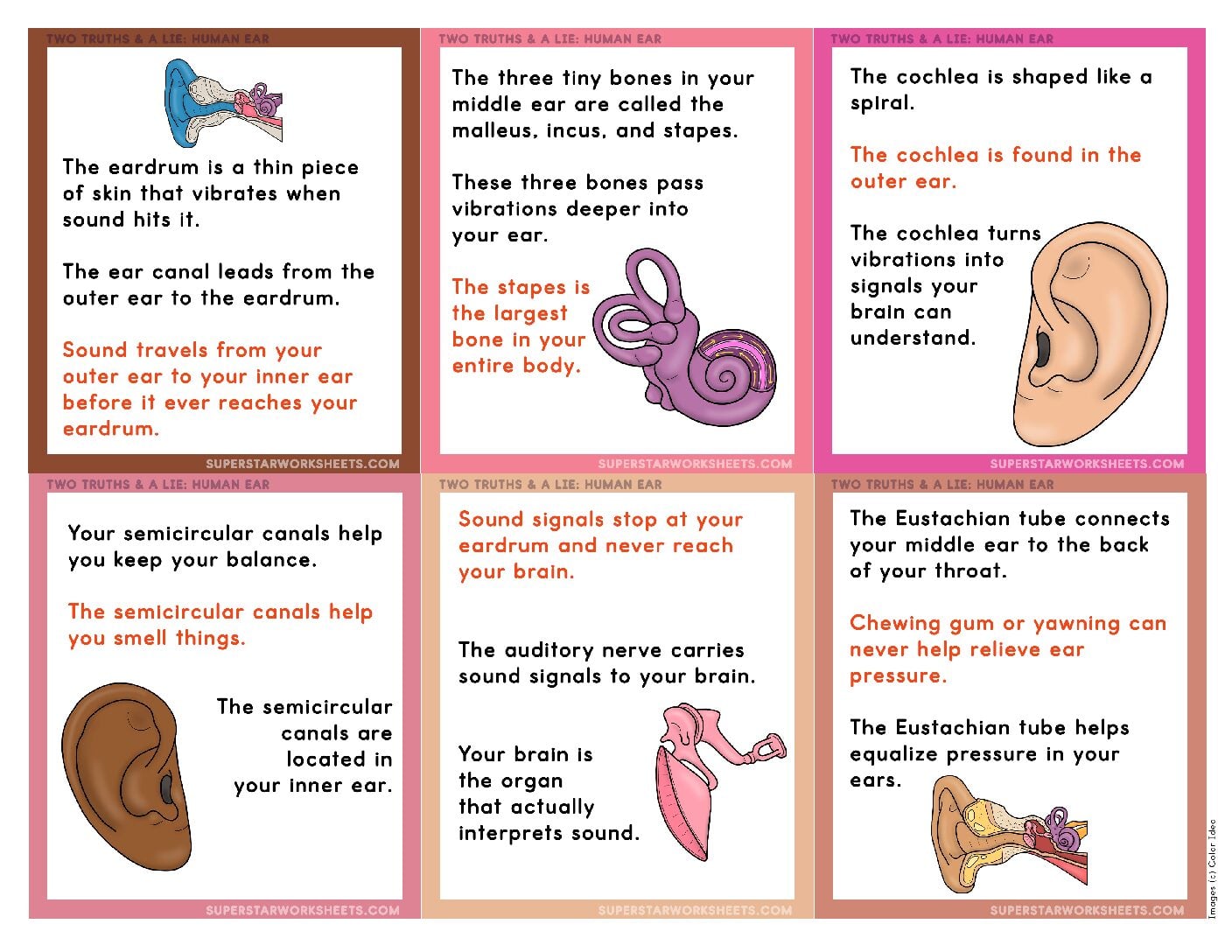
Here is a fun printable game you can play with your students. Two Truths and a Lie is a fact-finding game where each card contains two truths about the human ear and one lie, encouraging kids to think critically about what they read. For more free human organ worksheets, take a look at our Eye Worksheets today!
This printable graphic organizer helps students keep track of their human ear research. Students fill in each section of the KWLQ research guide, covering what they know, want to know, learned, and still wonder about.
Human Ear Fun Fact Finder (Research)
Encourage your students to seek and find fun facts about the human ear with this printable research-based scavenger hunt. Students put their research skills to work filling in each of the nine prompts.
Fun Facts About the Human Ear
Tiny Bones: The three smallest bones in your entire body all live inside your middle ear.
Always On: Your ears never take a break, and they keep listening for sound even while you sleep.
Wobbly Balance: Your inner ear does more than help you hear, it also helps you keep your balance.
Handy Wax: Earwax is not gross, it actually helps trap dust and germs before they get too deep inside your ear.
Two Is Better: Having two ears helps your brain figure out which direction a sound is coming from.
Constant Growth: Unlike most of your body, your ears keep slowly growing throughout your entire life.
Fast Travelers: Sound waves can travel through air, water, and even solid objects like walls.
Loud Warning: Sounds louder than 85 decibels, like a lawn mower, can start to damage your hearing over time.
Quick Reflex: Your ear has a tiny reflex that tightens muscles to help protect it from sudden, loud sounds.
Tiny Warriors: The hair cells inside your cochlea help you hear, but once they are damaged by loud noise, they do not grow back.
Leave a Reply