

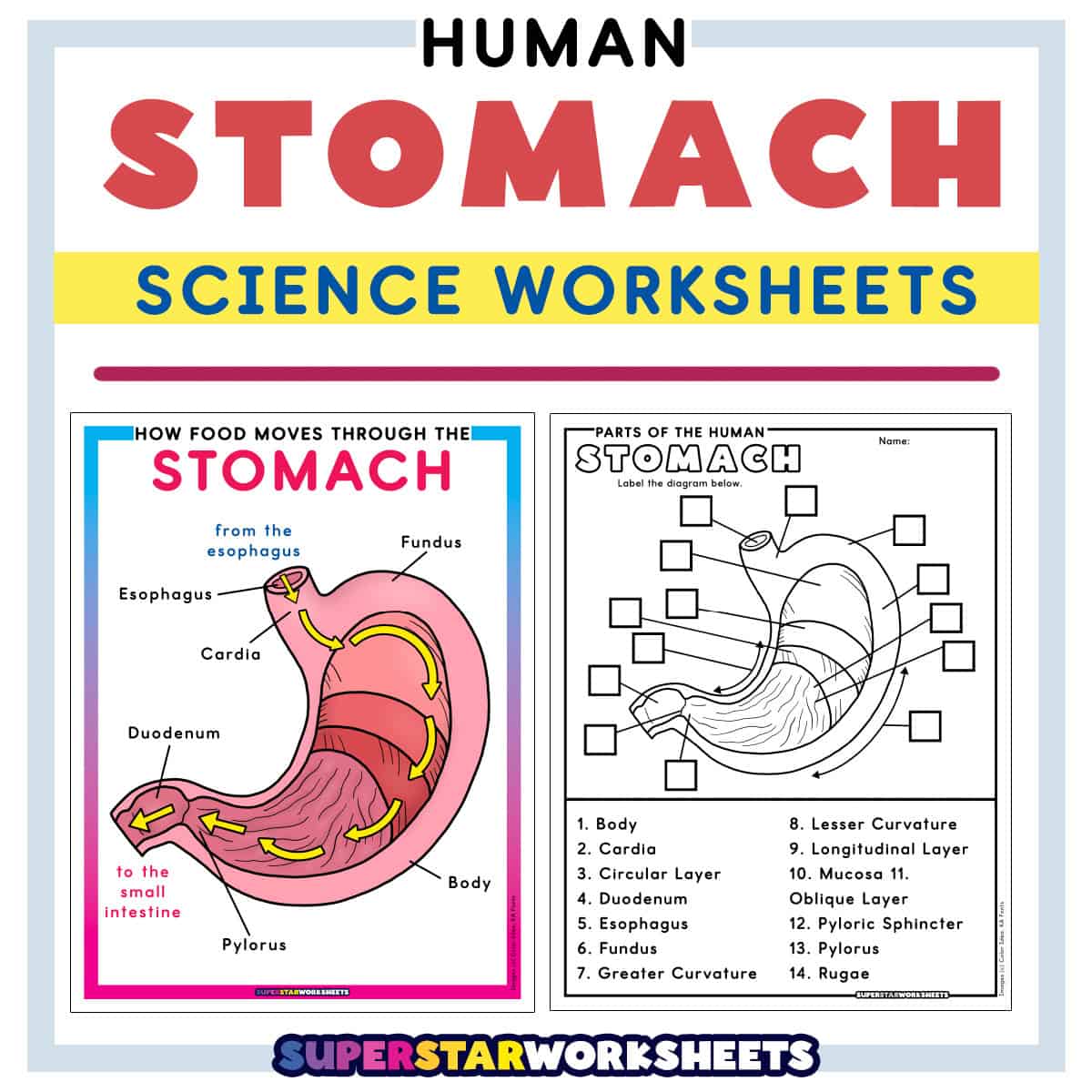
Free printable Human Stomach Diagram worksheets help kids explore how the digestive system works through labeling activities, coloring pages, quizzes, and hands-on crafts. Download and print PDF diagrams, vocabulary mats, and research pages covering everything from simple stomach parts for young learners to detailed digestion pathway charts for older students. These worksheets build skills in anatomy vocabulary, diagram reading, and scientific reasoning while keeping the content playful and easy to follow. Teachers can use them for science centers or whole-class lessons, and parents will find them just as useful for homeschool units on the human body.
Simple Human Stomach Diagrams for Kids
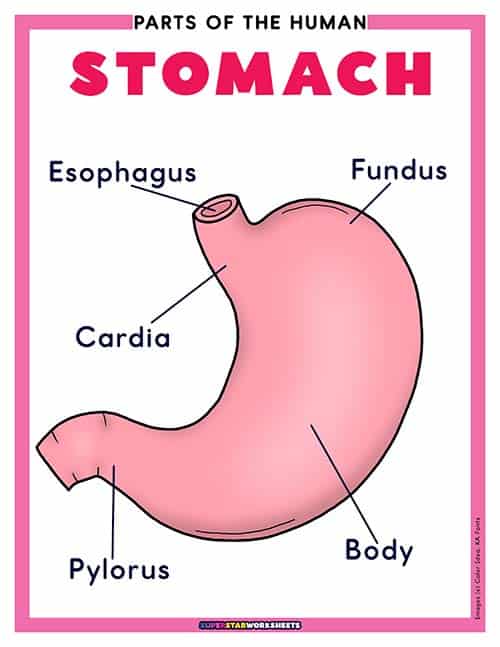
Download and print this simple and easy stomach diagram for kids. This colorful chart includes 5 basic parts of the human stomach for students to begin to understand stomach anatomy and function. Labeled with a large, easy-to-read font, you can use this printable poster as a first introduction for your late elementary students.
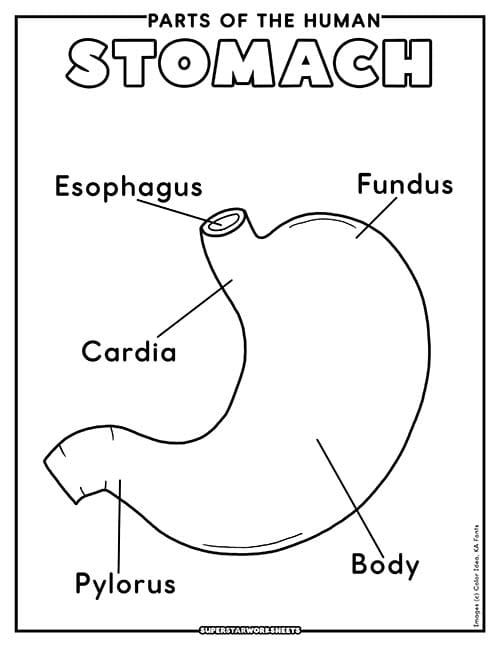
Simple Stomach Diagram B&W Coloring Page
This labeled stomach diagram is a black-and-white version of our simplified chart above. Covering five basic parts of the stomach (esophagus, cardia, fundus, body, and pylorus), students can color stomach anatomy while reinforcing each name.
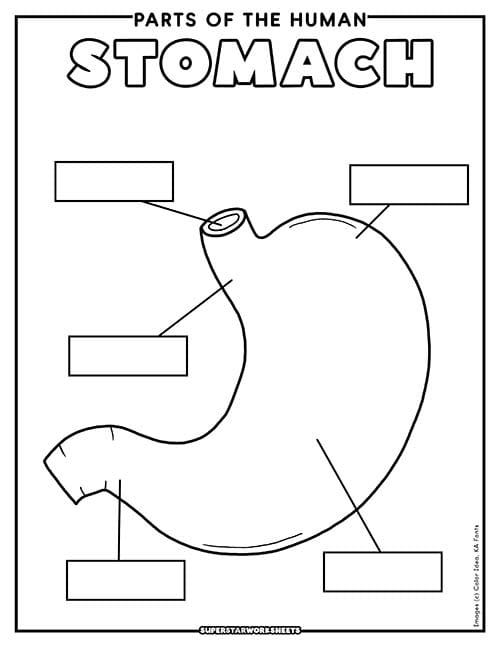
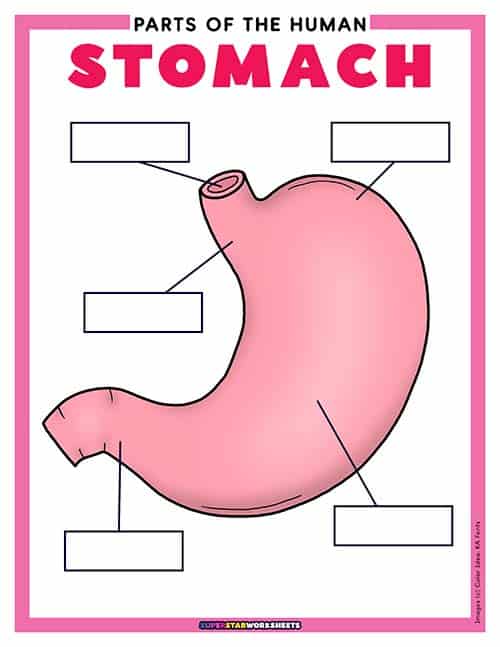
Download and print this simple blank labeling diagram of the human stomach. Students write the name of each part of the stomach in the provided blank box. With 5 anatomical features, this introductory version is great for late elementary or early middle school. Find more detailed labeling worksheets for parts of the stomach below.
Simple Stomach Diagram Labeling
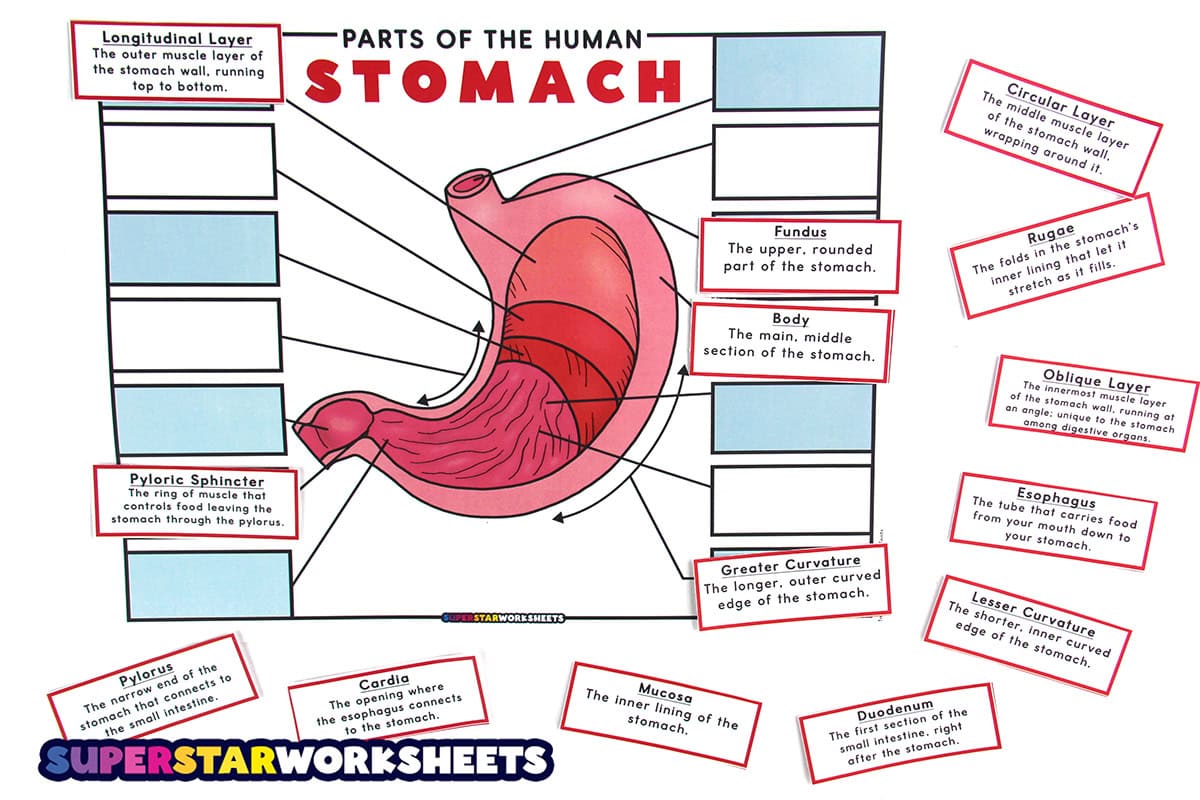
This learning center comes with printable prewritten labels for students to place on the printable mat. This low-risk activity provides ample practice for locating and naming the parts of the stomach without having to recall each specific name. Laminate for durability and keep as a reusable science learning center in your classroom.
Printable Human Stomach Diagrams
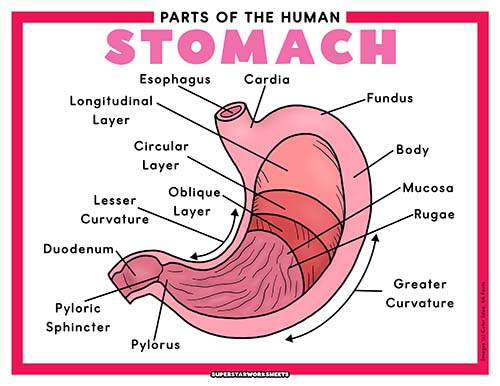
Download and print this free Parts of the Human Stomach Diagram for your students. Featuring a large, color-coded anatomical illustration of the stomach with 14 labeled parts. For more FREE human organ worksheets, take a look at our Human Lungs Worksheets today!
Human Stomach Diagram Black & White
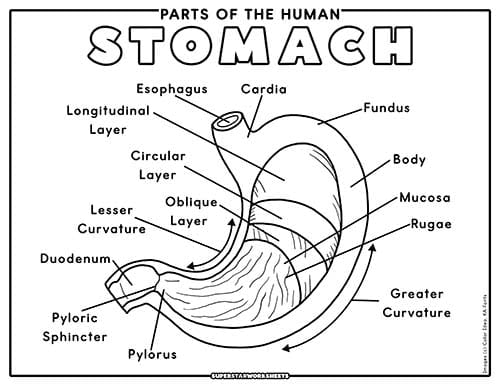
Free printable human stomach diagram with a simple outline illustration. This PDF is labeled with the parts of the stomach and is great for students to use as a cross-sectional coloring page to learn stomach anatomy.
Human Stomach Labeling Worksheet
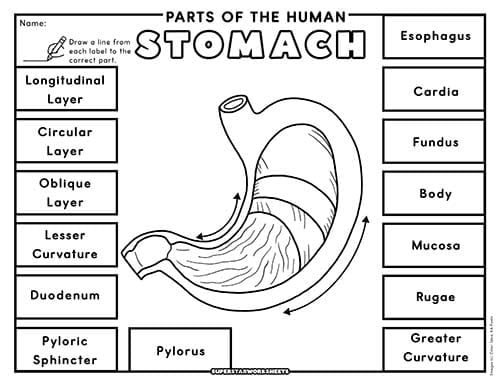
Students can begin to learn the part names and locations with this printable human stomach labeling worksheet. Students are not required to remember the names, but instead will draw a line from each label to the correct part. This is a good first practice exercise for learning the parts of a stomach.
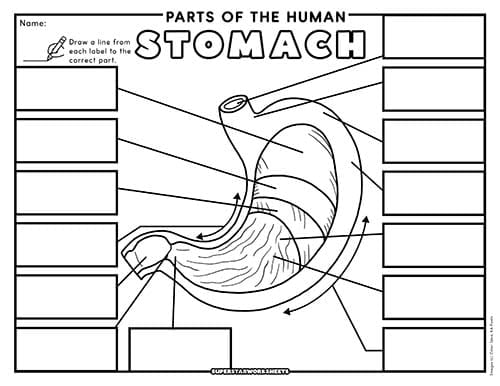
Blank Human Stomach Labeling Diagram
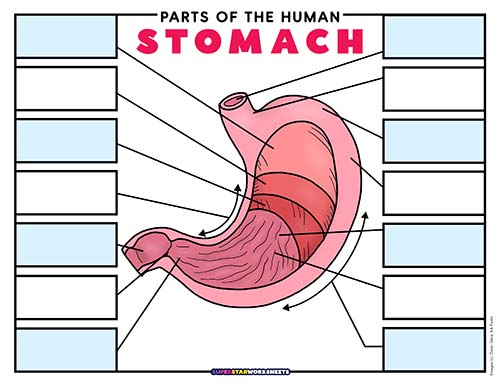
Students must recall the names of each of the 14 main parts of the human stomach and write them in the blank boxed labels. This is a good way to assess student retention, and you can provide a word bank for differentiation.
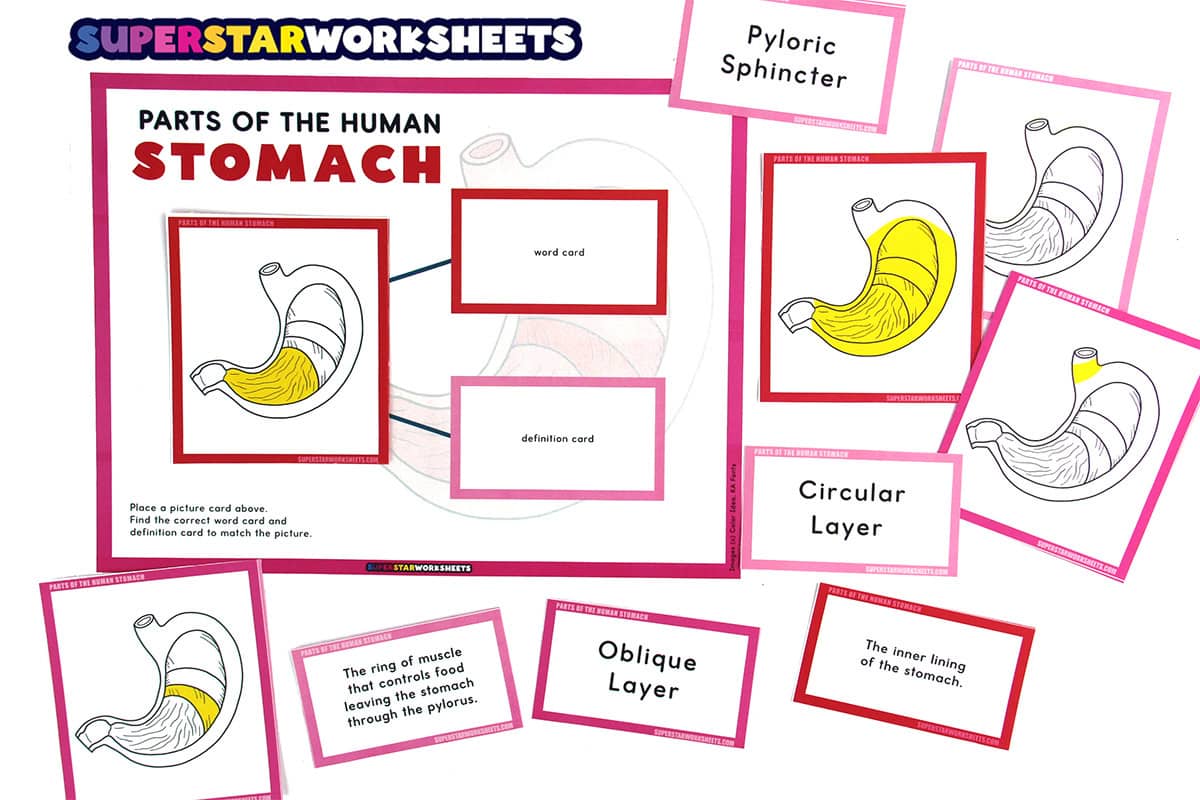
Stomach Anatomy Quizzes
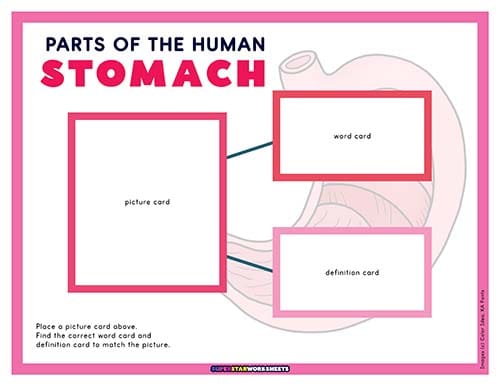
Stomach Anatomy Flashcard Quiz
Our take on traditional Montessori Nomenclature cards will optimize your learning centers with simple visual illustrations, bright highlights on individual parts, and self-correcting color borders. You choose how much information is given to students by cutting apart the picture, words, and definitions as students progress. Printable learning mat provided for matching activities.
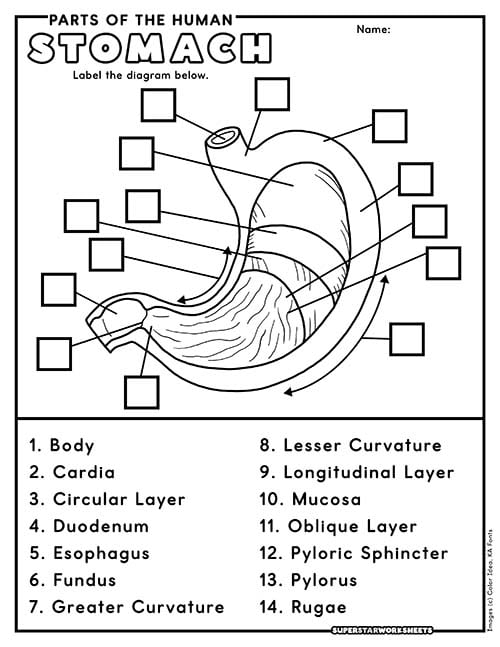
This printable stomach diagram provides your students with a word bank to reference and asks them to number each part shown on the diagram. This is another beginning practice worksheet to prepare your students for a quiz. Includes an answer key for easy self-checking. For more FREE printable human science worksheets, take a look at our Heart Worksheets!
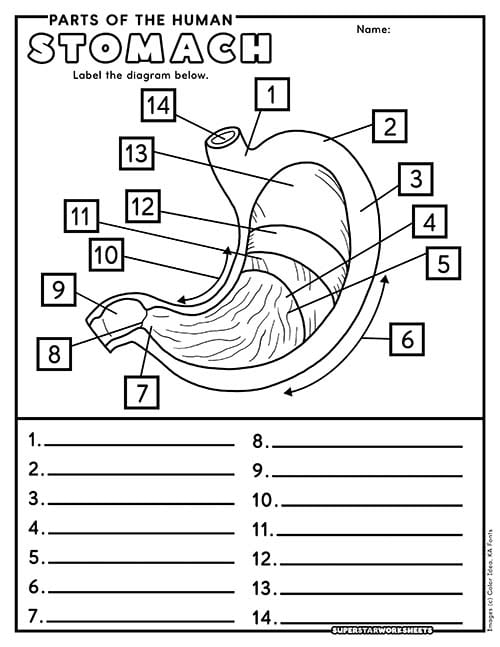
Assess student knowledge with this free printable human stomach labeling quiz. Featuring 14 numbered parts, students write the correct term on the line. Includes an answer key for quick teacher corrections.
Human Stomach Anatomy Printables
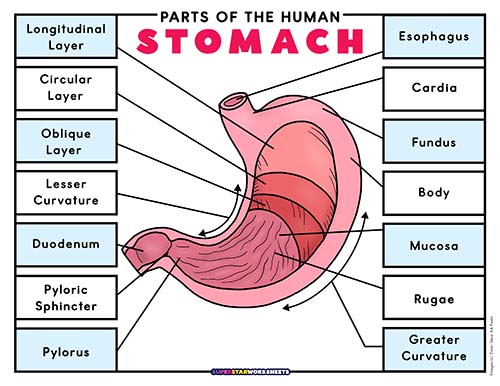
Here is a full-color labeled human stomach diagram that makes a great reference chart or poster for your science classroom.
Download this printable learning center activity mat for students who are learning the location and function of the parts of the human stomach. This set includes printable label cards as well as vocabulary definition cards. Use this as practice for labeling the human stomach.
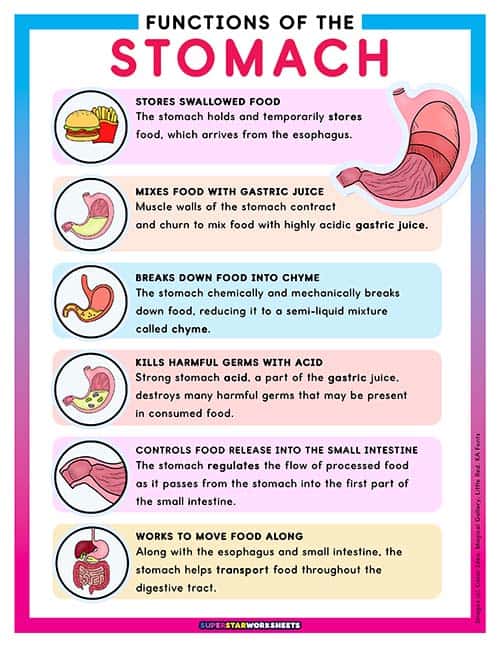
This reference chart breaks down the six main jobs of the stomach, from storing swallowed food to controlling release into the small intestine. Each function is explained in a short, factual sentence that names the body part involved.
Parts of the Human Stomach
- Body (Corpus): The main, middle section of the stomach.
- Cardia: The opening where the esophagus connects to the stomach.
- Circular Layer: The middle muscle layer of the stomach wall, wrapping around it.
- Duodenum: The first section of the small intestine, right after the stomach.
- Esophagus: The tube that carries food from your mouth down to your stomach.
- Fundus: The upper, rounded part of the stomach.
- Greater Curvature: The longer, outer curved edge of the stomach.
- Lesser Curvature: The shorter, inner curved edge of the stomach.
- Longitudinal Layer: The outer muscle layer of the stomach wall, running top to bottom.
- Mucosa: The inner lining of the stomach.
- Oblique Layer: The innermost muscle layer of the stomach wall, running at an angle; unique to the stomach among digestive organs.
- Pyloric Sphincter: The ring of muscle that controls food leaving the stomach through the pylorus.
- Pylorus: The narrow end of the stomach that connects to the small intestine.
- Rugae: The folds in the stomach’s inner lining that let it stretch as it fills.
Printable Stomach Digestion Diagrams
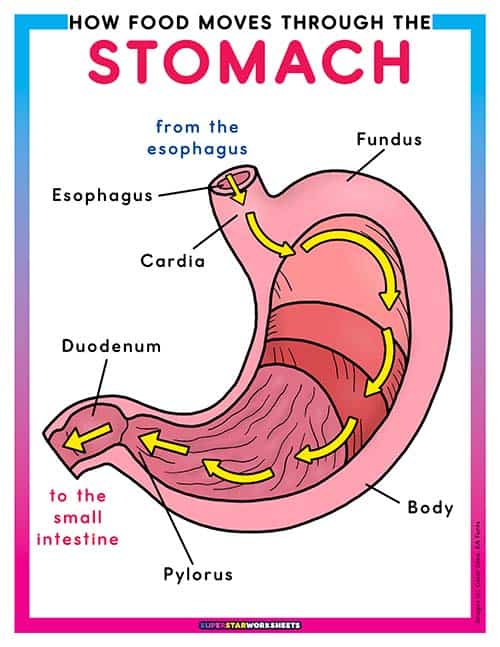
How Food Moves Through the Stomach
This large diagram traces the pathway food takes from the esophagus through the stomach and into the small intestine using color-coded arrows. It is an ideal anchor chart for teaching how digestion works step by step.
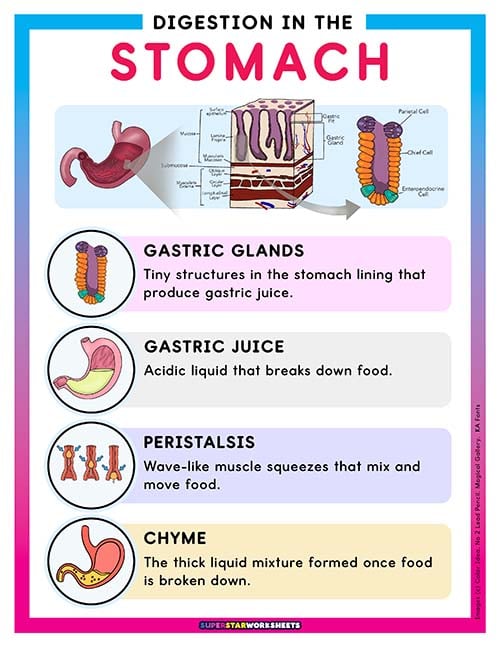
A zoomed-in look at the stomach lining and gastric glands shows exactly how gastric juice and muscle movement break food down into chyme. Four simple detail boxes break the process into easy steps for young scientists.
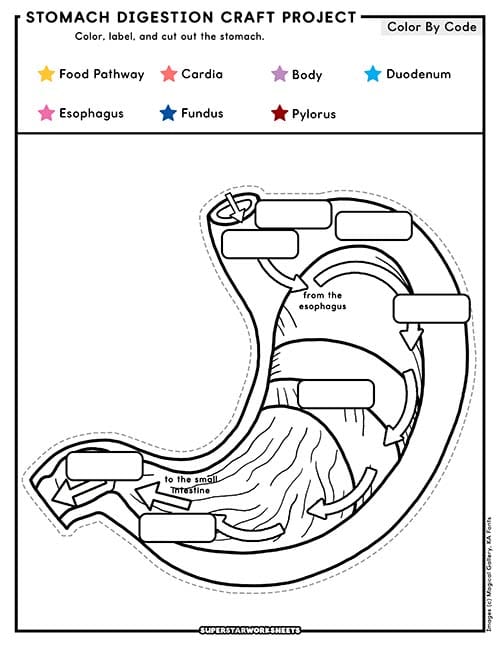
Stomach Digestion Color by Code Craft
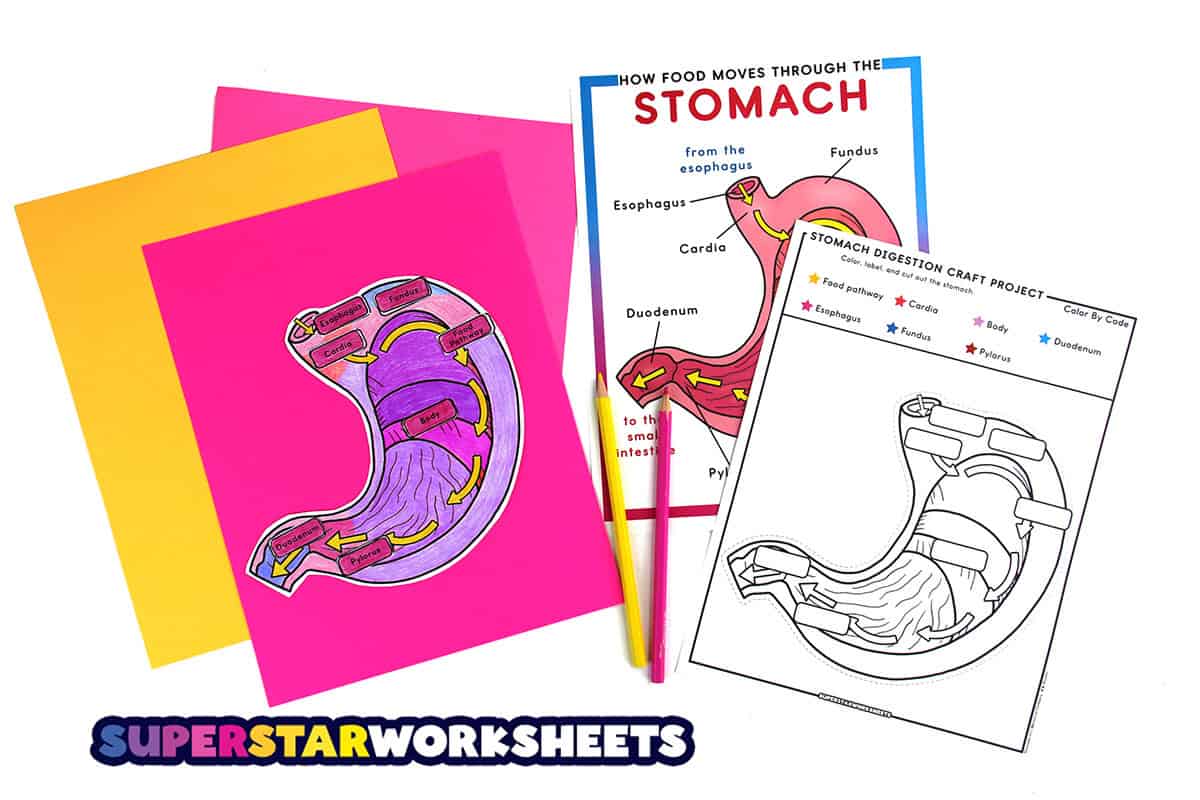
Students color and assemble this hands-on craft using a color code that matches the digestion pathway diagram. It turns the digestion process into a memorable, tactile project.
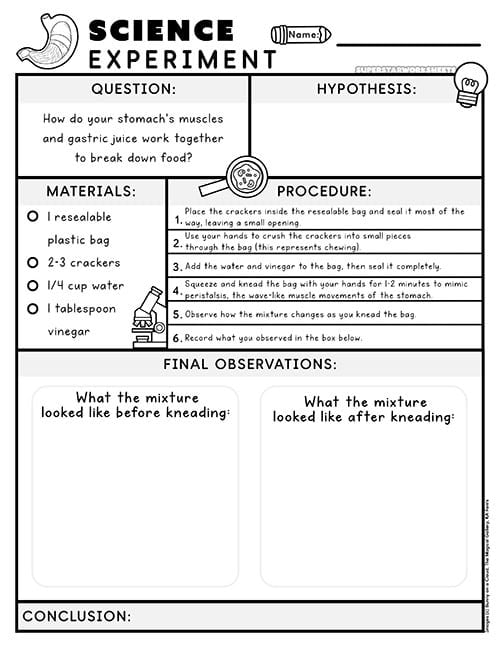
Stomach Digestion Science Experiment
This simple bag and cracker experiment lets kids build a working model of how the stomach mechanically and chemically breaks down food. It is a quick, low-mess way to observe digestion in action. Teachers! Check out our FREE Human Brain Worksheets here!
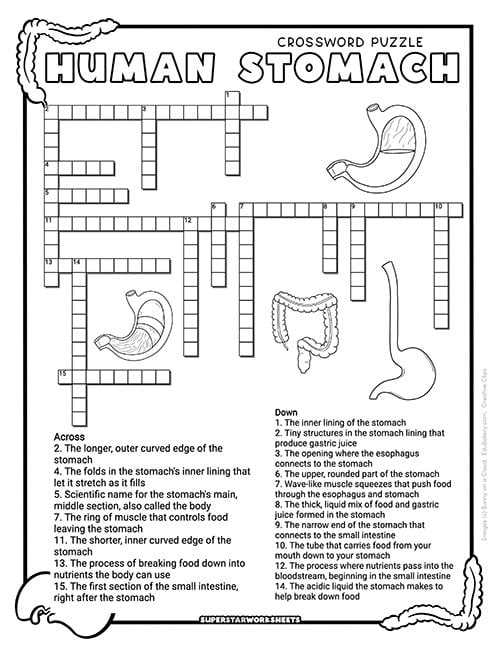
Human Stomach Crossword Puzzle
This crossword puzzle reinforces stomach vocabulary using clues pulled from the anatomy and digestion vocabulary banks. It makes a great review activity after a stomach unit.
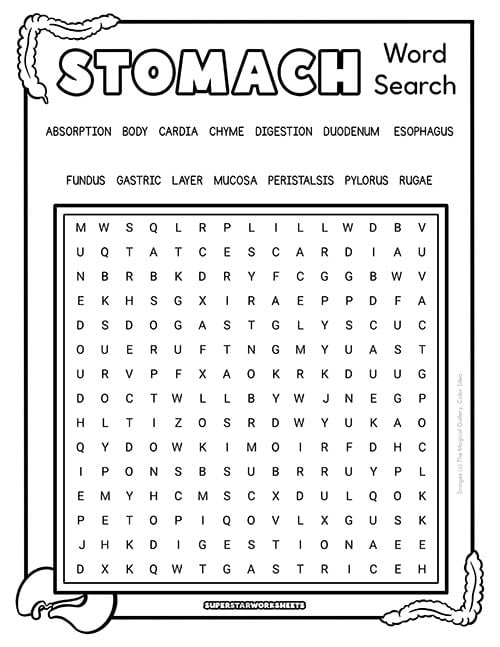
This word search gives students a fun, low-pressure way to recognize key stomach and digestion vocabulary. It works well as an early finisher or homework activity.
How Digestion Works
The stomach has one main job: take the food you swallow and turn it into something your body can absorb. Every time you eat, food travels down the esophagus and enters the stomach through the cardia. Muscles in the stomach wall squeeze and churn the food while gastric glands release gastric juice, an acidic liquid that breaks food down chemically. Together, this mechanical and chemical action turns food into a thick, soupy mixture called chyme. The stomach cannot do this work alone. The pyloric sphincter, a ring of muscle at the bottom of the stomach, controls how much chyme is released at a time into the duodenum, the first part of the small intestine, where digestion continues, and nutrients begin to be absorbed. Working together, the stomach and small intestine break down and absorb the food you eat every single day, almost always without you ever having to think about it.
Human Stomach Facts for Kids
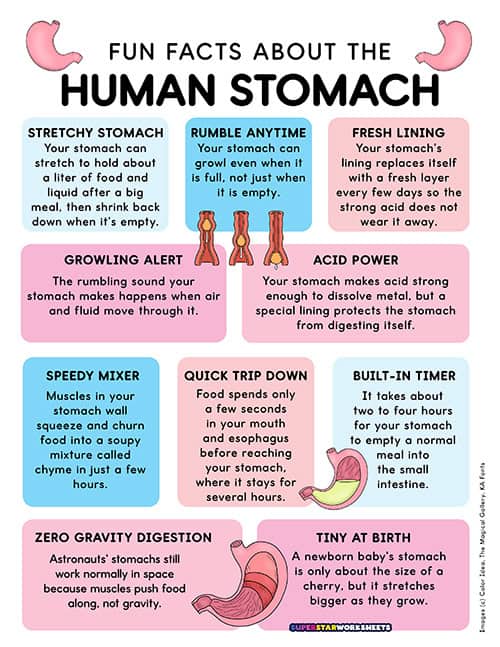
Fun Facts About the Human Stomach for Kids
Download and print this fun facts poster with amazing information about the human stomach. These are great charts to keep near your science learning centers for kids to read simple, yet memorable facts about how the stomach works.
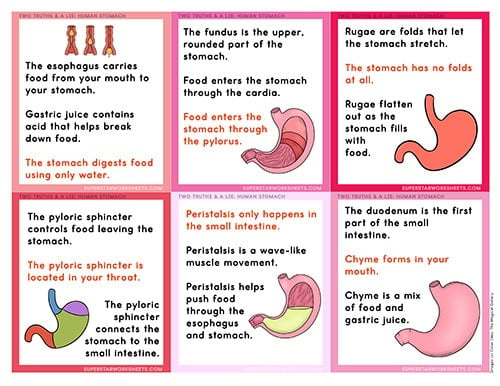
Human Stomach: Two Truths & a Lie
Here is a fun printable game you can play with your students. Two Truths and a Lie is a fact-finding game. Each card contains two truths about the human stomach and one lie, printed in red. Read the card aloud to students and ask them to raise their hand when they hear the lie. These are great morning icebreakers or anytime you need to bring student attention back into focus.
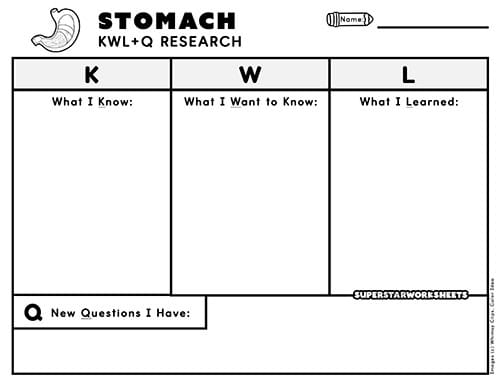
Stomach Science KWL+Q Worksheet
This printable graphic organizer will help students keep track of their human stomach research. Students fill in each section of the KWL+Q research guide: What I Know, What I Want to Know, What I Learned, and New Questions I have.
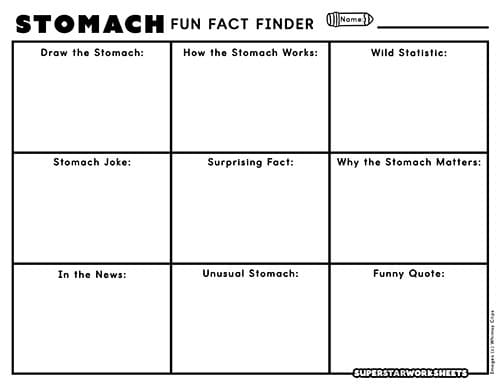
Human Stomach: Fun Fact Finder (Research)
Encourage your students to seek and find fun facts about the human stomach with this printable research-based scavenger hunt. Students will put their research skills to the test as they discover fun and engaging facts about the stomach. Includes drawing, jokes, wild statistics, surprising facts, funny quotes, and more.
Fun Facts About the Human Stomach
Stretchy Stomach: If you eat a big meal, your stomach can stretch to hold about a liter of food and liquid, then shrink back down when it’s empty.
Growling Alert: The rumbling sound your stomach makes happens when air and fluid move through it, whether it’s empty or full.
Acid Power: Your stomach makes acid strong enough to dissolve metal, but a special lining protects the stomach from digesting itself.
Fresh Lining: Your stomach’s lining replaces itself with a fresh layer every few days so the strong acid does not wear it away.
Speedy Mixer: Muscles in your stomach wall squeeze and churn food into a soupy mixture called chyme in just a few hours.
Zero Gravity Digestion: Astronauts’ stomachs still work normally in space because muscles push food along, not gravity.
Rumble Anytime: Your stomach can growl even when it is full, not just when it is empty.
Quick Trip Down: Food spends only a few seconds in your mouth and esophagus before reaching your stomach, where it stays for several hours.
Built-In Timer: It takes about two to four hours for your stomach to empty a normal meal into the small intestine.
Tiny at Birth: A newborn baby’s stomach is only about the size of a cherry, but it stretches bigger as they grow.
Leave a Reply