
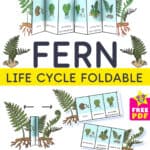
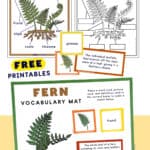
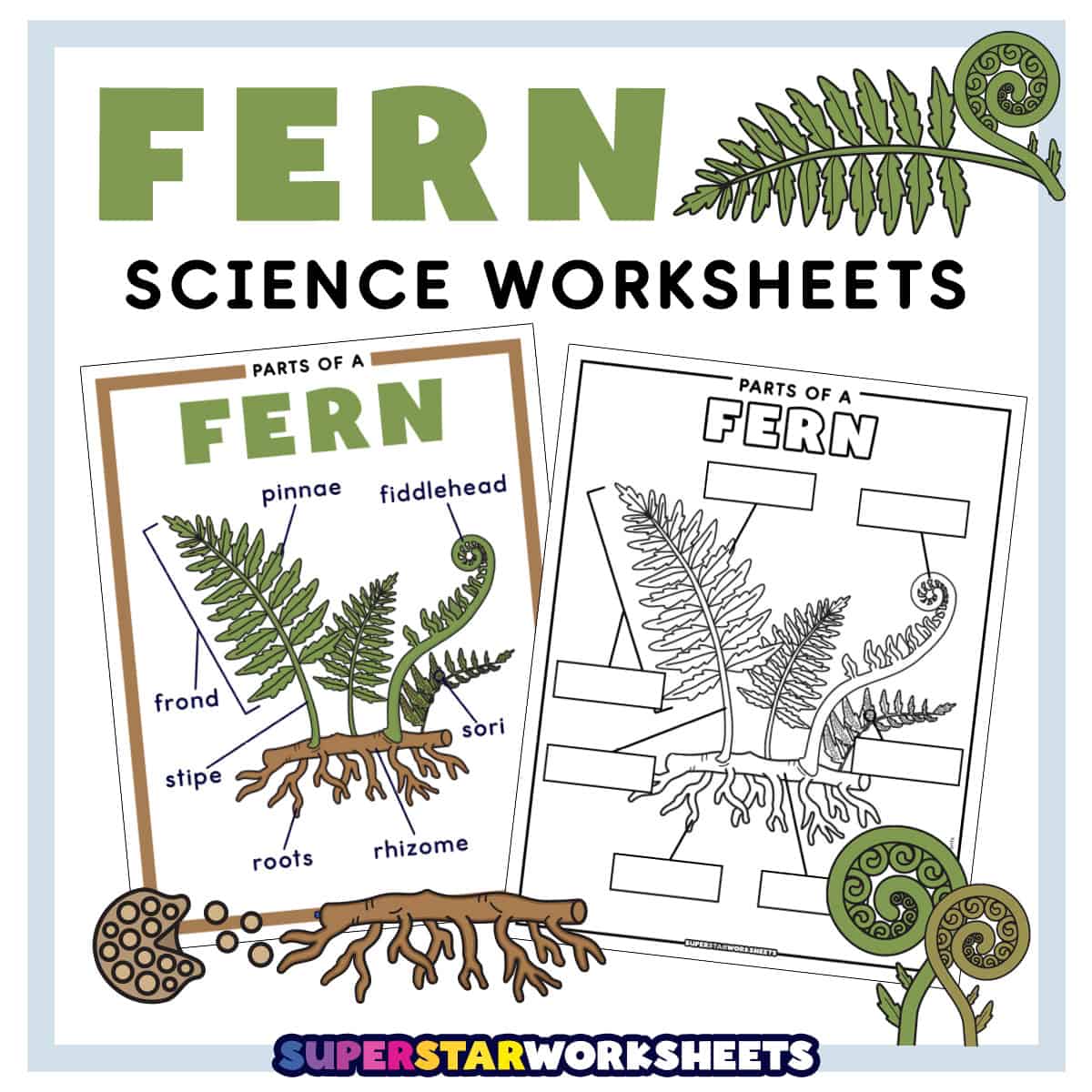
Free printable Fern Worksheets bring the fascinating world of ferns straight to your classroom or homeschool table. This full set of fern science activities covers everything from labeling the parts of a fern to exploring its unique two-stage life cycle, comparing spores and seeds, and investigating fern habitats and adaptations. Download and print PDF diagrams, vocabulary cards, life cycle crafts, reading passages, and a hands-on frond print investigation designed for young learners. Along the way, kids build vocabulary, practice scientific observation, and strengthen reading comprehension skills. Perfect for science centers, small group instruction, or independent homeschool science lessons.
Parts of a Fern Printables
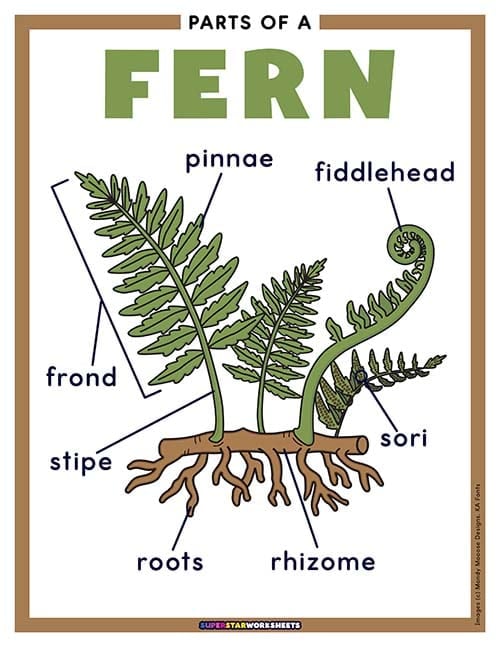
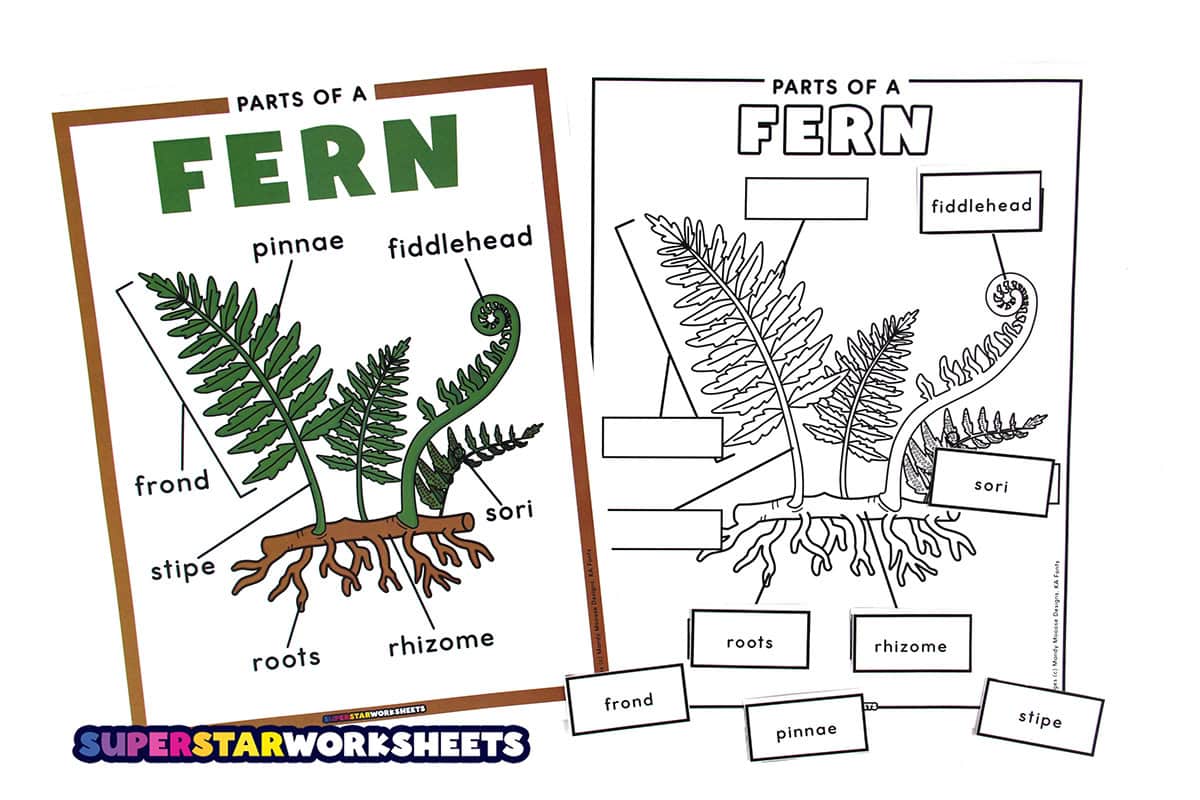
This colorful parts of a fern chart introduces young learners to fern anatomy, from the frond and fiddlehead to the rhizome and sori. Bright labels and simple definitions make this an ideal fern science reference for a classroom wall or science center.
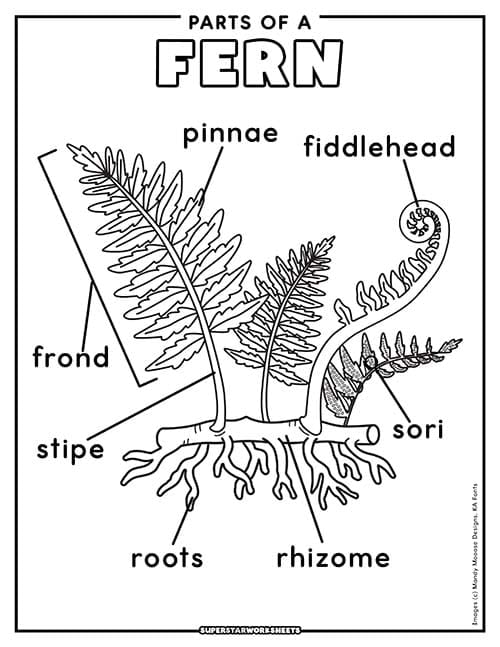
Parts of a Fern Coloring & Labeling Page
This black and white parts of a fern worksheet doubles as a coloring page and vocabulary review. Kids color the diagram while reinforcing fern anatomy terms like pinnae, stipe, and rhizome.
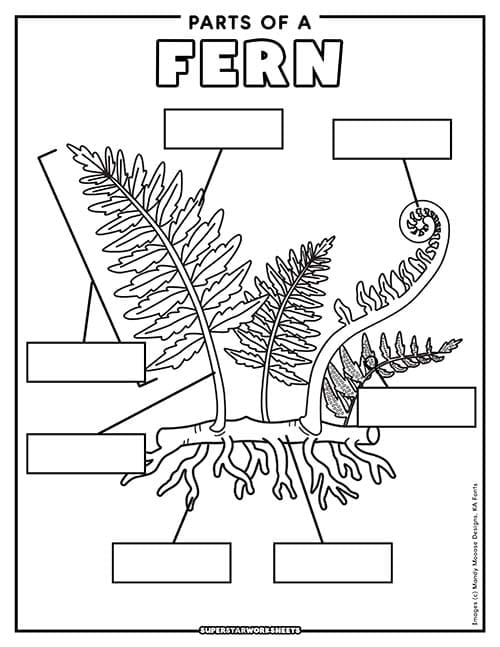
Blank Parts of a Fern Labeling Activity Page
Students label the parts of a fern by writing in key vocab terms in each blank. Alternatively, younger students can use the provided cut and paste labels instead of writing them on. This is a great way to quickly learn the parts of a fern.
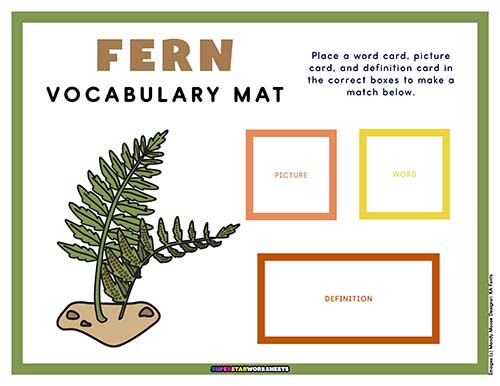
This hands-on fern vocabulary mat pairs picture, word, and definition cards so kids can practice fern anatomy terms independently. It’s a reusable learning center activity that works with both the parts and life cycle vocabulary card sets.
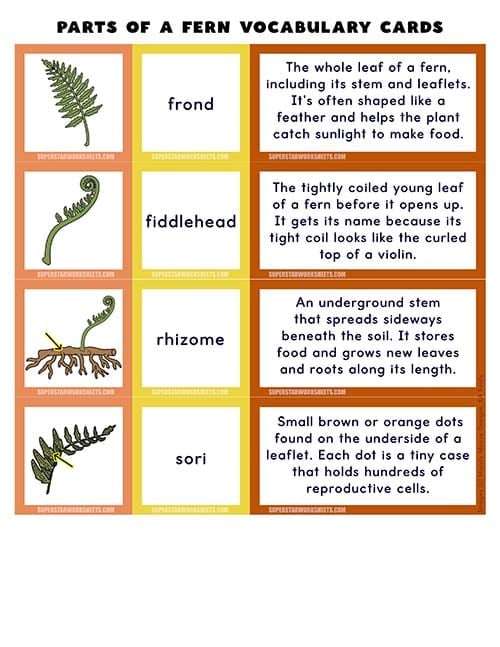
Parts of a Fern Vocabulary Cards
These three-part matching cards help kids connect fern vocabulary words with pictures and definitions. Core terms like frond, fiddlehead, rhizome, and sori are included alongside extended anatomy terms for older learners.
Teaching the Parts of a Fern
When introducing the parts of a fern to your students, it’s important to use language and vocabulary terms they are familiar with. Ferns are especially interesting because they grow, survive, and make new ferns without ever producing a single flower or seed! Here are our recommended definitions for each part of the fern, each with a visual description as well as its purpose and how it connects within the living system.
frond: the leaf of a fern. It is long, green, and feathery, and it soaks up sunlight to help the fern make its own food!
fiddlehead: a young frond that is tightly coiled up like the top of a violin. It slowly uncurls and opens up as it grows!
pinnae: the small leaflets that make up a frond. Lined up along the frond, they give the fern its feathery look!
rachis: the central stalk that runs through the middle of the frond. All the pinnae are connected to it, like branches on a tree!
stipe: the bare stalk at the bottom of the frond, below the leaflets. It connects the frond to the rhizome and holds it up toward the light!
rhizome: an underground stem that grows sideways through the soil. It stores food and grows new fronds and roots along its length, helping the fern spread!
roots: thin, stringy parts that grow from the rhizome. They hold the fern in place and soak up water and nutrients from the soil!
sori: small brown or orange dots found on the underside of many fern leaflets. They are clusters of tiny cases that hold the fern’s spores!
spores: tiny, dust-like specks released from the sori. Instead of seeds, ferns use spores to grow into brand-new ferns!
Fern Life Cycle Printables
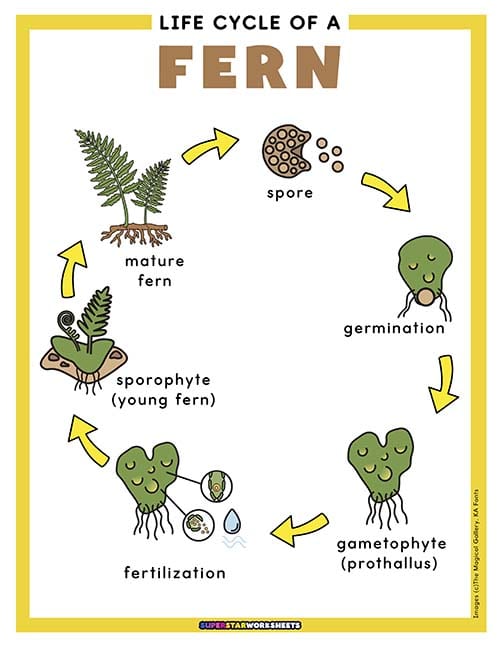
This fern life cycle chart walks kids through every stage of a fern’s unique two-part life cycle, from spore to mature fern. It’s an eye-catching reference for teaching how ferns reproduce differently than flowering plants.
Fern Life Cycle Cut and Paste Activity
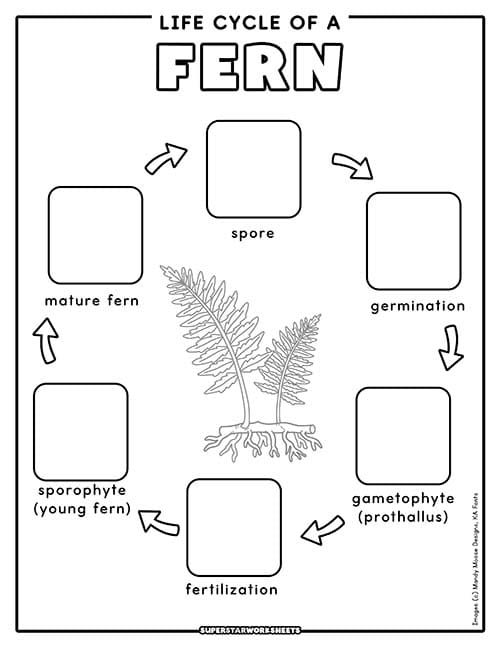
In this hands-on fern life cycle activity, kids cut out and sequence each stage of the cycle in the correct order. It’s a fun way to practice sequencing and review life cycle vocabulary.
Life Cycle of a Fern Label Worksheet
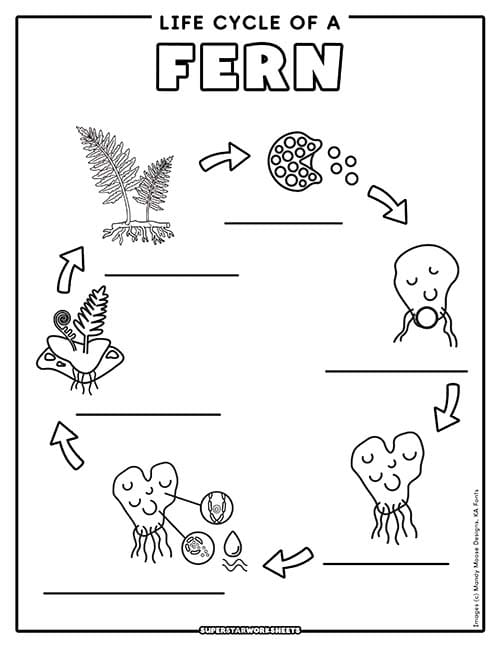
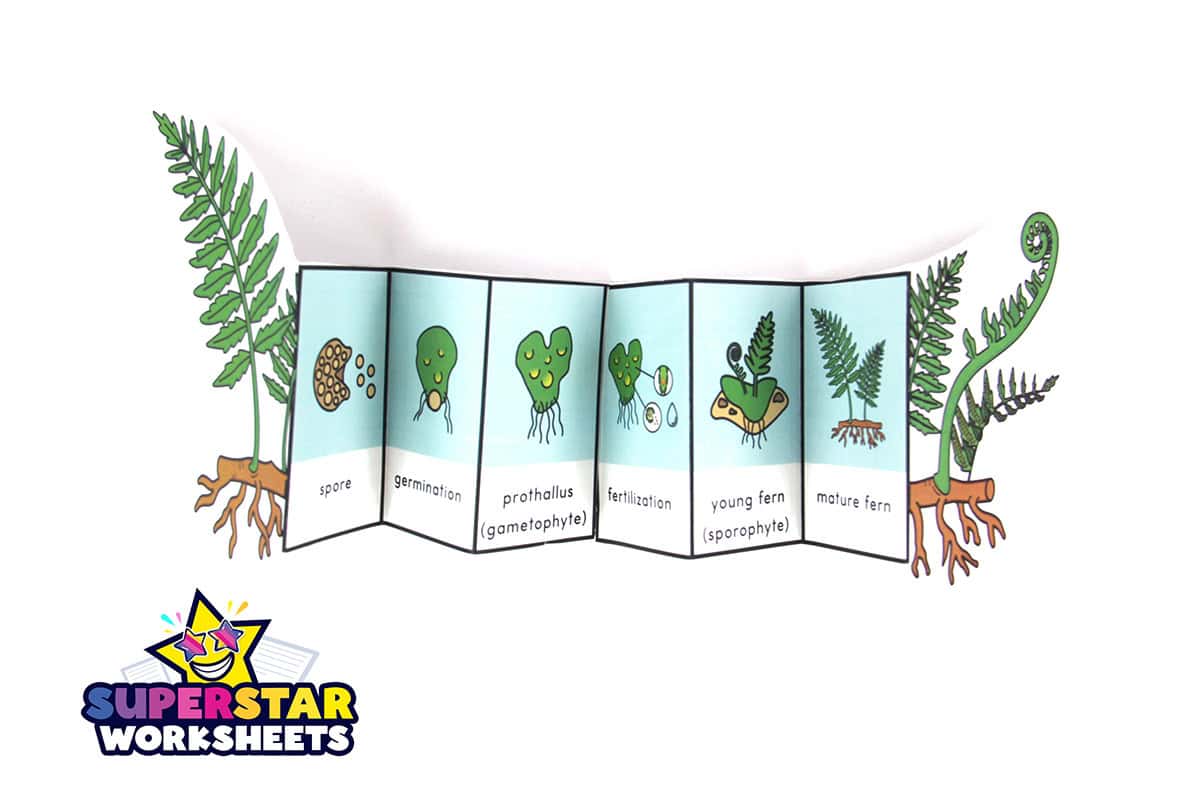
Free printable fern life cycle labeling worksheet for students to practice writing the correct science vocabulary term for each stage of development. This black-and-white PDF printable is helpful for students to color and label each of the growth stages of a fern: spores, germination, prothallus, fertilization, young fern, and mature fern.
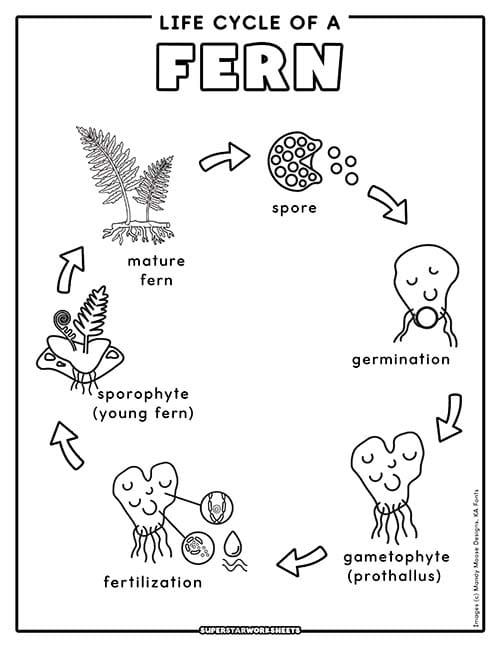
Fern Life Cycle Coloring & Labeling Page
This fern life cycle worksheet lets kids color and label each stage of the cycle. It reinforces sequencing skills alongside fern life cycle vocabulary. For more FREE printables, take a look at our Plant Worksheets!
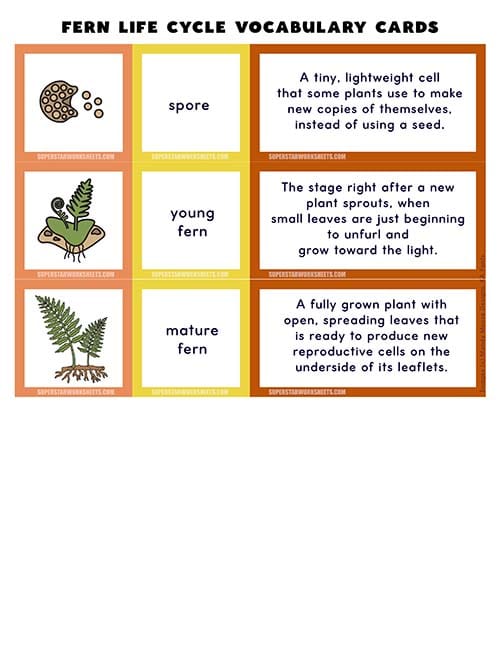
Fern Life Cycle Vocabulary Cards
These fern life cycle vocabulary cards pair pictures, words, and definitions for each stage of the cycle. Core terms are included alongside extended vocabulary like prothallus and fertilization for older learners.
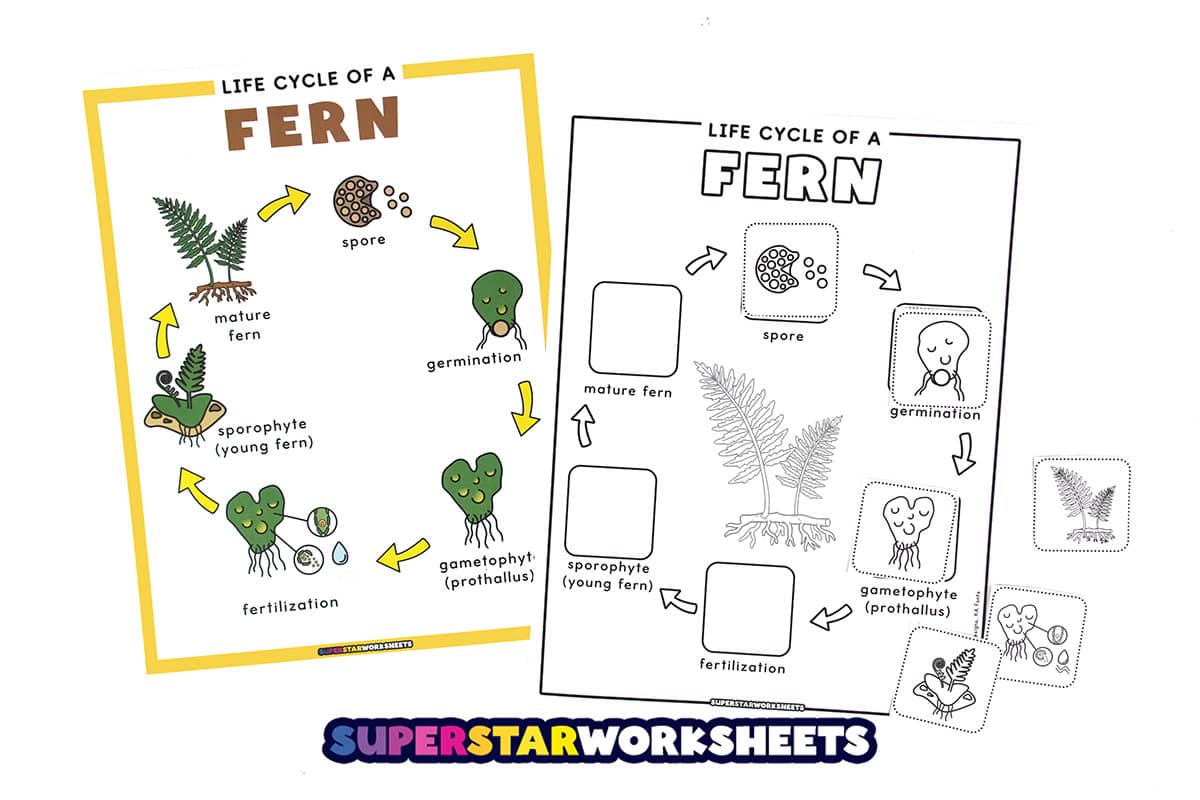
Teaching the Fern Life Cycle
The fern life cycle is a fascinating change of pace for students, because unlike flowering plants, a fern begins as a tiny spore instead of a seed! Lay a mature frond sori-side down on white paper overnight so students can see the dust-like spores it releases. Help students learn the different names for each stage and use them interchangeably (i.e. prothallus and gametophyte, or young fern and sporophyte).
spore: a tiny, dust-like speck released from the sori on the underside of a fern frond. When it lands in a damp, shady spot, it can start to grow into a new fern!
germination: when a spore begins to sprout and grow. It needs moisture and the right conditions to get started!
prothallus: a tiny, flat, heart-shaped plant that grows from the spore, also called the gametophyte. It is usually smaller than a fingernail, and it makes the cells needed to start a brand-new fern!
fertilization: when a male cell and a female cell join together. On a fern, the male cell swims through a thin layer of water to reach the female cell, which is why ferns need damp places to grow!
young fern: a small new fern that grows up out of the prothallus, also called the sporophyte. As it grows its first fiddleheads and roots, the prothallus withers away!
mature fern: a full-grown fern with fronds of its own. Sori form on the underside of its fronds, ready to release spores and start the whole life cycle all over again!
Fern Life Cycle Crafts & Activities for Kids
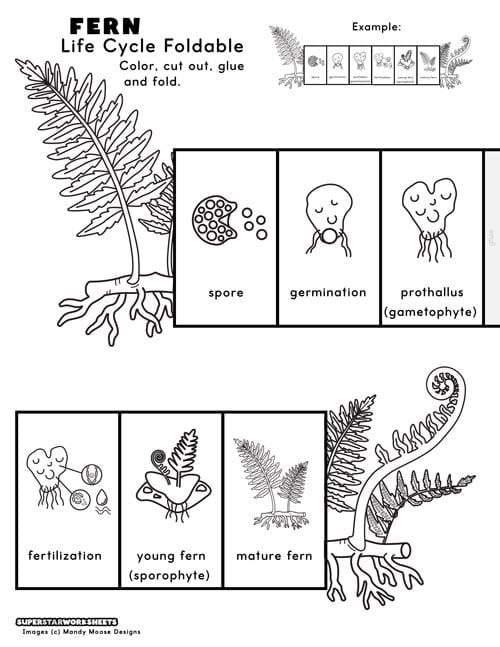
Fern Life Cycle Foldable Craft
This fern life cycle foldable craft lets kids build a hands-on model of the complete fern life cycle. Perfect for an interactive science notebook or a life cycle bulletin board display.
Fern Science Experiments for Kids
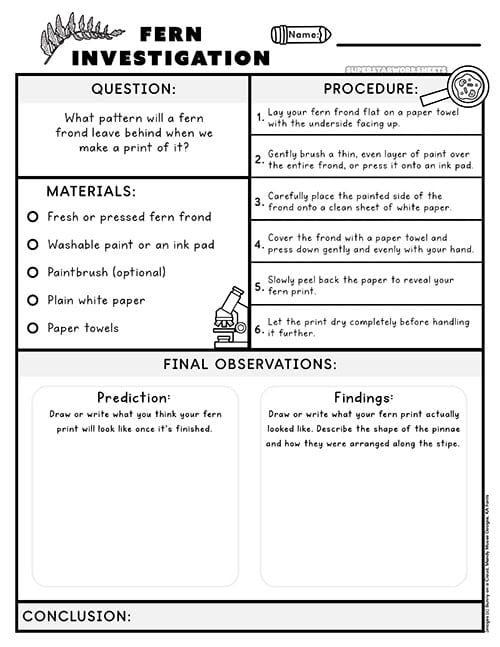
Fern Frond Print Investigation
This fern frond print investigation invites kids to predict, observe, and record the pattern a real fern frond leaves behind. It’s a simple, hands-on way to connect fern anatomy to real scientific observation.
Fern Frond Print Science Experiment
What pattern will a fern frond leave behind? This investigation invites kids to predict, observe, and record the pattern a real fern frond makes when it’s printed onto paper. Prints reveal the repeating pattern of pinnae branching off the frond’s central stalk, the same structure that helps a real fern spread its leaf surface out to capture as much sunlight as possible. It’s a simple, hands-on way to connect fern anatomy to real scientific observation.
Question: What pattern will a fern frond leave behind when we make a print of it?
Hypothesis: Before starting, ask students to draw or write what they think their fern print will look like once it’s finished.
Materials:
- Fresh or pressed fern frond
- Washable paint or an ink pad
- Paintbrush (optional)
- Plain white paper
- Paper towels
- Lab journal or observation sheet
Procedure:
- Lay your fern frond flat on a paper towel with the underside facing up.
- Gently brush a thin, even layer of paint over the entire frond, or press it onto an ink pad.
- Carefully place the painted side of the frond onto a clean sheet of white paper.
- Cover the frond with a paper towel and press down gently and evenly with your hand.
- Slowly peel back the paper to reveal your fern print.
- Let the print dry completely before handling it further.
What to Look For:
Students should notice the repeating pattern of pinnae branching off the central stalk on both sides, mirroring the frond’s real structure. Many prints will also show fine details like the veins in each leaflet, and the leaflets often get smaller toward the tip of the frond.
Conclusion:
After observations are complete, students compare their print to their prediction and explain how the frond’s branching shape helps a fern capture sunlight.
Fern Research & Fun Facts Printables
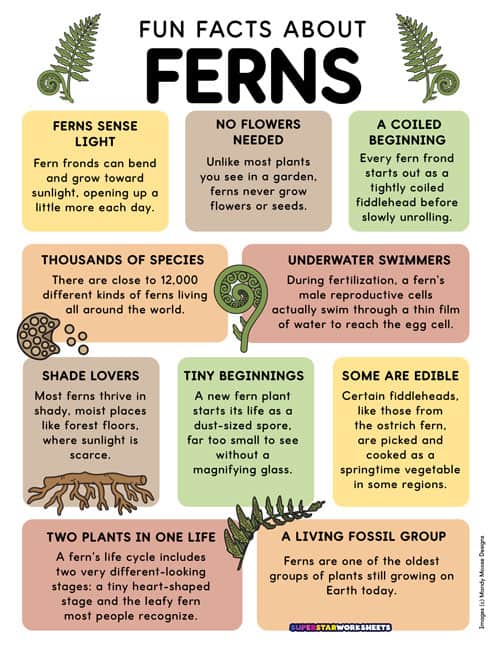
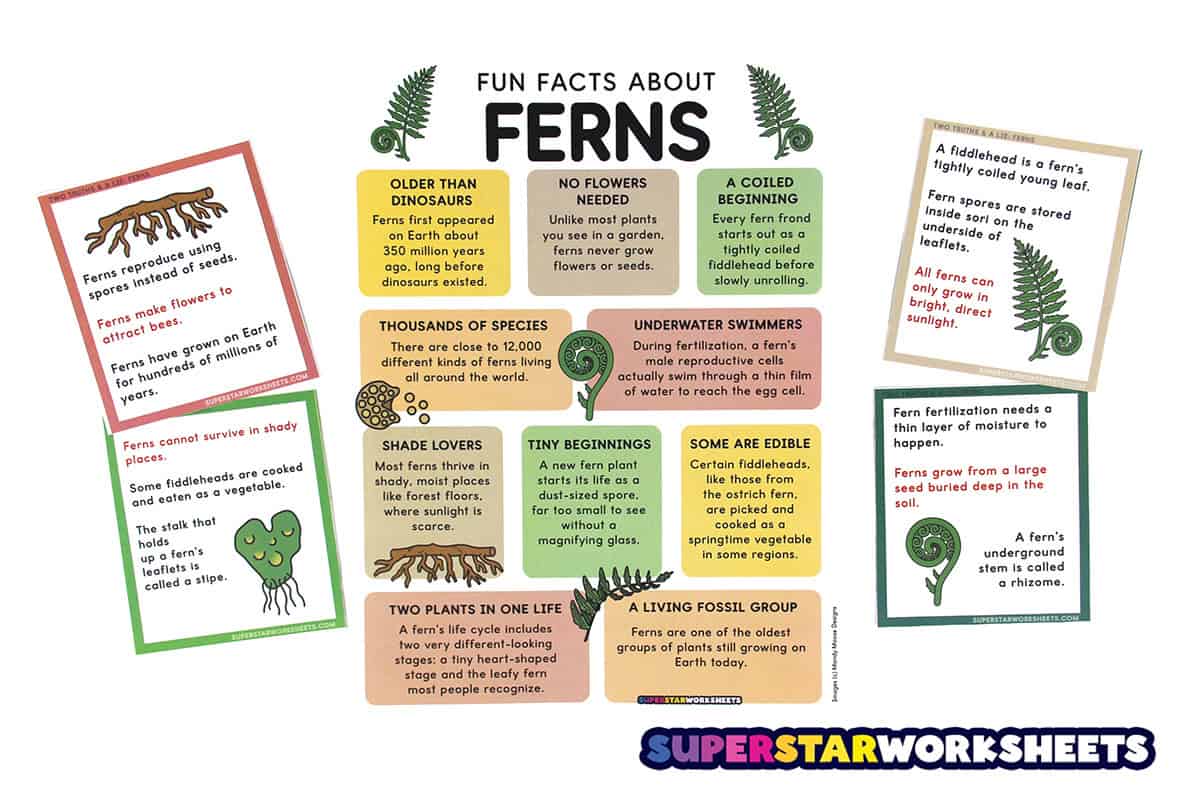
This fun facts about ferns poster shares surprising highlights, from how old ferns are as a plant group to how they grow and reproduce. It’s a great conversation starter before diving into a fern research project.
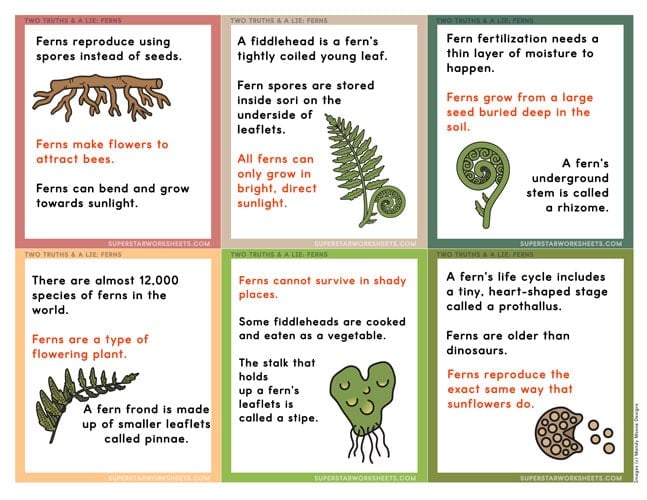
This two truths and a lie fern game challenges kids to spot the false fern fact among true statements. It’s a fun small group or whole-class review activity for any fern unit.
Fern Fun Fact Finder Research Worksheet
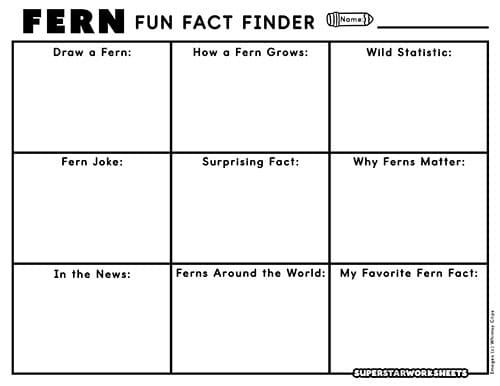
This fern research worksheet gives kids nine open-ended prompts to explore and record fun fern facts. It’s an engaging way to build research skills around a nature topic.
Amazing Fern Facts
So Many Kinds: There are more than 10,000 different kinds of ferns in the world.
Ancient Plants: Ferns have been growing on Earth for more than 350 million years.
Tree Ferns: Some tropical tree ferns can grow over 60 feet tall, with fronds as long as a car!
Tiny Floaters: Mosquito fern is one of the smallest ferns in the world, with fronds about the size of a fingernail that float on top of ponds.
Spore Power: A single fern can release millions of tiny spores in just one season.
Space Traveler: The resurrection fern curls up and turns brown when it’s dry, then turns green again after it rains, and it even traveled to space on a shuttle in 1997!
Edible Fiddleheads: The fiddleheads of the ostrich fern are a springtime treat that people cook and eat.
World Travelers: Bracken fern grows on every continent except Antarctica, making it one of the most widespread plants on Earth.
Ancient Energy: Much of the coal we use today formed from ancient forests of ferns and other plants that lived millions of years ago.
No Flowers Needed: Ferns never grow flowers or seeds, and they use spores to make new ferns instead.
Spores vs. Seeds Printables
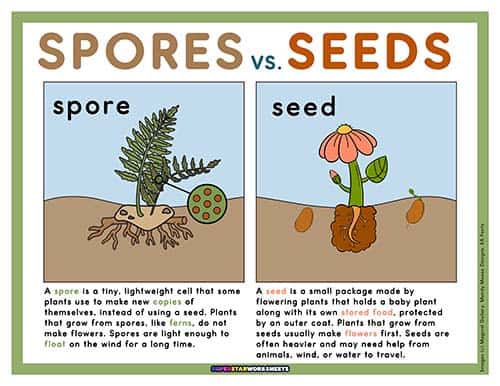
This spores vs. seeds chart compares how ferns and flowering plants reproduce side by side. It’s a simple visual that helps kids see the differences between spore-based and seed-based plant reproduction.
Spores or Seeds Sorting Activity
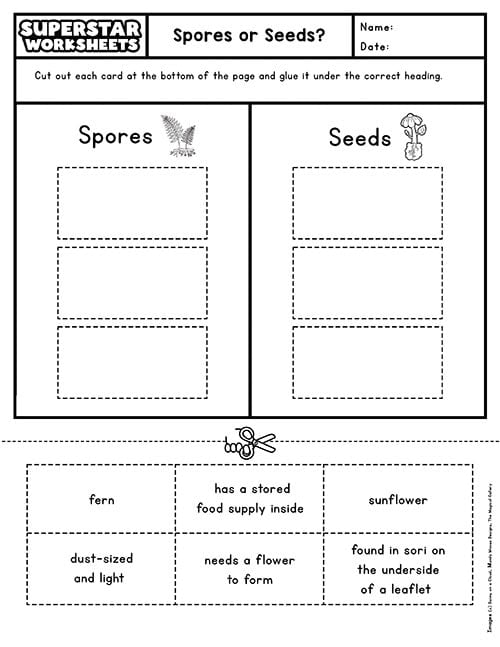
In this spores vs. seeds sorting activity, kids classify facts and pictures under the correct heading. It’s a hands-on way to reinforce the differences between these two types of plant reproduction.
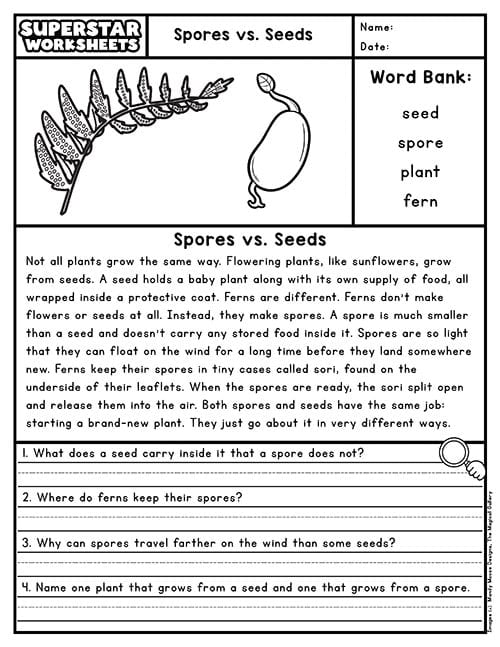
Spores vs. Seeds Reading Comprehension
This spores vs. seeds reading passage and question set builds nonfiction reading comprehension while reinforcing plant science vocabulary. A teacher answer key is included.
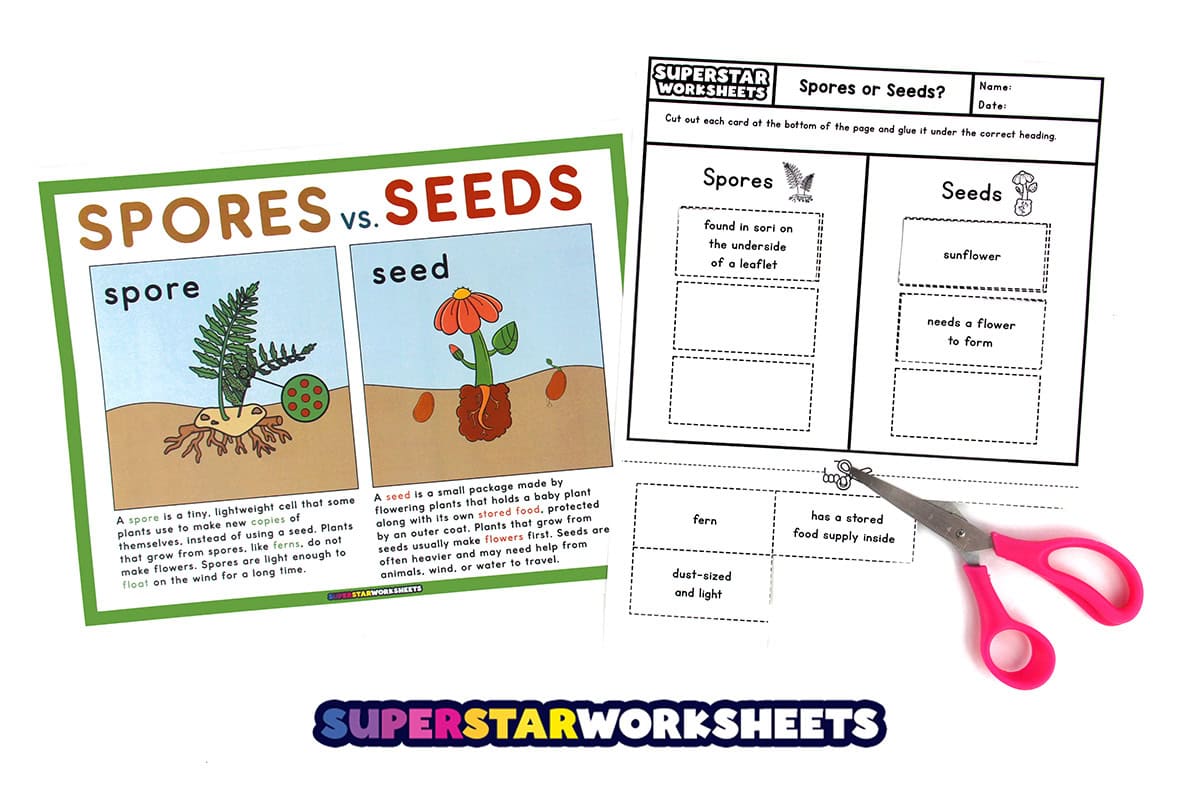
Teaching Spores vs. Seeds
Spores and seeds both start new plants, but they go about it in very different ways! Have students compare a bean seed and a sprinkle of fern spores with a hand lens. Here are our recommended definitions for each term, with a visual description and its purpose.
seed: a small package made by plants like flowers, trees, and pine trees. It holds a baby plant and its own food supply, all wrapped inside a protective coat!
embryo: the tiny baby plant found inside a seed. It already has the beginnings of a root, stem, and leaves, ready to grow!
stored food: the food packed inside a seed. It gives the baby plant energy to grow until it can make its own food from sunlight!
seed coat: the tough outer covering of a seed. It keeps the baby plant safe until the time is right to grow!
spore: a tiny, dust-like speck made by plants like ferns and mosses. It is much smaller than a seed, has no baby plant or food supply inside, and can travel far on the wind!
sori: the small brown or orange dots on the underside of many fern fronds. They hold the fern’s spores until they are ready to be released!
Fern Habitats & Adaptations Printables
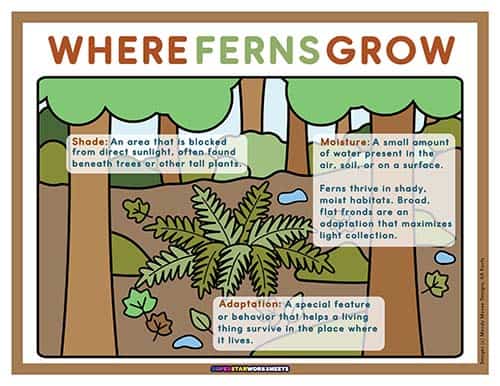
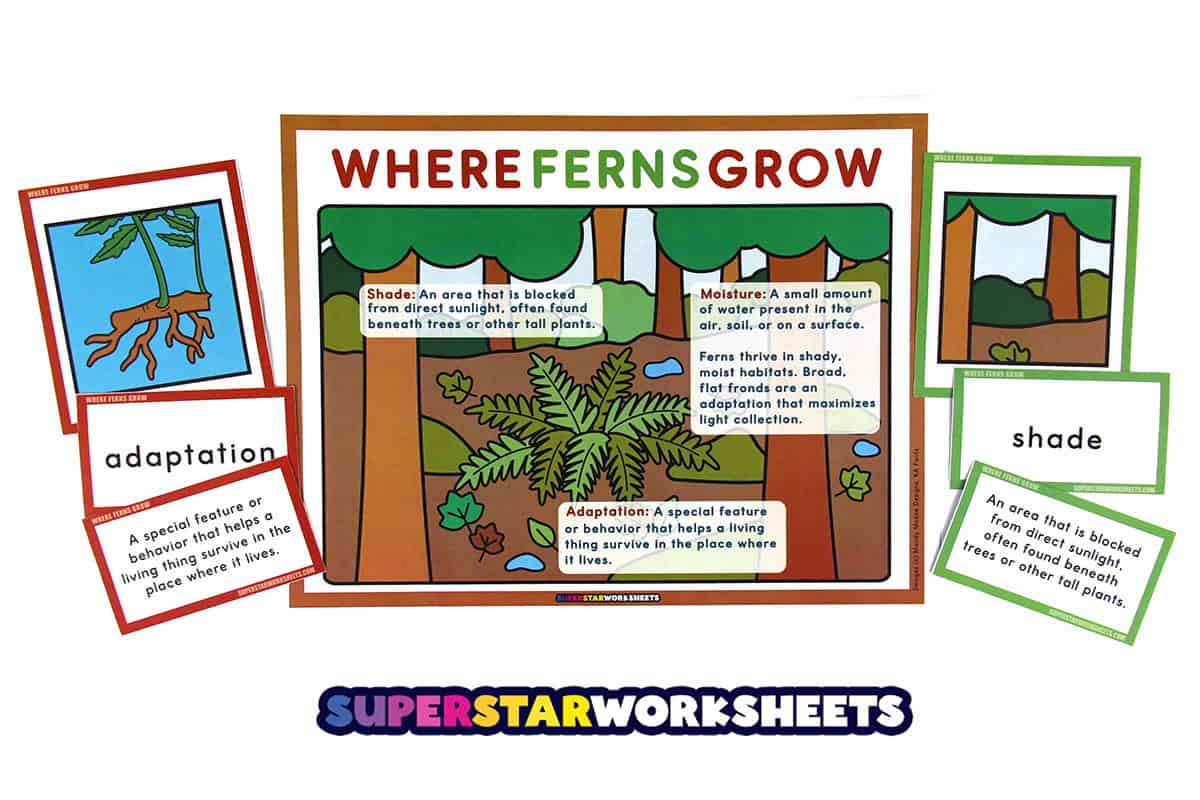
This fern habitats chart shows exactly why ferns thrive in shady, moist places like forest floors. It highlights the adaptations that help ferns survive where many flowering plants cannot. Teachers! If you are needing more free science printables check out our Mushroom Worksheets!
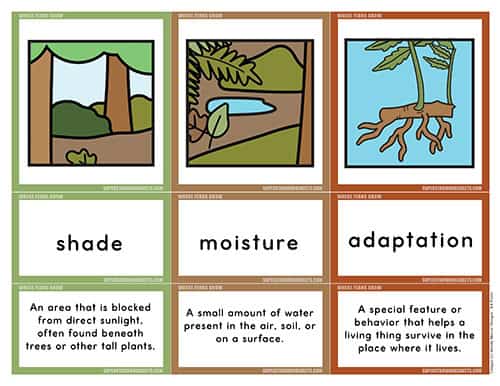
These three-part matching cards reinforce fern habitat vocabulary like shade, moisture, and adaptation. Zoomed-in visuals connect each term back to the Fern Habitats Chart.
Fern Habitats & Adaptations Reading Comprehension
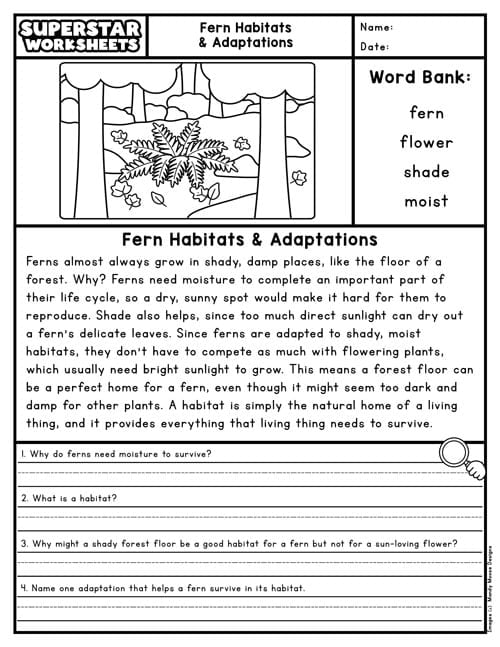
This nonfiction reading passage explains why ferns are so well-adapted to shady, damp habitats. Comprehension questions and a teacher answer key are included.
Teaching Fern Habitats & Adaptations
Most ferns are well adapted to shady, moist places like the forest floor, where they face less competition from sun-loving plants. Take students outside to look for the shadiest, dampest spot near your school and talk about whether a fern could live there. Here are our recommended definitions for each term, with a visual description and its purpose.
habitat: the natural home of a living thing. It gives a plant or animal everything it needs to survive, like food, water, and shelter!
shade: a cool, darker area where direct sunlight is blocked. Many ferns grow best in shady spots under tall trees!
moisture: a small amount of water in the soil or air. Ferns need damp places to grow, because their tiny male cells swim through water to reach the female cells and start a new fern!
forest floor: the ground beneath the trees in a forest. Tall trees block out direct sunlight, and fallen leaves help keep the soil damp, making it a perfect home for ferns!
adaptation: a special feature that helps a living thing survive in its environment. Being able to grow well in shade is an adaptation that helps ferns thrive on the forest floor!
competition: when living things need the same resources, like sunlight, water, or space. Since most flowering plants need bright sunlight, ferns face less competition in shady habitats!
Fiddleheads Printables
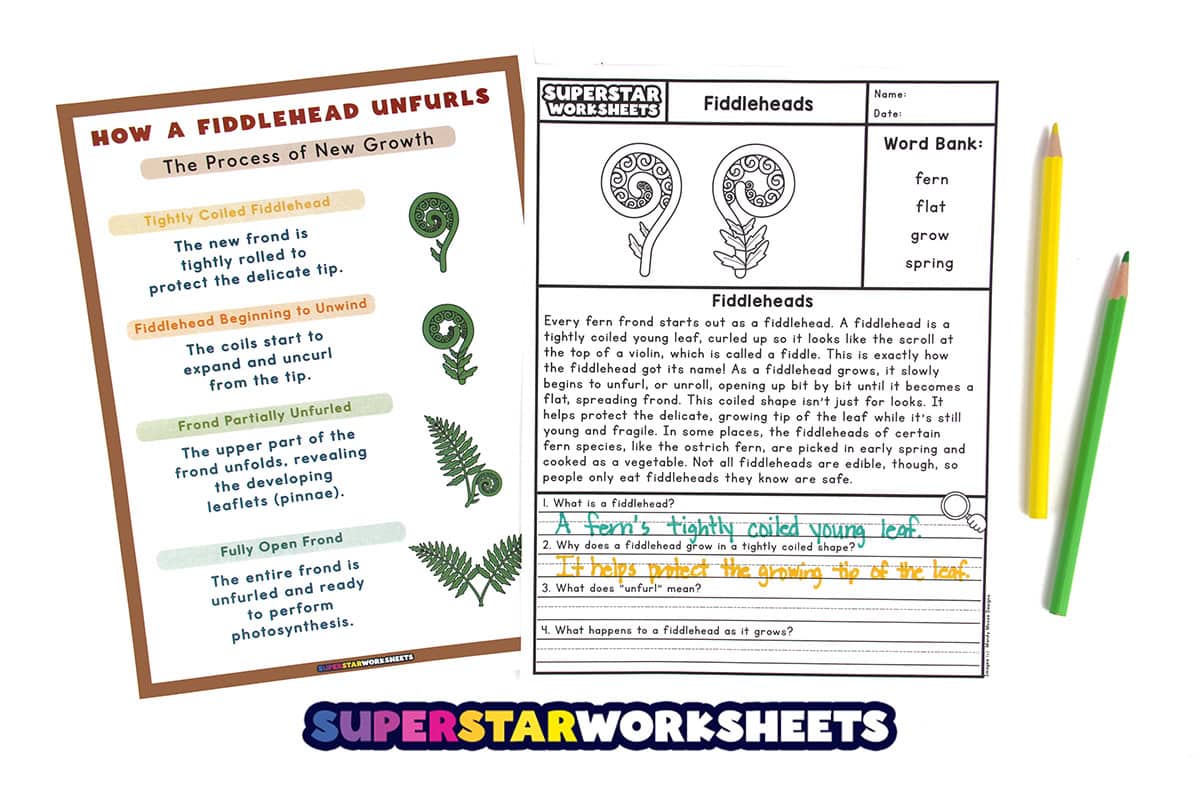
How a Fiddlehead Unfurls Chart
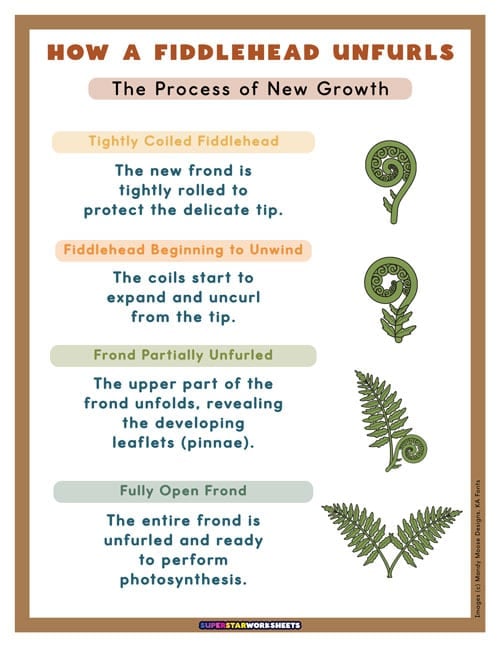
This fiddlehead chart shows the fascinating process of a coiled fern leaf slowly unfurling into a full frond. It’s a great visual for introducing the science behind this unique plant structure.
Fiddlehead Unfurling Labeling Worksheet
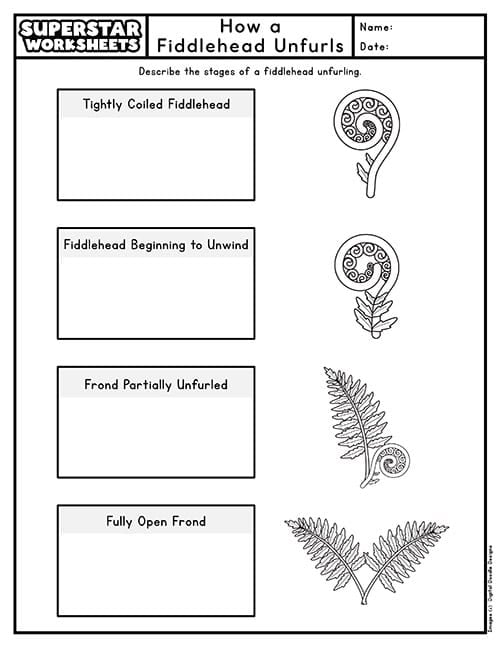
In this fiddlehead worksheet, kids label each stage of a frond unfurling using key vocabulary. It reinforces sequencing skills alongside fern-specific science terms.
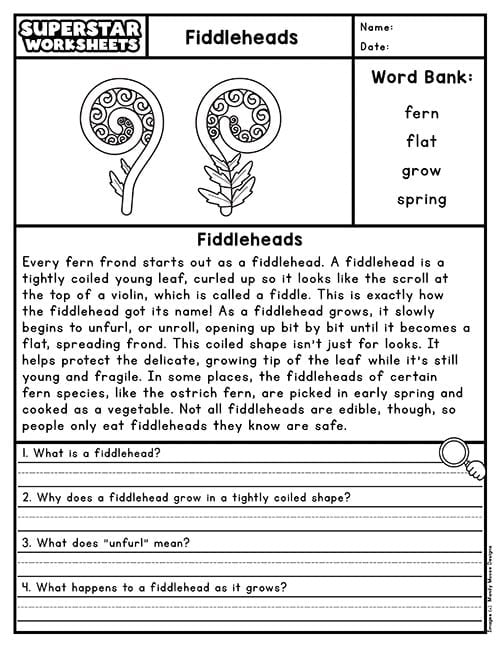
Fiddleheads Reading Comprehension
This nonfiction reading passage explores how fiddleheads get their name and why they grow in a tight coil. Comprehension questions and a teacher answer key are included.
Teaching Fiddleheads
A fiddlehead is a young fern leaf, coiled up tight to protect its delicate growing tip until it’s ready to unfurl. If you can find a fern in early spring, have students sketch the same fiddlehead every few days to watch it slowly unroll. Here are our recommended definitions for each term, with a visual description and its purpose.
fiddlehead: a young fern leaf that is tightly curled up in a spiral. It is named for the curled scroll at the top of a violin, which is also called a fiddle!
coiled: wound up in a tight spiral, like a snail shell. This shape helps protect the delicate tip of the young leaf while it grows!
unfurl: to slowly unroll and open up. As a fiddlehead grows, it unfurls little by little until it becomes a fully open frond!
frond: the full-grown leaf of a fern. It is long, green, and feathery, and it soaks up sunlight to help the fern make its own food!
edible: safe to eat. Ostrich fern fiddleheads are cooked and eaten as a springtime vegetable, but many other fiddleheads are not safe to eat, so students should never taste one they find outside!
Leave a Reply