
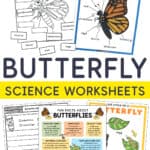
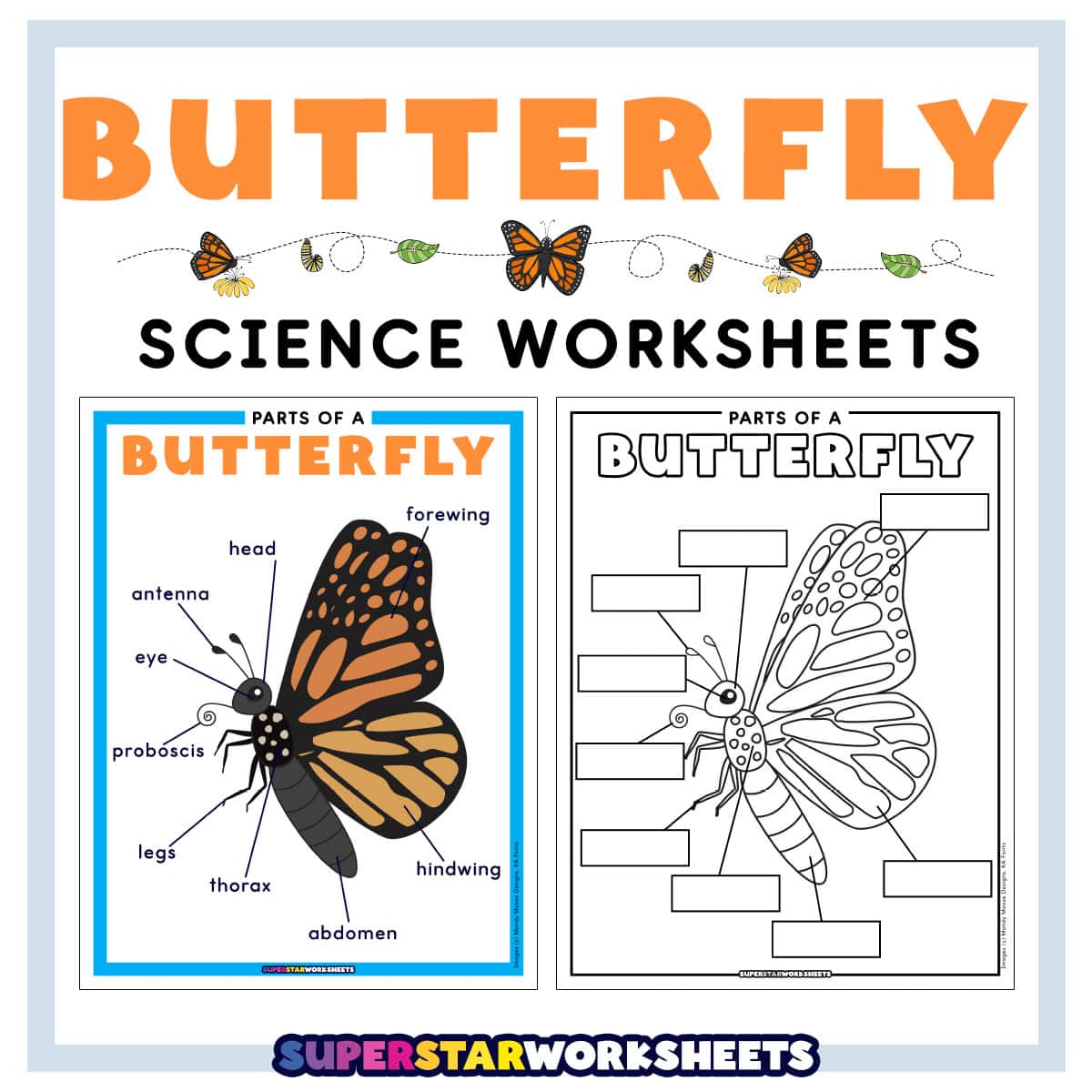
Free printable Butterfly Worksheets are perfect for teaching kids about the parts of a butterfly, the butterfly life cycle, and adaptations like camouflage and migration. Download and print PDF charts, hands-on learning mats, vocabulary cards, and fun activities designed for elementary students. These worksheets build key science skills like identifying body parts, sequencing life cycle stages, and understanding how animals survive in the wild. Perfect for classroom science centers, homeschool nature study, or a spring butterfly unit.
Parts of a Butterfly Printables
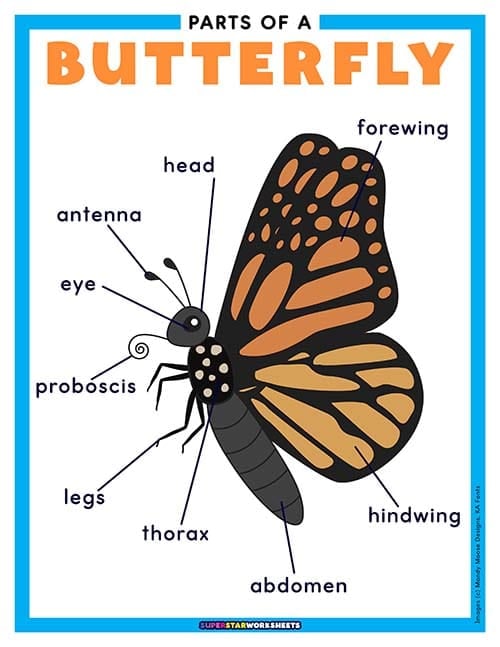
Download and print this beautiful, full color Parts of a Butterfly diagram in PDF format to show students the different external parts of a butterfly. This classroom-ready anatomy poster is designed for high visibility and easy reading. Use it as a labeling anchor chart to help your students learn, read, and label the parts of a butterfly: head, eye, antenna, thorax, abdomen, forewing, hindwing, legs, and proboscis.
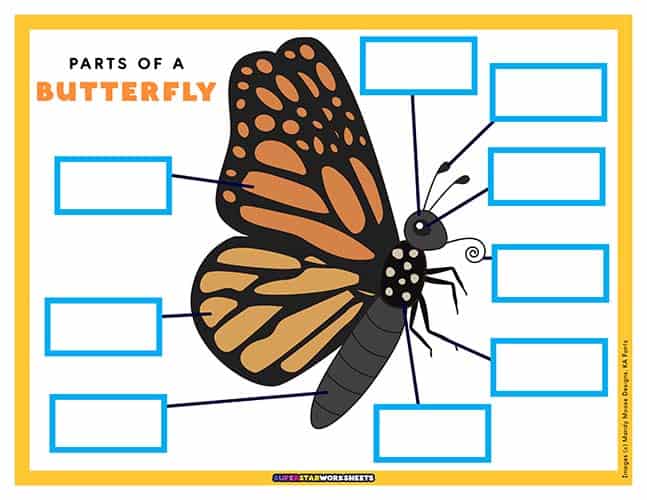
Parts of a Butterfly Learning Center
Students can practice labeling the parts of a butterfly with this simple, reusable learning center activity. Featuring a full color labeling mat and printable label cards, we recommend laminating this non-consumable set to use in your classroom.
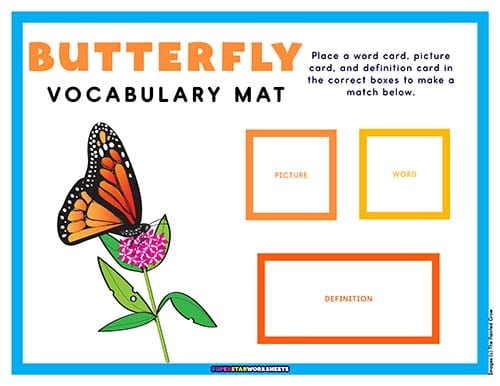
Butterfly Vocabulary Learning Mat
Students build butterfly vocabulary with this simple, reusable learning mat. Kids match picture cards, word cards, and definitions, then read each definition aloud once they make a match. This mat pairs with vocabulary card sets from every arc of this unit, including parts, life cycle, and adaptations.
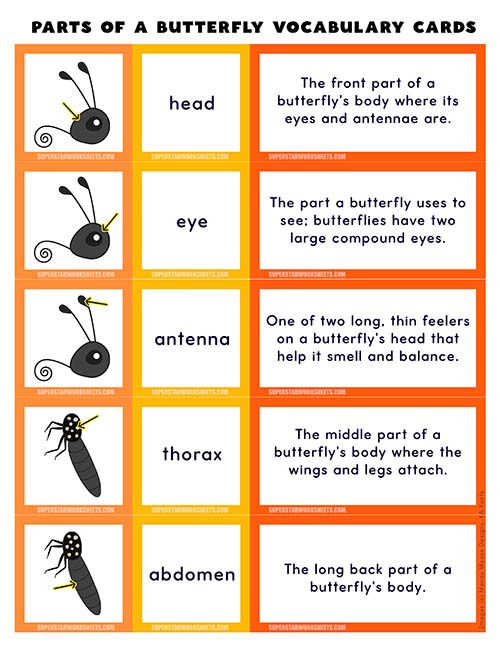
Parts of a Butterfly Vocabulary Cards
Students build important science vocabulary skills with these parts of a butterfly cards. This set includes visual graphics, terminology, and simple definitions to help your students learn the parts of a butterfly, including the concept of symmetry.
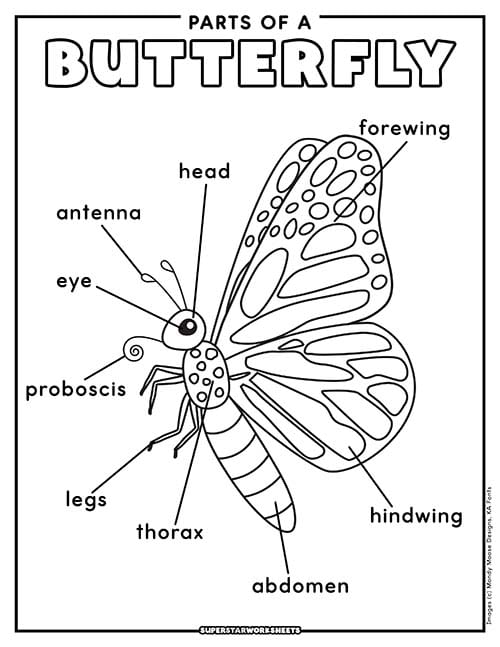
Parts of a Butterfly Coloring Page
Free printable parts of a butterfly coloring page. Download and print this PDF featuring a clearly labeled black and white diagram of a butterfly. Each part is labeled for early readers to color and review.
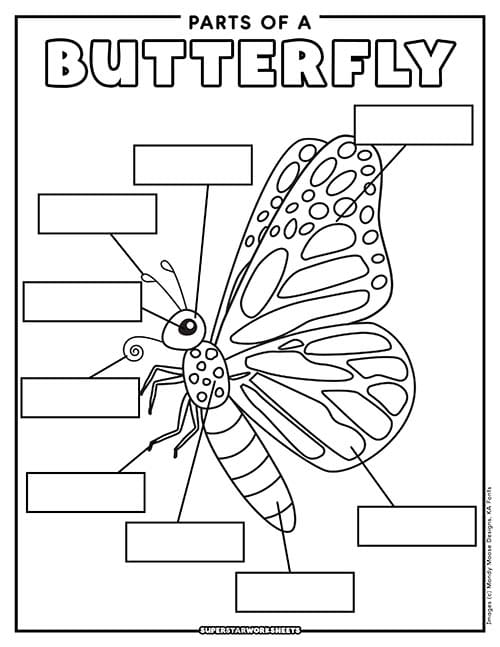
Label the Parts of a Butterfly Worksheet
Free blank printable butterfly parts labeling worksheet for students to practice placing the correct vocabulary term for each of the 9 main parts of a butterfly. This set includes cut and paste labels, providing easy differentiation for younger students.
Teaching the Parts of a Butterfly
Butterflies have several important external parts that help them survive. The head holds the eyes and antennae, while two long antennae help a butterfly smell and keep its balance. A butterfly’s thorax is the middle section where the wings and legs attach, and the abdomen is the long back part of its body. Butterflies have two pairs of wings: the forewing near the head, and the hindwing near the tail. To drink nectar, a butterfly uses its proboscis, a long, curly tube that works just like a straw. Notice that a butterfly’s wings show symmetry — the pattern on one side matches the pattern on the other!
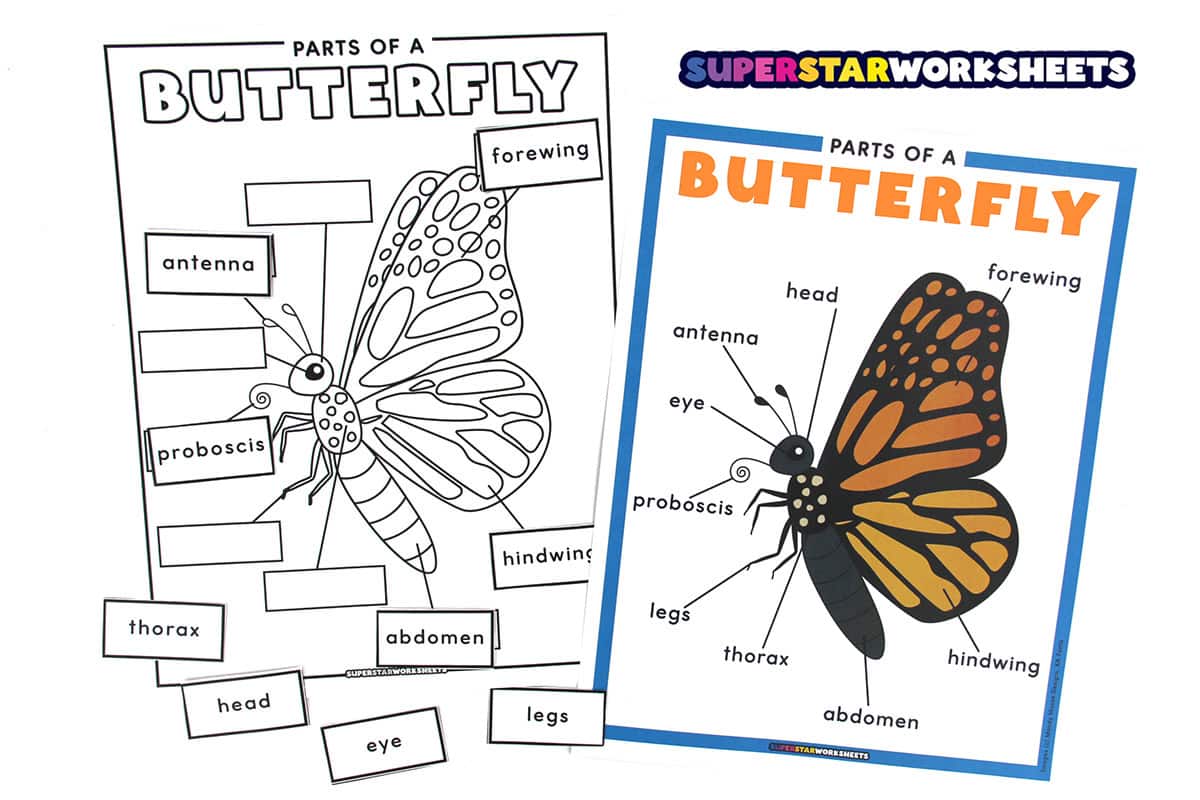
Teaching Tip: Have students fold a paper butterfly cutout in half to see symmetry in action, then compare it to the diagram above.
Butterfly Life Cycle Printables
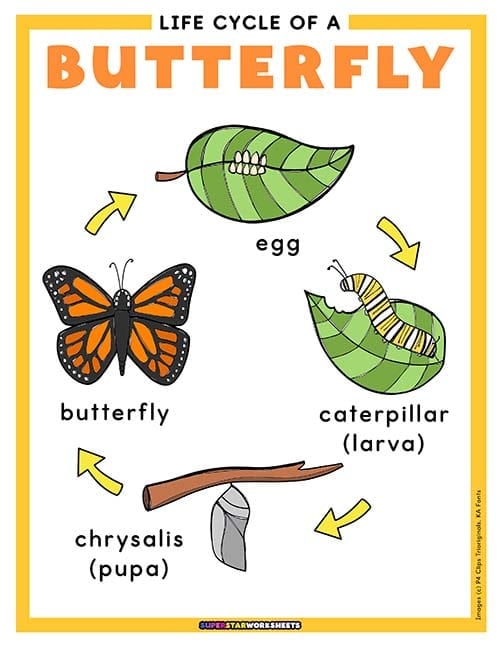
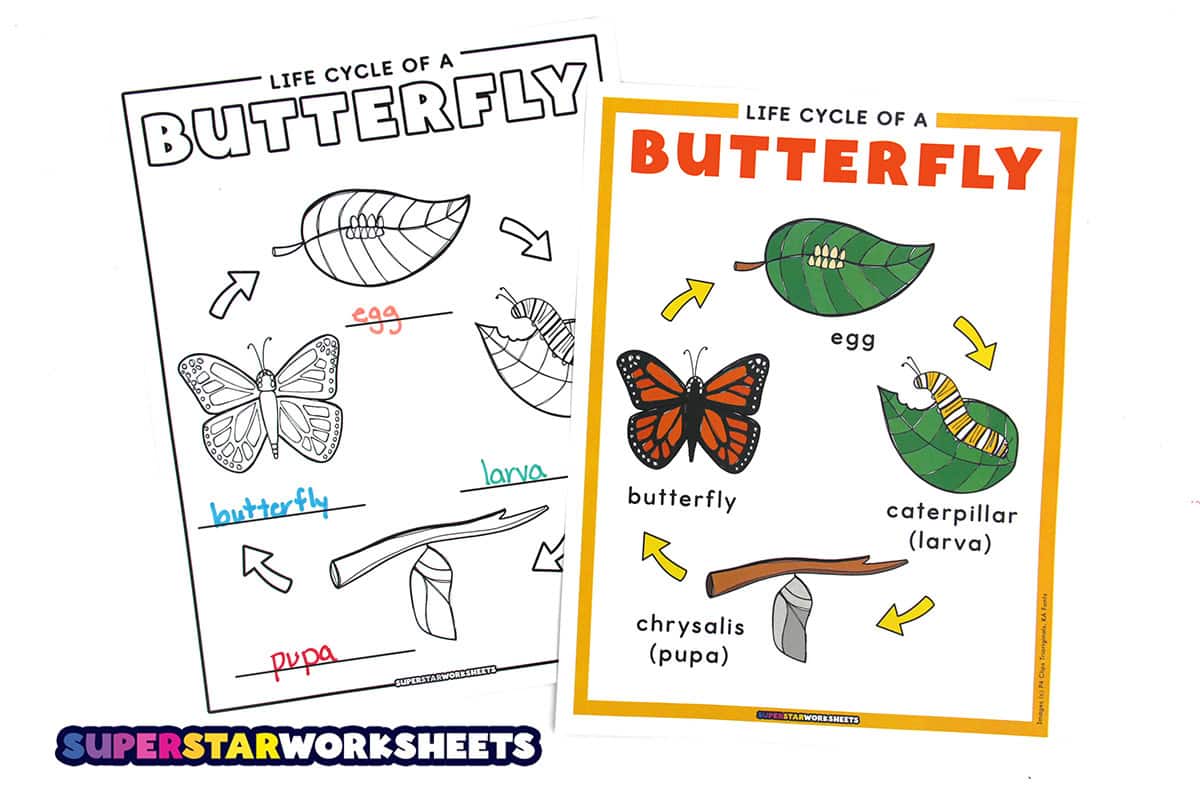
Download and print this free, full color PDF poster chart featuring the four stages of the butterfly life cycle. From egg to adult butterfly, this anchor chart serves as a wonderful classroom reference tool or helpful visual in your science journals. For more FREE printables check out our Leaf Worksheets!
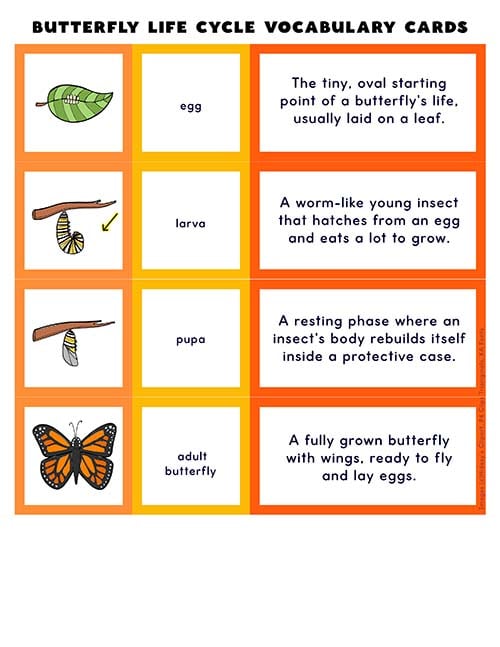
Butterfly Life Cycle Vocabulary Cards
Students practice matching each stage of the butterfly life cycle to the correct vocabulary term and a simple definition. This set is a wonderful resource for science learning centers, memory match, or concentration games for elementary students.
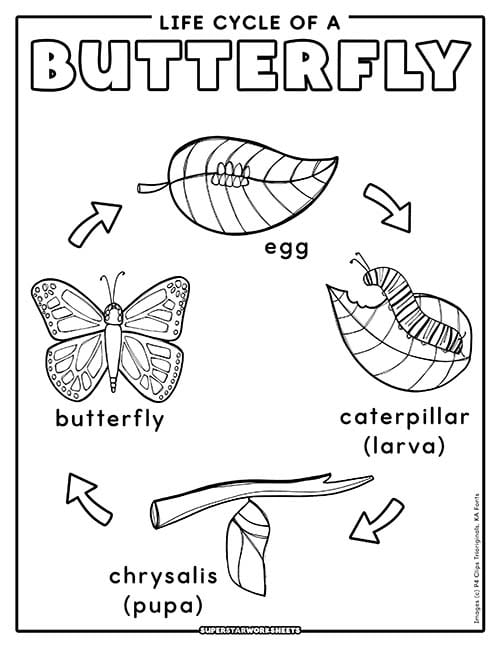
Butterfly Life Cycle Coloring Page
Students can color this simple, black outline life cycle coloring sheet. Students color each of the four stages in a butterfly’s life: egg, caterpillar, chrysalis, and butterfly.
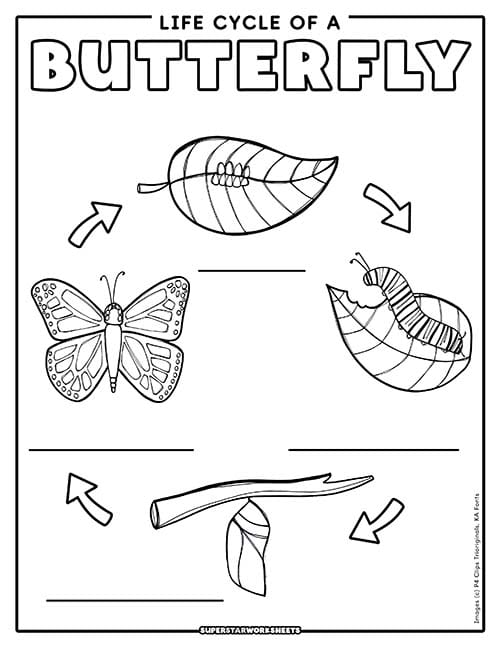
Butterfly Life Cycle Label Worksheet
Free printable butterfly life cycle labeling worksheet for students to practice writing in the correct vocabulary term for each stage of development. This black and white PDF is a helpful way for students to review and label each growth stage.
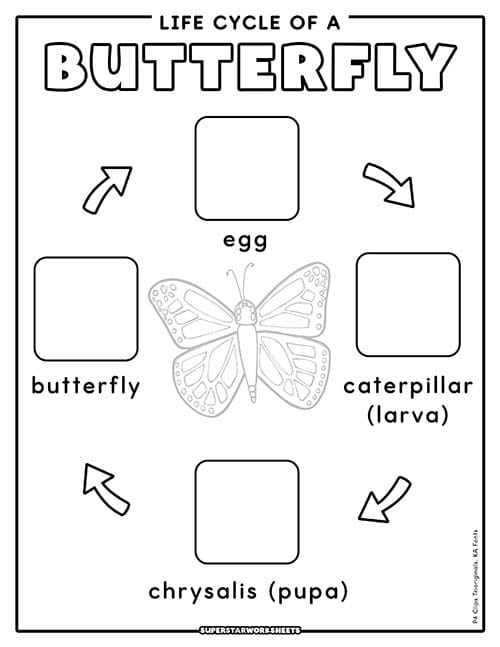
Butterfly Life Cycle Cut & Paste Worksheet
Free printable butterfly life cycle cut and paste activity. Students cut out each stage of the life cycle and paste it into the correct order on the life cycle circle, then use the matching clipart strip to practice sequencing again.
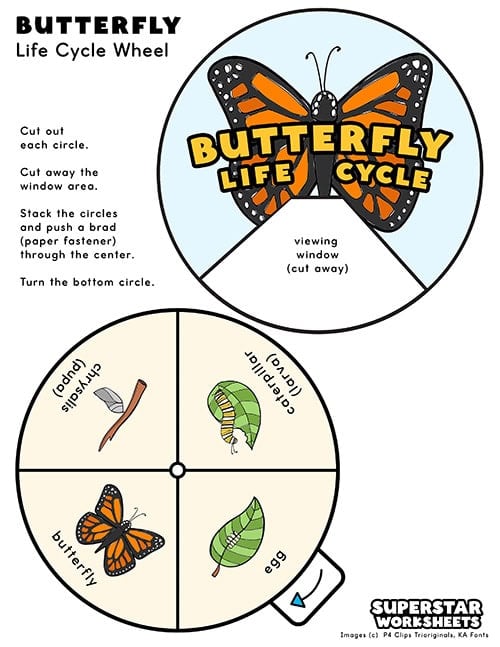
Printable butterfly life cycle wheel featuring all four stages of butterfly growth. Students color, cut, and assemble the wheel, then spin it to review the order of the life cycle. Teachers! If you are needing more free printable butterfly worksheets, check out our Butterfly Coloring Pages!
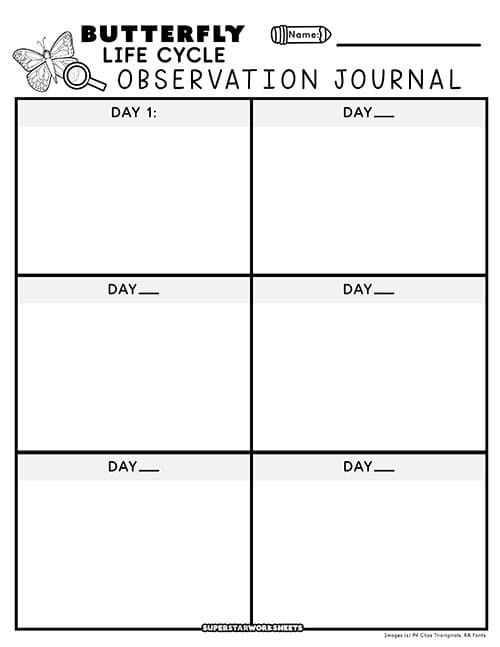
Pair this printable observation journal with a classroom butterfly garden kit to help students record real-time changes as their caterpillars grow. Students draw and describe what they notice each day, then summarize all four life cycle stages they observed in order. Pair with Insect Lore Raise and Release Butterfly Garden Kit!
Teaching the Butterfly Life Cycle
Butterflies go through complete metamorphosis, a dramatic change in body form as they grow. It begins with a tiny egg, usually laid on a leaf. From the egg hatches a larva, more commonly called a caterpillar, a worm-like creature that eats constantly to grow. Next, the caterpillar forms a pupa, which for a butterfly is called a chrysalis or a hard, protective case where its body rebuilds itself completely. Finally, a fully grown adult butterfly emerges, ready to fly and lay eggs of its own.
Teaching Tip: Pair this unit with a classroom butterfly garden kit so students can observe real metamorphosis and record their findings in the Butterfly Observation Journal above.
Butterfly Adaptations Printables
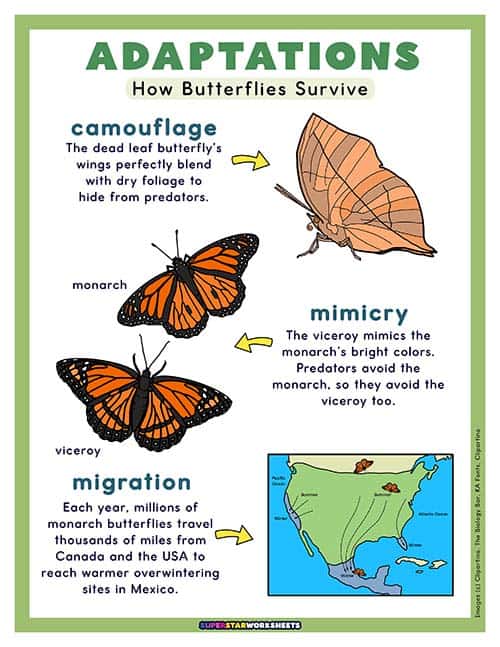
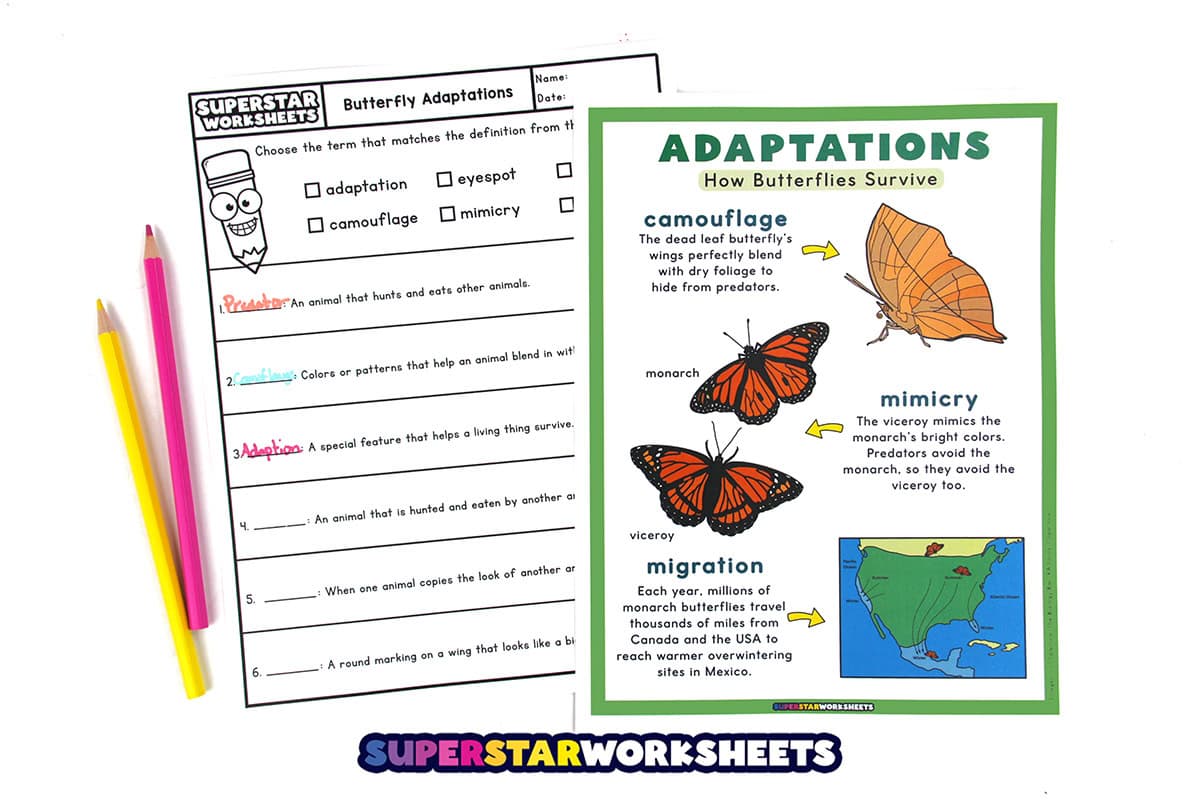
Download this full color infographic poster explaining three ways butterflies stay safe: camouflage, mimicry, and migration. This engaging classroom poster is a great introduction before diving into individual adaptation worksheets and activities.
Hide the Butterfly Camouflage Activity
Students apply the concept of camouflage with this hands-on classroom activity. Kids color a blank butterfly template to match a hiding spot in the classroom, tape it up, and challenge their classmates to find it.
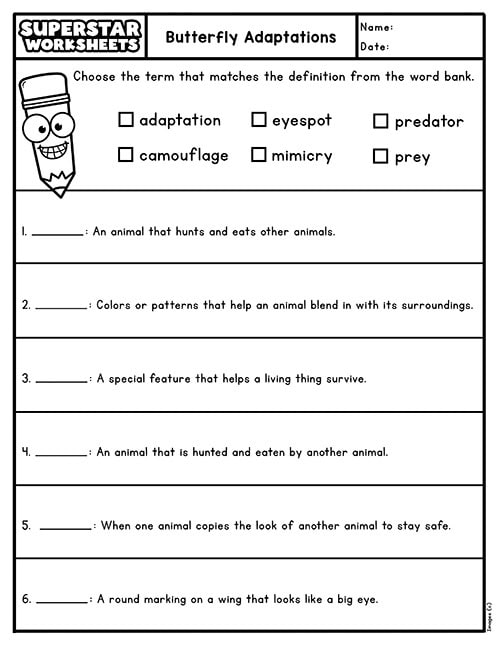
Butterfly Adaptations Worksheet
Free printable butterfly adaptations worksheet where students fill in the blank with the correct vocabulary term for each definition. This is a great way to review camouflage, mimicry, predator, prey, eyespot, and adaptation vocabulary.
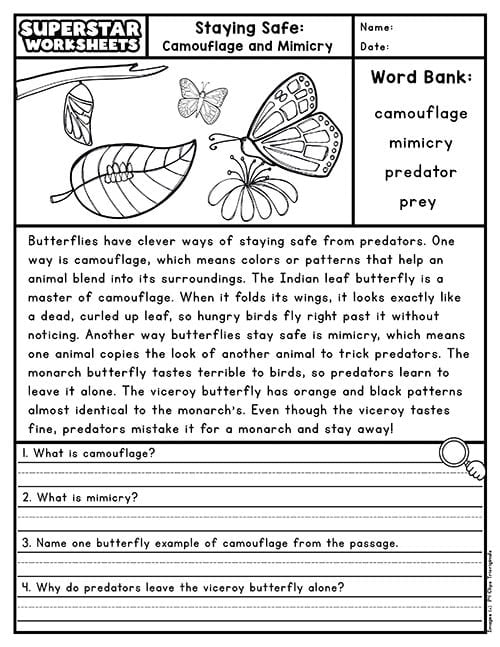
Staying Safe: Camouflage and Mimicry Reading Comprehension
Free printable reading passage and comprehension worksheet about how butterflies use camouflage and mimicry to stay safe from predators. Students read about the Indian leaf butterfly and the viceroy butterfly, then answer questions to check understanding.
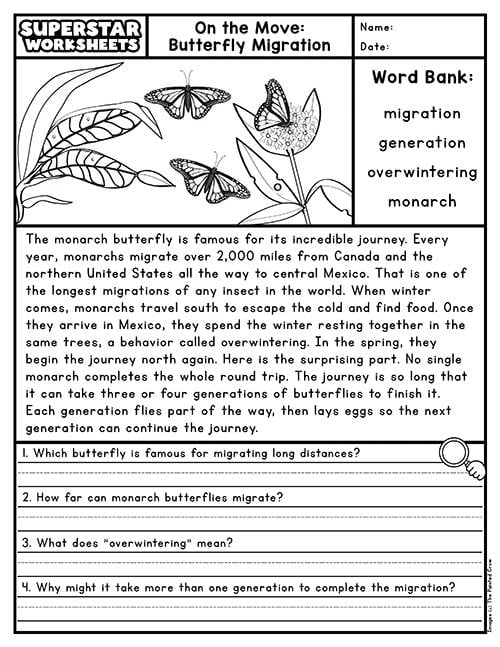
On the Move: Butterfly Migration Reading Comprehension
Free printable reading passage and comprehension worksheet about monarch butterfly migration. Students learn how far monarchs travel, what overwintering means, and why it takes multiple generations to complete the journey.
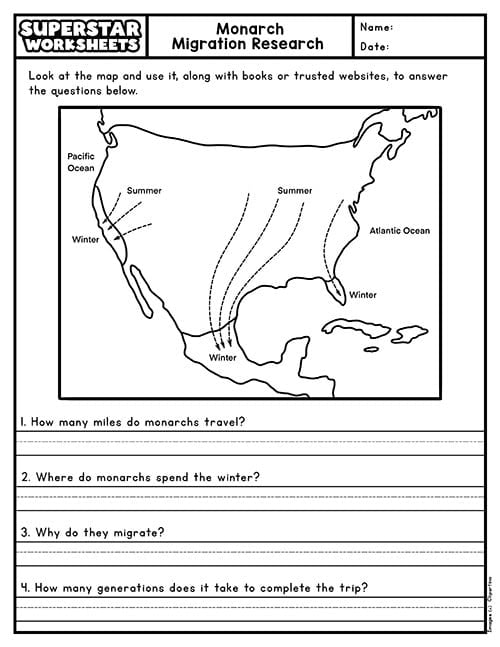
Monarch Migration Research Page
Students use a simple migration map along with books or trusted websites to answer guided research questions about monarch butterfly migration. A great follow-up activity after the migration reading comprehension worksheet.
Teaching Butterfly Adaptations: Camouflage, Mimicry & Survival
Butterflies have clever ways of staying safe from predators. One is camouflage, colors or patterns that help a butterfly blend into its surroundings, like the Indian leaf butterfly’s folded wings look just like a dead leaf. Another is mimicry, when one animal copies the look of another to trick predators, like the viceroy butterfly copying the monarch’s bright pattern. Some butterflies even have an eyespot, a marking that looks like a big eye to startle predators away. Beyond staying hidden, some butterflies rely on migration to survive. The monarch butterfly travels incredible distances between generations, resting together during the winter months in a behavior called overwintering.
Teaching Tip: Use the Hide the Butterfly activity above as a kinesthetic way to reinforce how camouflage works before moving into the reading comprehension worksheets.
Butterfly Science Facts for Kids
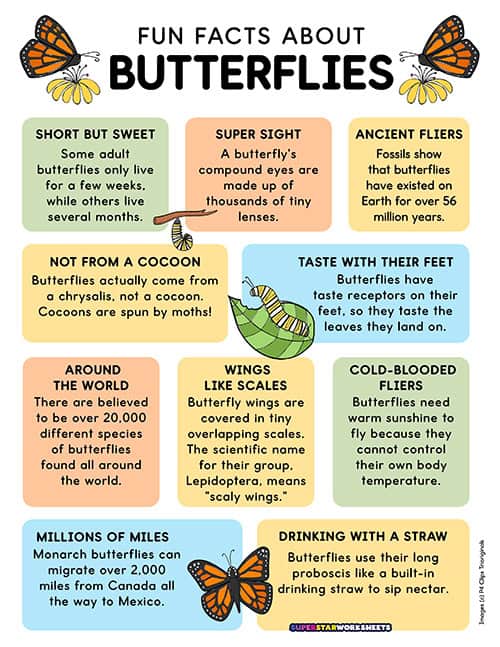
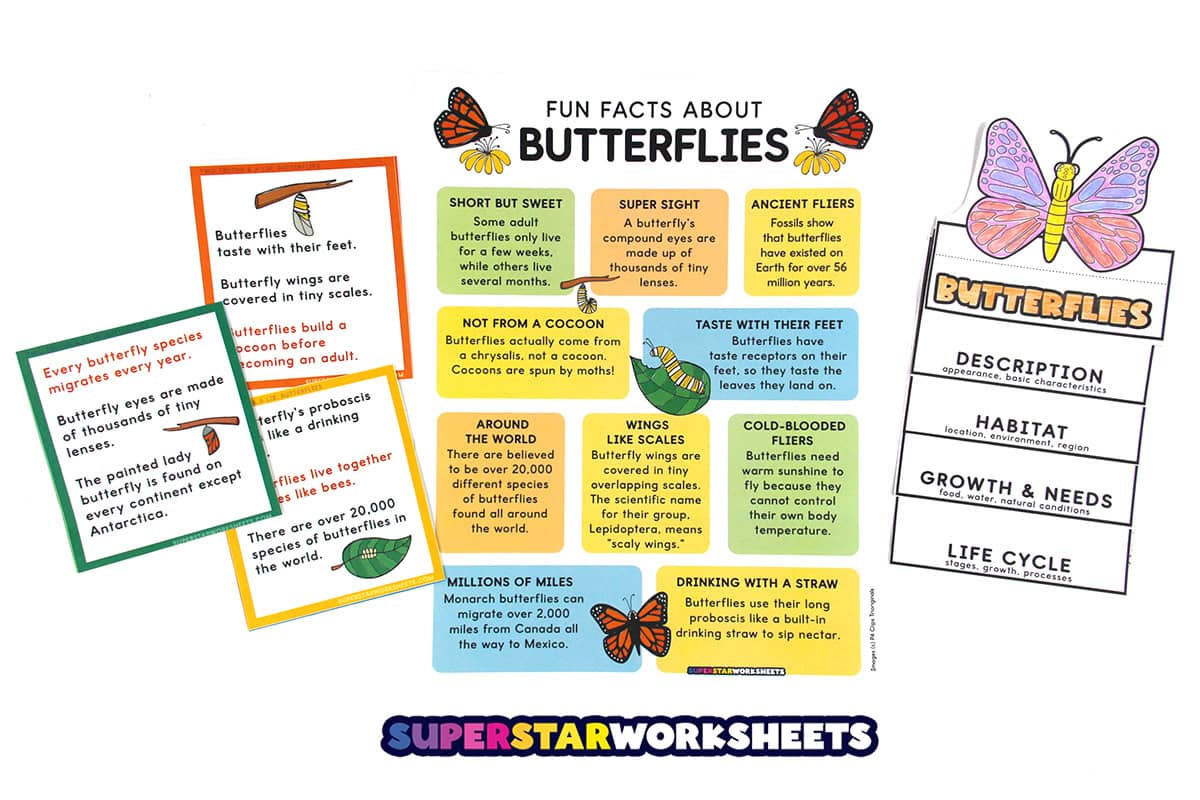
Colorful infographic poster featuring 10 fun and surprising facts about butterflies. A wonderful whole-class reference for a butterfly unit study or science center.
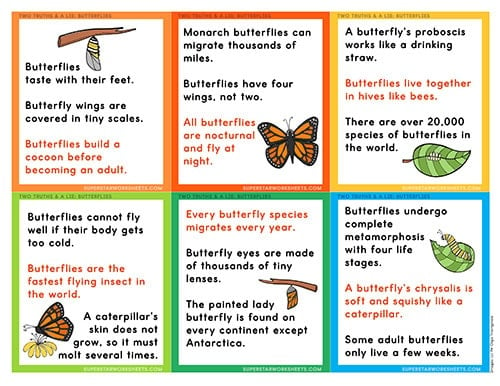
Two Truths and a Lie: Butterflies
Teachers read outloud three butterfly statements per card and students decide which one is the lie. A fun, engaging way to review butterfly facts as a whole class or in small groups. Need more free butterfly printables? Try our How to Draw a Butterfly printables!
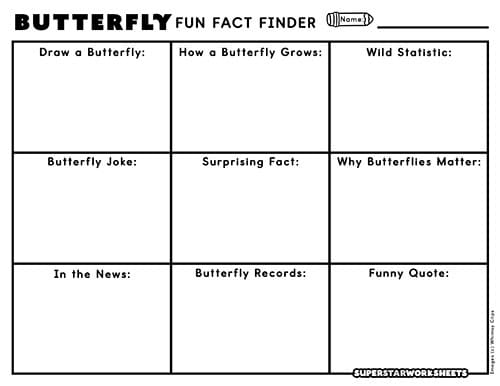
Free printable research worksheet with 9 fun prompts for students to explore and record butterfly facts. A great independent research activity for a butterfly unit study.
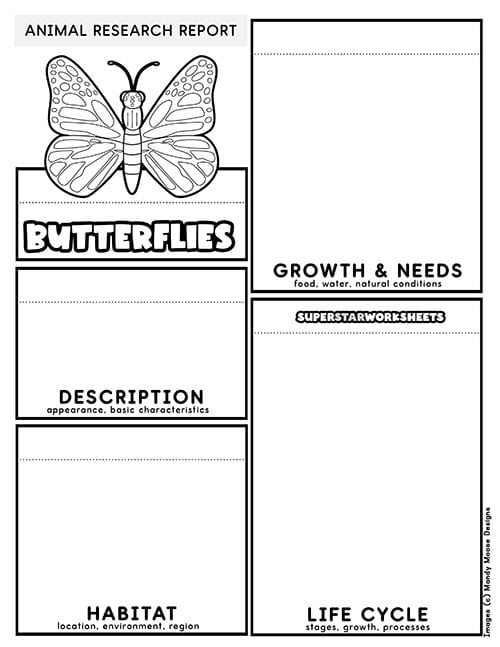
Butterfly Animal Research Report
Free printable animal research report template for students to research and record facts about butterflies. Students complete four sections: description, habitat, growth and needs, and life cycle.
Amazing Butterfly Facts
Butterflies are full of surprises! Explore these fun facts with your students:
- Not From a Cocoon: Butterflies actually come from a chrysalis, not a cocoon. Cocoons are spun by moths!
- Taste With Their Feet: Butterflies have taste receptors on their feet, so they taste the leaves they land on.
- Short but Sweet: Some adult butterflies only live for a few weeks, while others live several months.
- Millions of Miles: Monarch butterflies can migrate over 2,000 miles from Canada all the way to Mexico.
- Super Sight: A butterfly’s compound eyes are made up of thousands of tiny lenses.
- Drinking with a Straw: Butterflies use their long proboscis like a built-in drinking straw to sip nectar.
- Cold-Blooded Fliers: Butterflies need warm sunshine to fly because they cannot control their own body temperature.
- Ancient Fliers: Fossils show that butterflies have existed on Earth for over 56 million years.
- Wings Like Scales: Butterfly wings are covered in tiny overlapping scales. The scientific name for their group, Lepidoptera, means “scaly wings.”
- Around the World: There are believed to be over 20,000 different species of butterflies found all around the world.
Teaching Tip: Use these facts as a daily “Butterfly Fact of the Day” warm-up, or turn them into a Two Truths and a Lie challenge with the game above.
Comments (2)
Thank you! These will work perfect for my daughter’s butterfly week!
thank you. This will come handy for our butterfly farm visit.