
Free printable seed worksheets for elementary students! Download and print our Parts of a Seed PDF diagrams, labeling activities, vocabulary cards, and cut and paste worksheets. Explore types of seeds and sizes with sorting mats and identification activities, then dive into seed dispersal with charts, sorting games, and a circle book covering all six ways seeds travel. Finish your seed unit study with fun seed science facts, research activities, and a hands-on seed germination experiment for kids. Everything you need to teach seeds is available as a free PDF download below.
Parts of a Seed Printables
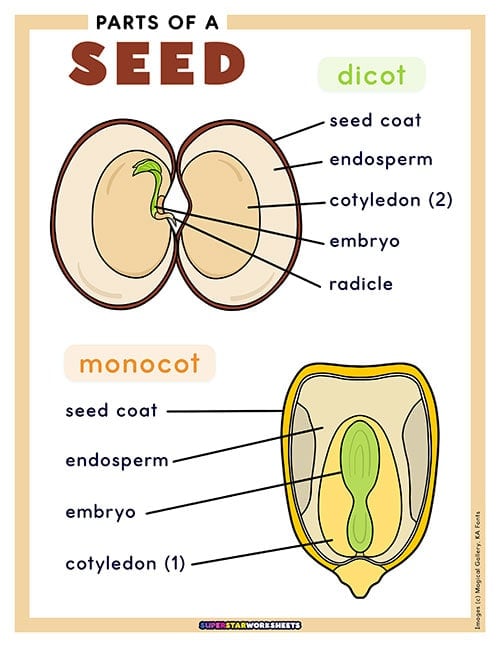
Download and print this full-color Parts of a Seed diagram featuring a side-by-side comparison of a corn seed (monocot) and a bean seed (dicot). This classroom-ready anchor chart labels all key seed parts in lowercase for early readers and clearly identifies each seed type. Use as a reference poster during seed science lessons or hang near your science center.
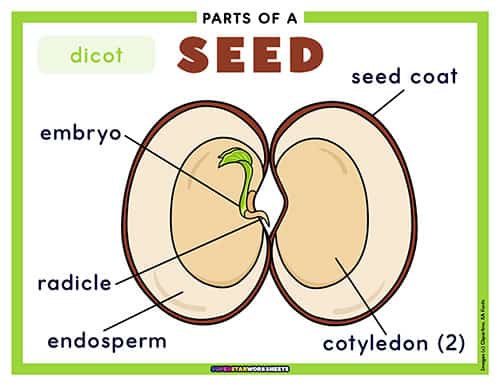
Free printable keyword…..download, print, pdf, as well as keyword variations, modifiers, and adjacent.
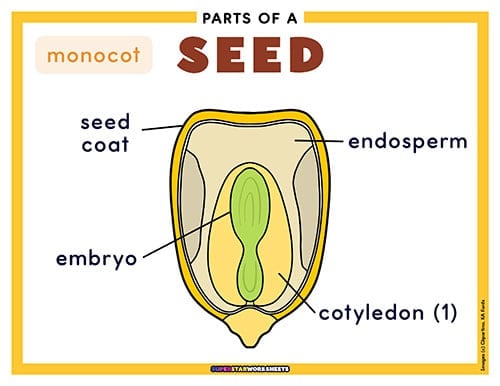
Free printable keyword…..download, print, pdf, as well as keyword variations, modifiers, and adjacent.
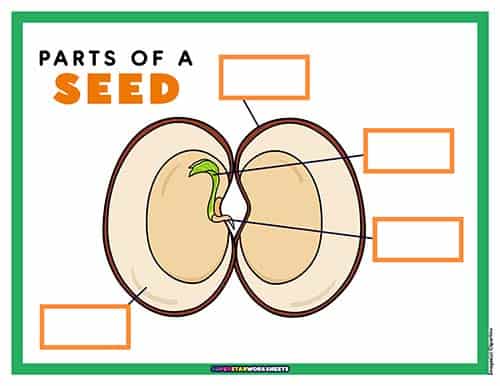
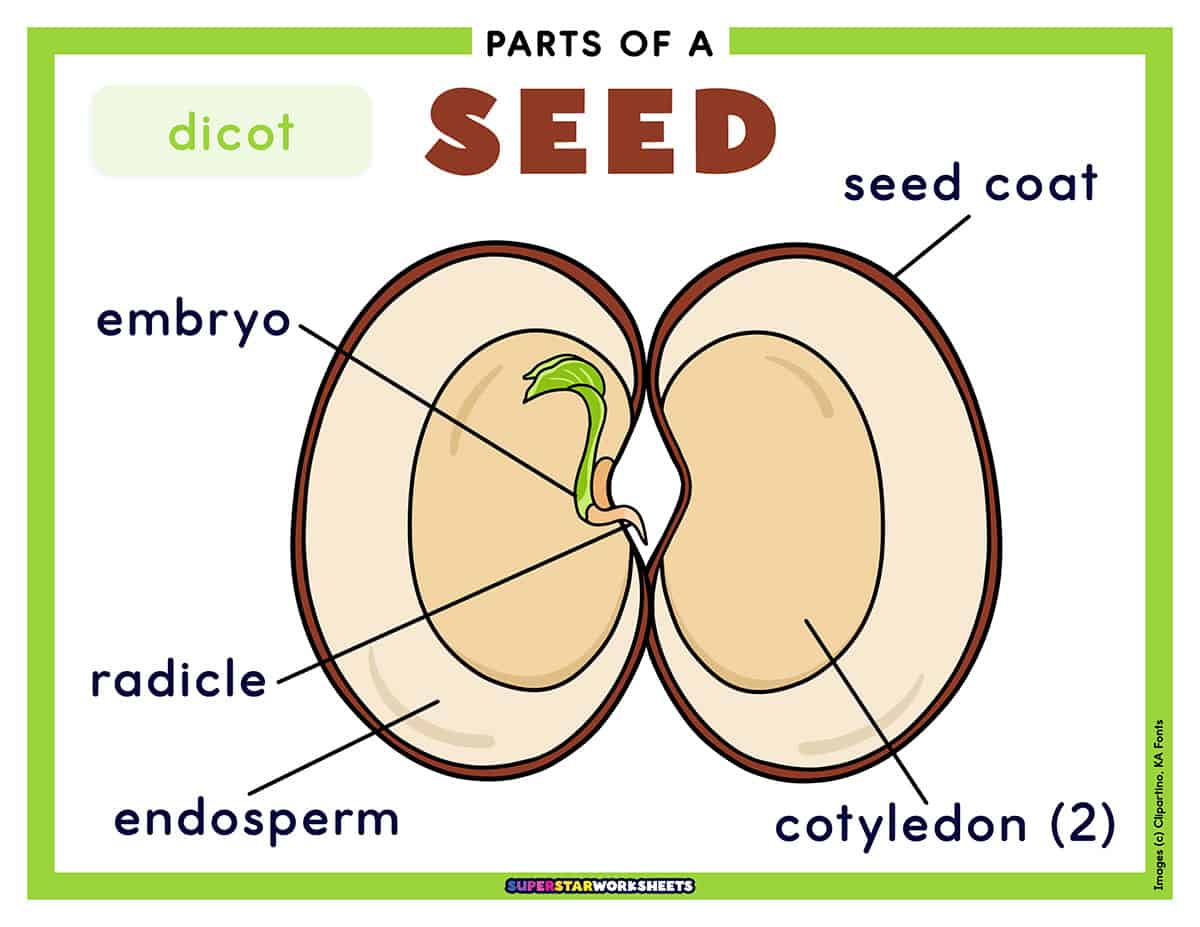
Students practice labeling the parts of a seed with this reusable hands-on learning mat. This non-consumable set features a blank bean seed cross-section diagram and printable label cards for seed coat, embryo, cotyledon, and radicle. Laminate for repeated use in science centers or small group activities.
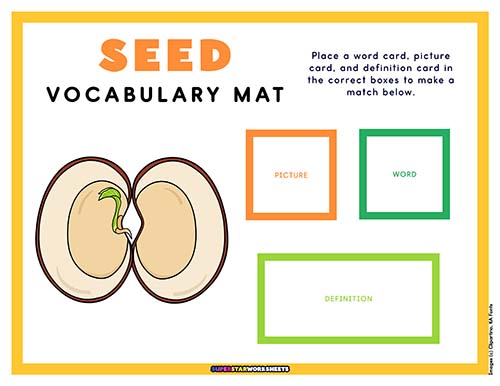
Build seed science vocabulary with this reusable three-part card matching mat. Students place picture cards, word cards, and definition cards in the correct boxes to make a match. This learning center activity works with both the seed parts vocabulary cards and the seed dispersal vocabulary cards.
Parts of a Seed Vocabulary Cards
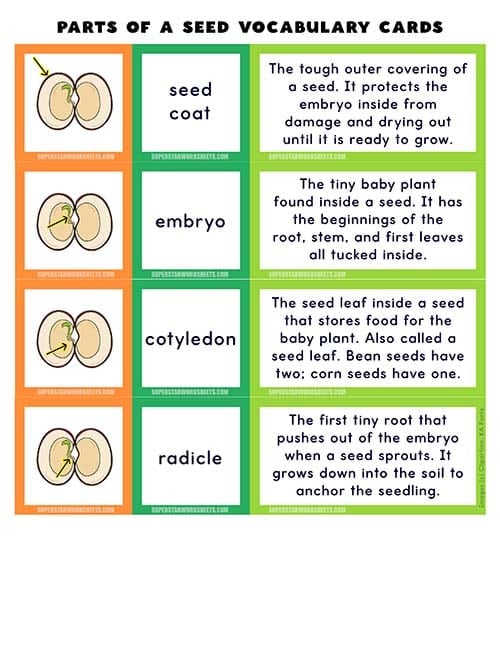
Students learn the parts of a seed with these printable three-part vocabulary cards featuring a picture, word, and definition for each term. This set covers seed coat, embryo, cotyledon, radicle, monocot, and dicot. Use with the vocabulary mat or as a standalone matching activity. For more free printables, take a look at our Plant Worksheets!
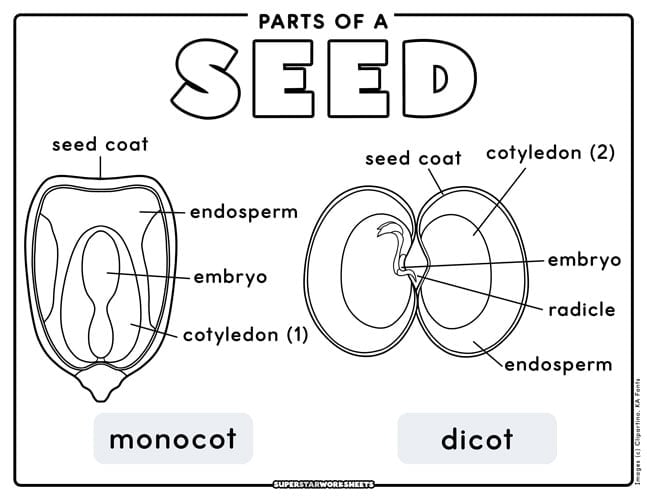
Students color and study the parts of a seed with this black and white dual diagram showing a corn seed and a bean seed side by side. All parts are labeled in lowercase for early readers. Use as a follow-up to the full-color chart or as a take-home reference page
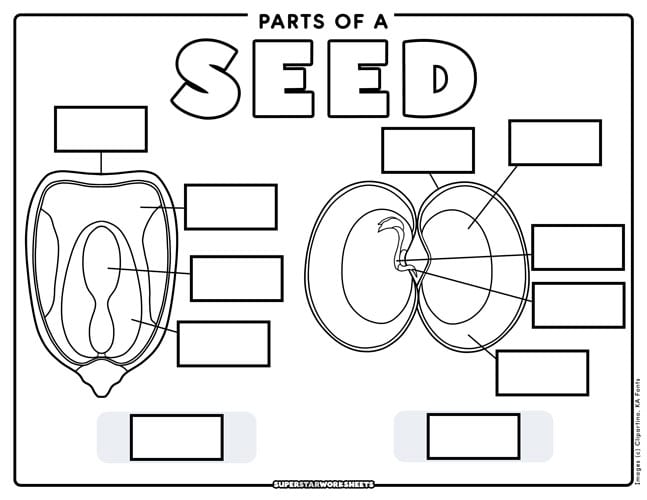
Label the Parts of a Seed Worksheet
Students cut out seed part labels and paste them onto blank corn and bean seed diagrams with this printable labeling activity. This differentiated worksheet builds vocabulary and diagram skills for seed coat, embryo, cotyledon, radicle, monocot, and dicot. Great for science notebooks or assessment.
Seed Cross-Section Coloring Page
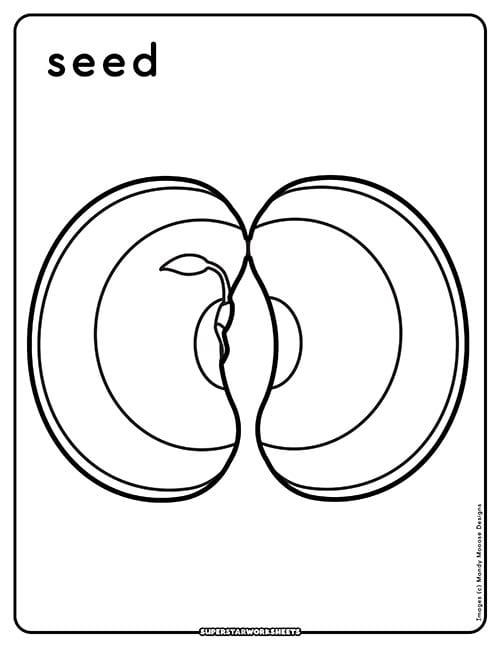
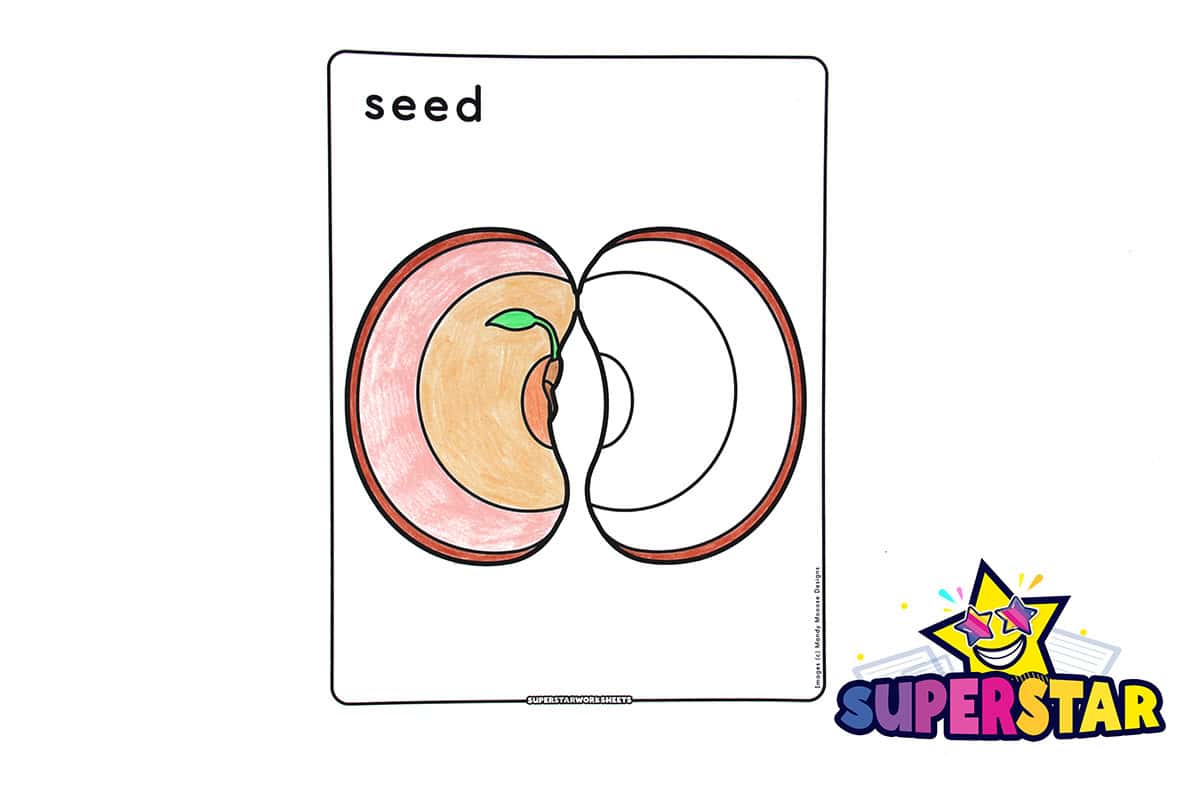
Preschool and kindergarten students can color this simple seed cross-section coloring page featuring a large bean seed interior. Bold outlines and a simple design make this perfect for early learners who are just beginning to explore what is inside a seed.
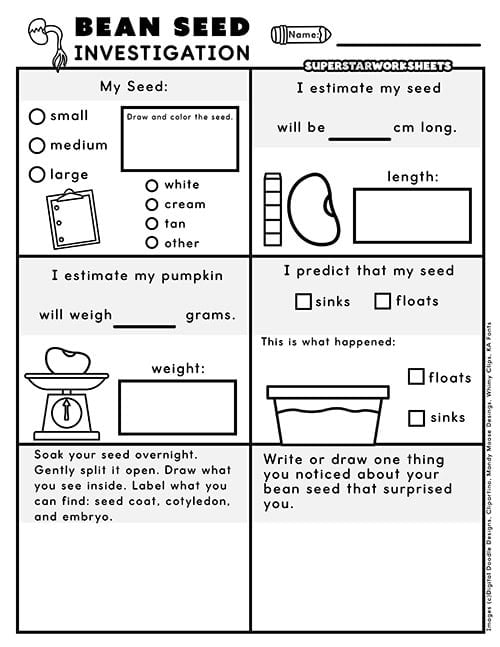
Bean Seed Investigation Worksheet
Students observe, measure, and dissect a real bean seed with this hands-on science investigation sheet. Six guided observation sections lead students through size, color, length, weight, sink or float testing, and a seed dissection drawing. A memorable, concrete introduction to seed anatomy.
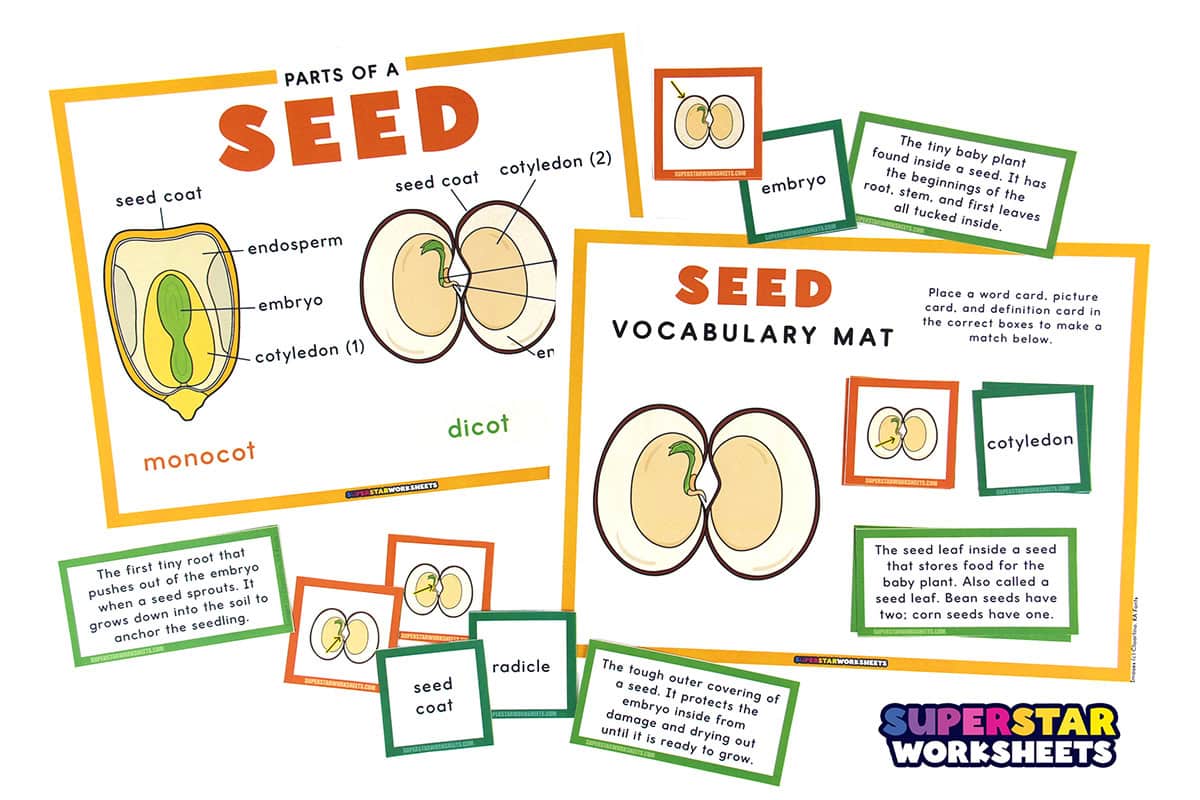
Teaching the Parts of a Seed
Every seed contains the same three essential parts: a seed coat, an embryo, and a cotyledon. Understanding these parts helps students connect structure to function and builds the foundation for understanding germination and plant growth.
The seed coat is the tough outer covering that wraps around and protects everything inside. It keeps the embryo safe from damage, disease, and drying out until conditions are right for the seed to sprout. The embryo is the tiny baby plant tucked inside the seed. It contains the beginnings of the root, the stem, and the first leaves, everything the new plant will need to begin growing. The cotyledon, also called the seed leaf, stores the food energy the embryo will use during germination before the seedling can make its own food through photosynthesis.
One of the most engaging concepts for young learners is the difference between monocots and dicots. Monocots, like corn, have only one cotyledon inside their seeds. Dicots, like beans, have two. Students can discover this for themselves by soaking a bean seed overnight and gently splitting it in half. The two halves are the two cotyledons, and the tiny embryo is visible at one end. The radicle is the embryonic root, the very first root to emerge from the seed when it sprouts. It appears on the bean seed diagram as a reference term for students who are ready for more detail.
Teaching Tip: Soaking lima bean seeds or kidney bean seeds overnight before your lesson makes them easy to split and examine. Provide plastic knives or toothpicks for students to gently open their own seeds. Have students draw what they see before introducing the vocabulary terms, this observation-first approach deepens retention.
Parts of a Seed Vocabulary
seed coat: The tough outer covering of a seed that protects the embryo inside from damage and drying out.
embryo: The tiny baby plant found inside a seed. It contains the beginnings of the root, stem, and leaves.
cotyledon: The seed leaf inside a seed that stores food energy for the sprouting plant. Also called a seed leaf.
radicle: The first root that grows out of the embryo when a seed sprouts. It anchors the seedling into the soil.
monocot: A type of flowering plant whose seeds contain one cotyledon. Corn is a common example.
dicot: A type of flowering plant whose seeds contain two cotyledons. Beans are a common example.
Types of Seeds Worksheets
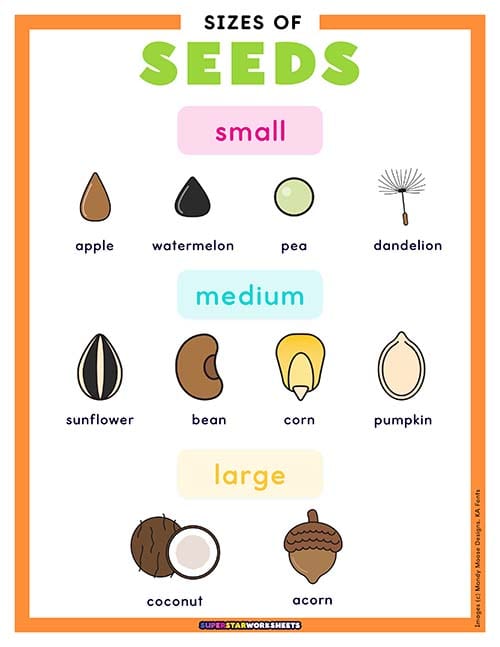
Download this full-color sizes of seeds reference chart featuring ten labeled seed illustrations organized into small, medium, and large categories. Students learn to identify sunflower seeds, bean seeds, pea seeds, corn seeds, apple seeds, pumpkin seeds, watermelon seeds, acorns, dandelion seeds, and coconuts by sight. A great anchor chart for any seed science unit.
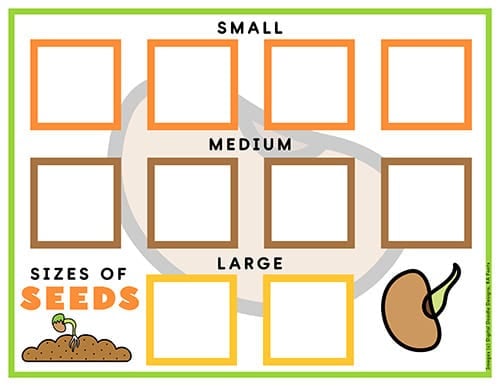
Students sort ten seed picture cards into small, medium, and large categories on this reusable sorting mat. Laminate the mat and cards for use in science centers or small group instruction. This hands-on seed activity builds classification skills and introduces students to the variety of seed sizes found in nature.
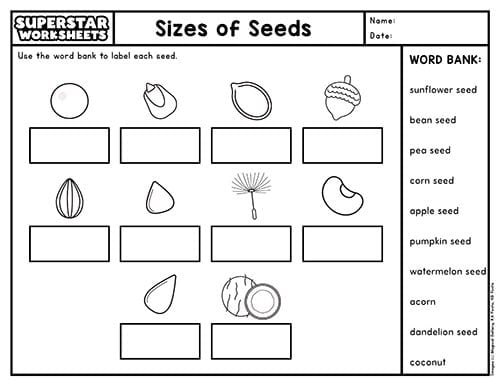
Students use the word bank to identify and label ten seed illustrations on this printable seed identification worksheet. Featuring all ten seed types from the chart and sorting mat, this activity reinforces seed vocabulary and visual recognition skills. Great for science notebooks or independent practice.
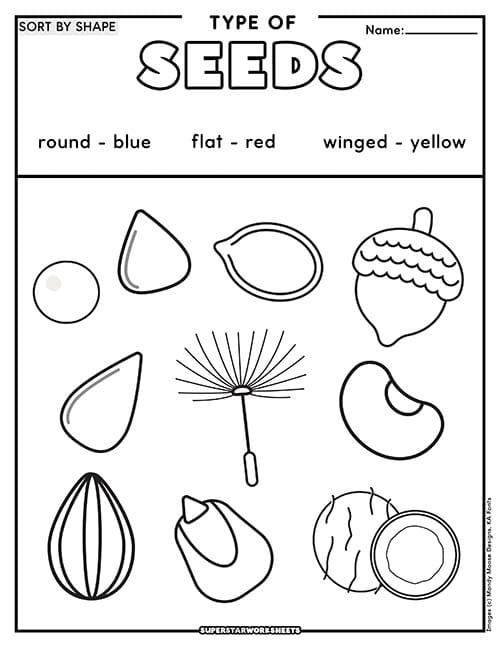
Students categorize seeds by shape and color them by code on this engaging printable activity. Seeds are sorted into three shape groups as students color each seed according to the key. A fun and visual way to explore how seed shapes connect to how seeds travel.
Teaching Types of Seeds
Seeds come in a remarkable variety of shapes, sizes, and textures. Each of those features serves a purpose. Helping students observe and classify seeds builds foundational science skills in sorting, comparing, and connecting structure to function.
Small seeds like pea seeds, apple seeds, dandelion seeds, and watermelon seeds are light and compact. Medium seeds like sunflower seeds, bean seeds, corn seeds, and pumpkin seeds are some of the most familiar to young learners, many can be found in a kitchen pantry. Large seeds like acorns and coconuts are heavy and nutrient-rich, built to survive long journeys or deep burial. The shape of a seed often tells us something about how it travels: round seeds may roll, flat seeds may stack closely in a pod, and feathery or winged seeds like dandelion seeds are built to float on the wind.
The color-by-shape activity in this collection introduces students to the connection between seed shape and seed dispersal.
Teaching Tip: Bring in a small collection of real seeds for a seed sort before the worksheets. A mix of pumpkin seeds, sunflower seeds, pea seeds, dried beans, and acorns gives students something concrete to observe, sort, and discuss before moving to pencil-and-paper activities.
Types of Seeds Vocabulary
sunflower seed: A medium-sized, flat seed with a striped shell that grows in the center of a sunflower.
bean seed: A medium-sized, oval-shaped dicot seed with a smooth coat and two cotyledons inside.
pea seed: A small, round, smooth seed that grows inside a pea pod.
corn seed: A medium-sized, flat, yellow monocot seed (kernel) that grows in rows on a corncob.
acorn: The large, round seed of an oak tree, topped with a bumpy cap.
dandelion seed: A tiny, lightweight seed attached to a fluffy white parachute that floats on the wind.
coconut: The very large, round seed of a coconut palm tree with a thick, buoyant husk.
Seed Dispersal Worksheets
How Seeds Travel: Seed Dispersal Methods Chart
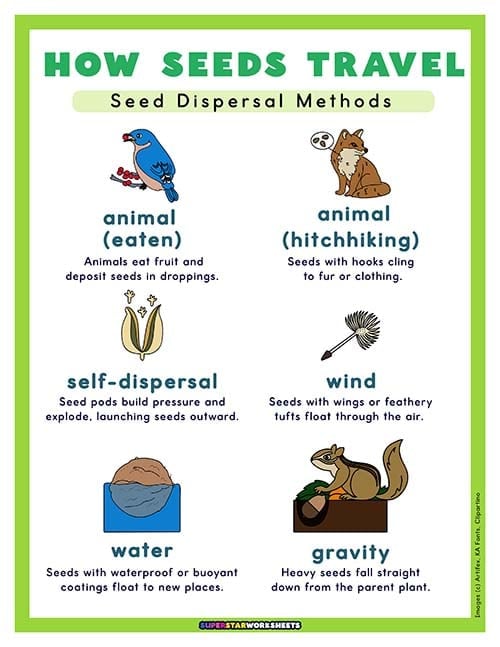
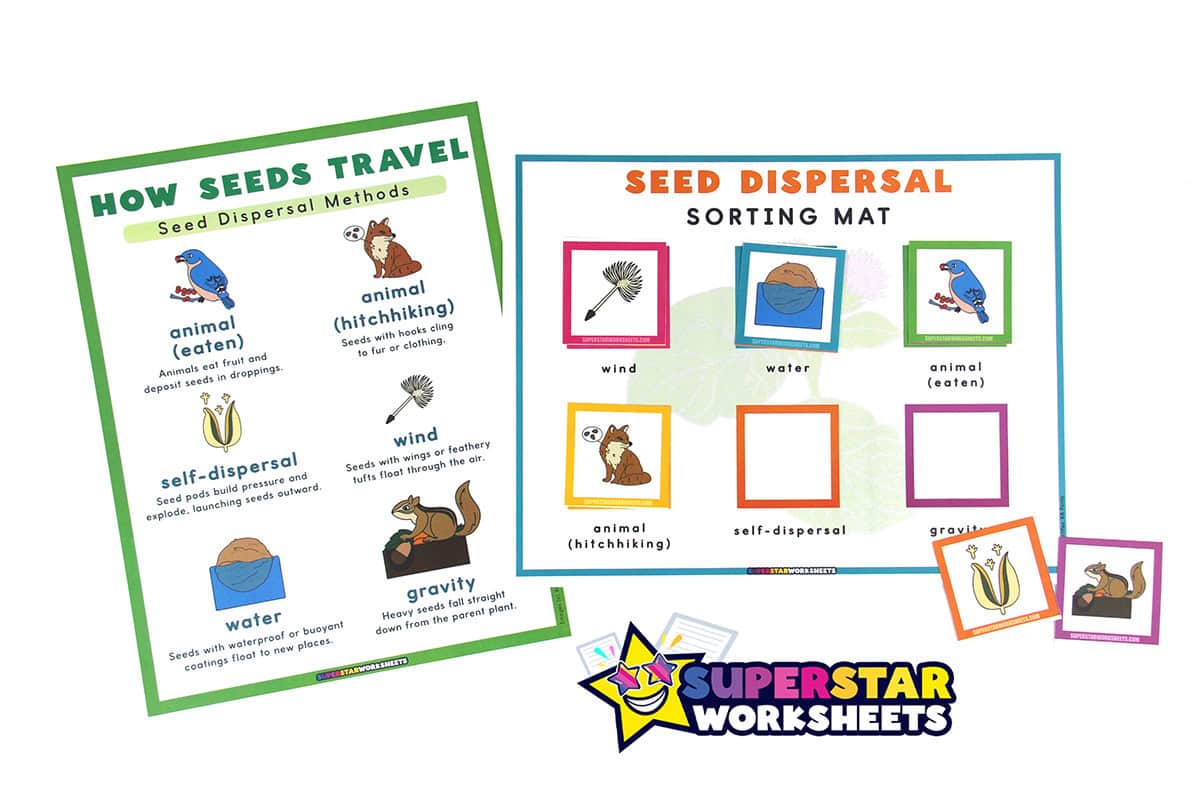
Download and print this full-color seed dispersal methods chart featuring all six ways seeds travel away from their parent plant. Each method is shown with an illustration, a bold label, and a one-sentence description. This anchor chart covers wind, water, animal (eaten), animal (hitchhiking), self-dispersal, and gravity dispersal.
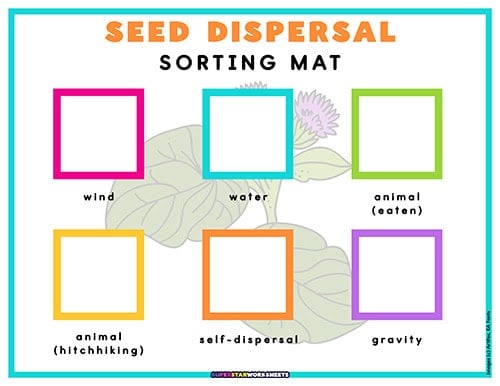
Students sort twelve seed example cards onto a reusable six-section seed dispersal sorting mat. This hands-on seed dispersal activity covers dandelion, maple samara, coconut, lotus, berry, apple, burr, sticker weed, touch-me-not, witch hazel, acorn, and chestnut. Laminate for repeated use at science stations.
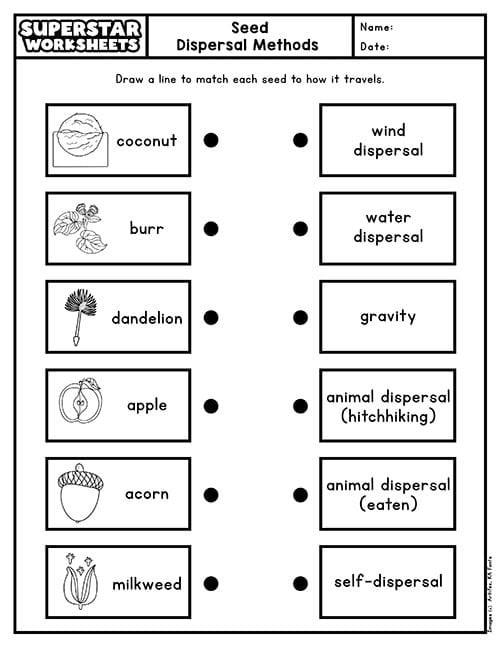
Students draw a line to match each seed or plant to its correct dispersal method on this printable seed dispersal matching worksheet. Featuring six seed examples and six dispersal method labels, this activity reinforces the vocabulary and concepts introduced in the dispersal chart. For more FREE printable science worksheets take a look at our Flower Worksheets.
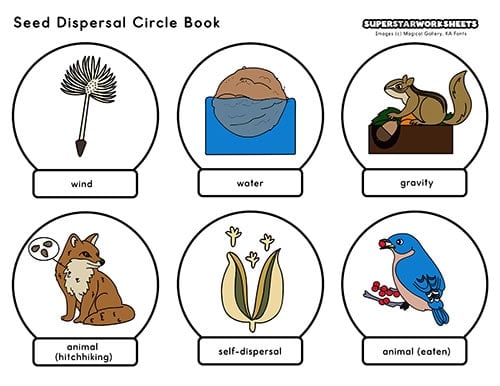
Students create a six-circle seed dispersal book featuring one dispersal method per circle. Each circle includes a clipart illustration and the dispersal method label. Students color, cut, and assemble this take-home reference tool covering wind, water, gravity, animal (hitchhiking), self-dispersal, and animal (eaten).
Teaching How Seeds Travel
If seeds fell straight down from every parent plant, new plants would be crowded together and compete for the same light, water, and nutrients. Dispersal is the movement of seeds away from the parent plant. Seeds have evolved a remarkable variety of strategies for reaching new places to grow.
Wind dispersal is one of the most familiar methods for young learners. Dandelion seeds ride tiny feathery parachutes called pappus that catch the breeze. Maple seeds, called samaras, have a wing-like structure that makes them spin like helicopters as they fall, slowing their descent and allowing the wind to carry them. Water dispersal is used by seeds with waterproof or buoyant coatings. The coconut is the most dramatic example. Its thick, fibrous husk allows it to float across entire oceans and still germinate when it washes ashore. Animal dispersal happens two ways: some animals eat fruit and later deposit the seeds in their droppings far from the parent plant. Others unknowingly carry seeds when a burr or spiny seed clings to their fur or clothing. The tiny hooks on a burr are one of nature’s most effective hitchhiking tools.
Self-dispersal is perhaps the most dramatic method. Plants like the touch-me-not build up hydraulic pressure inside their seed pods until the pod suddenly explodes, launching seeds outward at high speed. Gravity dispersal is the simplest method. Heavy seeds like acorns and chestnuts simply fall from the plant and land on the ground below, sometimes rolling a short distance away.
Teaching Tip: Have students test wind dispersal by blowing a dandelion seed head or dropping a paper samara from shoulder height. Ask: which seeds traveled the farthest? Which stayed closest to where they started? Connecting the activity to the seed dispersal chart before sorting reinforces the vocabulary and builds observation skills.
Seed Dispersal Vocabulary
dispersal: The process of seeds spreading away from the parent plant to a new place where they can grow.
wind dispersal: When seeds are carried to a new place by the wind. Examples: dandelion, maple samara.
water dispersal: When seeds float on water to reach a new location. Example: coconut.
animal dispersal: When animals carry seeds by eating fruit and depositing seeds in droppings, or by carrying seeds on their fur or clothing.
self-dispersal: When a plant launches its own seeds by building pressure in a seed pod that explodes open. Example: touch-me-not.
gravity: When heavy seeds fall from the parent plant straight to the ground below. Example: acorns, chestnuts.
burr: A prickly seed covering with tiny hooks that cling to fur or clothing to travel to new places.
samara: A winged seed structure shaped like a helicopter blade. Example: maple tree seed.
seed pod: A protective case that holds seeds inside until they are ready to be released.
Seed Science Facts for Kids
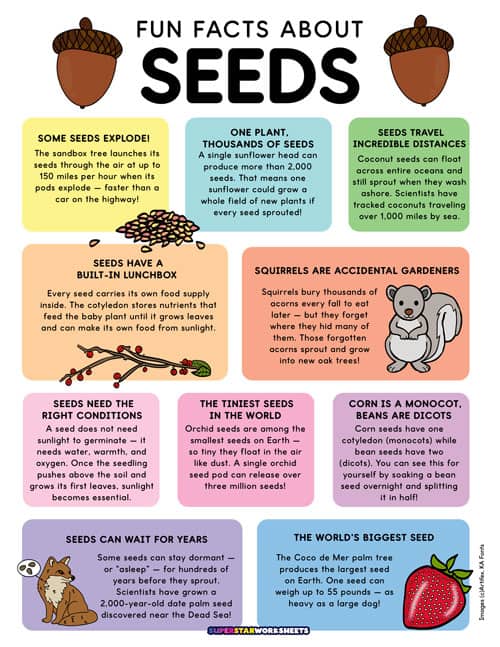
Fun Facts About Seeds for Kids
Download and print this colorful seed science facts poster featuring ten illustrated fact blocks with bold titles and full-sentence facts. Hang near your science center or use as a read-aloud reference during seed science lessons. A great introduction to the Seed Research section.
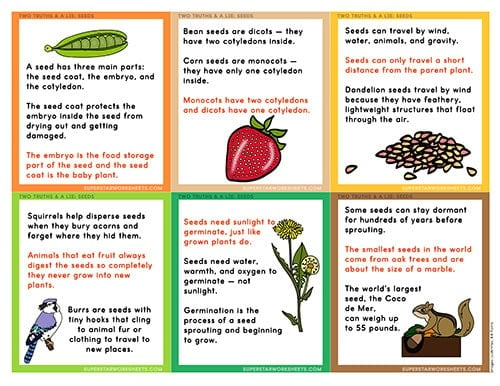
Two Truths & a Lie: Seed Science
Teachers read three statements on each card and students identify the one lie hidden among two truths. This engaging seed science game features six cards covering seed anatomy, monocots and dicots, seed dispersal, germination, and amazing seed facts. The lie is printed in red on each card.
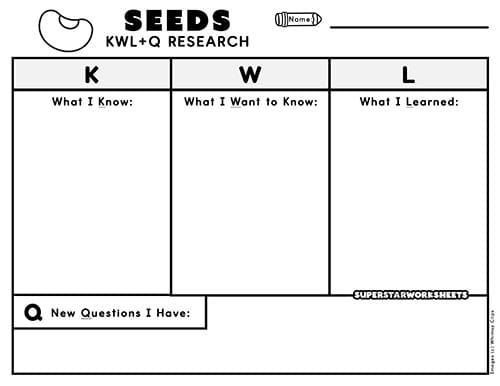
Seeds KWL+Q Research Worksheet
Students record what they know, wonder, learn, and still want to ask about seeds with this printable KWLQ graphic organizer. Use at the beginning and end of your seed unit to show student growth, or assign as an independent research activity paired with the fun facts poster.
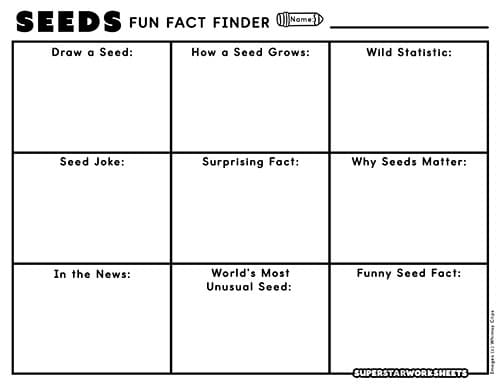
Students put their research skills to the test with this nine-cell seed fact finder worksheet. Each cell contains a unique research prompt including drawing a seed, finding a wild statistic, discovering a seed joke, and identifying the world’s most unusual seed. A fun and open-ended research activity for any seed science unit.
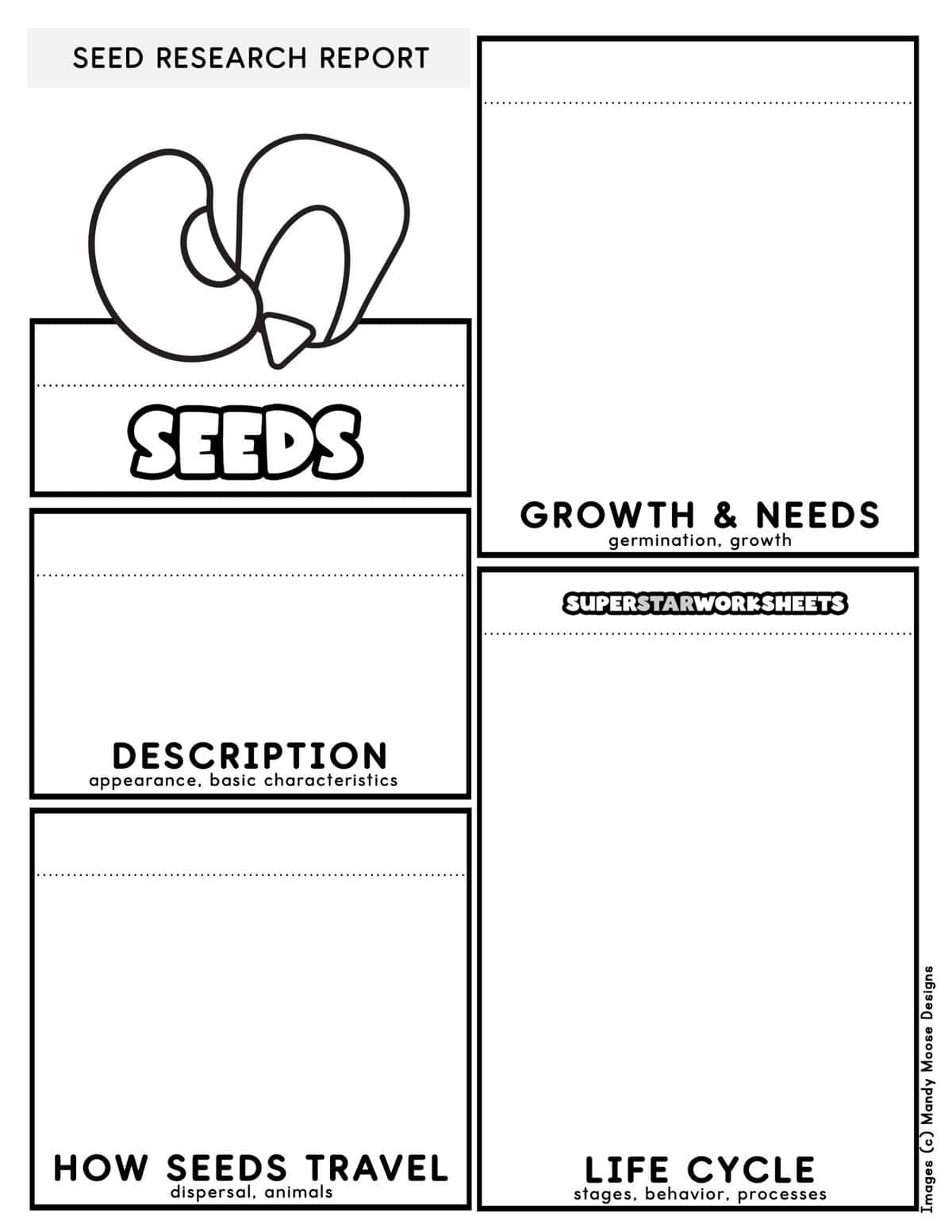
Once students have gathered their seed facts, they can organize and record them in this four-section seed research report layer book. Students write about seed descriptions, how seeds travel, what seeds need to grow, and the seed life cycle. A simple and engaging first research report for elementary students.
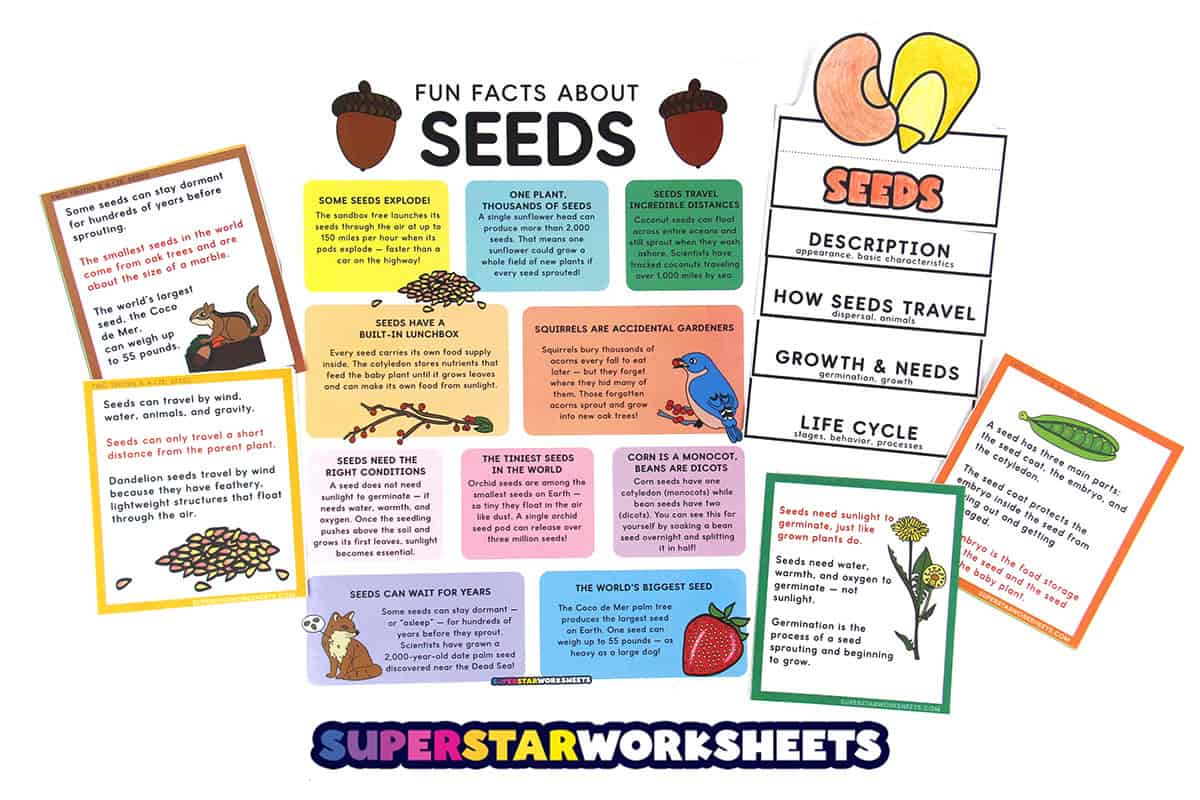
Amazing Seed Facts
Seeds are some of the most extraordinary structures in nature. Here are ten remarkable seed facts to share with your students:
Seeds Can Wait for Years: Some seeds can stay dormant or “asleep” for hundreds of years before they sprout. Scientists have grown a 2,000-year-old date palm seed discovered near the Dead Sea!
The World’s Biggest Seed: The Coco de Mer palm tree produces the largest seed on Earth. One seed can weigh up to 55 pounds, as heavy as a large dog!
Seeds Have a Built-In Lunchbox: Every seed carries its own food supply inside. The cotyledon stores nutrients that feed the baby plant until it grows leaves and can make its own food from sunlight.
Some Seeds Explode!: The sandbox tree launches its seeds through the air at up to 150 miles per hour when its pods explode, faster than a car on the highway!
One Plant, Thousands of Seeds: A single sunflower head can produce more than 2,000 seeds. That means one sunflower could grow a whole field of new plants if every seed sprouted!
Seeds Travel Incredible Distances: Coconut seeds can float across entire oceans and still sprout when they wash ashore. Scientists have tracked coconuts traveling over 1,000 miles by sea.
Squirrels Are Accidental Gardeners: Squirrels bury thousands of acorns every fall to eat later, but they forget where they hid many of them. Those forgotten acorns sprout and grow into new oak trees!
Seeds Need the Right Conditions: A seed does not need sunlight to germinate it needs water, warmth, and oxygen. Once the seedling pushes above the soil and grows its first leaves, sunlight becomes essential.
The Tiniest Seeds in the World: Orchid seeds are among the smallest seeds on Earth, so tiny they float in the air like dust. A single orchid seed pod can release over three million seeds!
Corn Is a Monocot, Beans Are Dicots: Corn seeds have one cotyledon (monocots) while bean seeds have two (dicots). You can see this for yourself by soaking a bean seed overnight and splitting it in half!
Teaching Tip: Read one fact aloud each day as a morning warm-up during your seed unit. Ask students to illustrate their favorite fact and add it to a class “Seed Facts” bulletin board.
Seed Science Vocabulary
germination: The process by which a seed sprouts and begins to grow into a new plant.
dormant: In a state of rest or sleep. A dormant seed is alive but not yet growing.
seedling: A very young plant that has just sprouted from a seed.
sprout: The first tiny shoot that pushes up out of a seed as it begins to grow.
Seed Germination Experiment for Kids
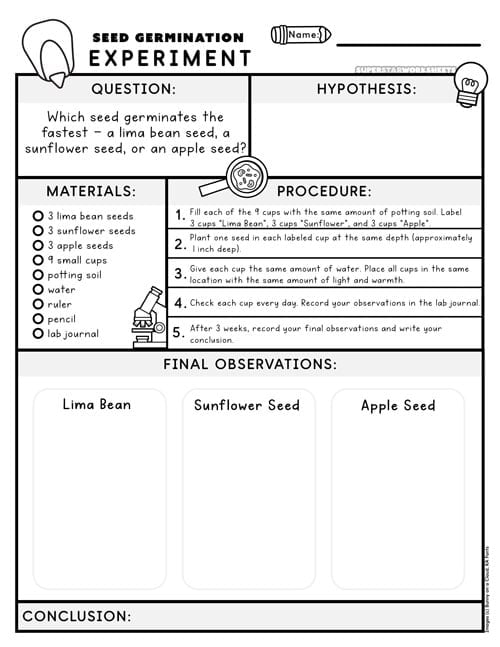
Students compare the germination speed of three common seeds. A lima bean seed, a sunflower seed, and an apple seed, with this printable seed science experiment sheet. Students record their hypothesis, follow the procedure, observe daily changes, and draw final observations for each seed type. Includes a science connection about seed dormancy.
Seed Germination Observational Journal
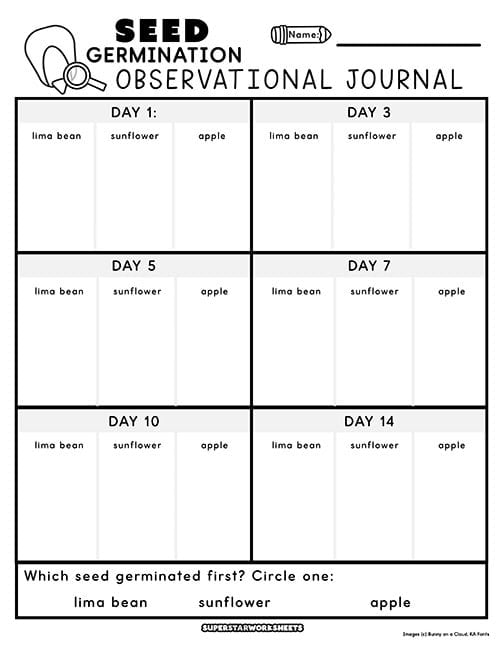
Pair this printable observational journal with the germination experiment to track changes across six observation periods. Each journal page is split into three columns, one per seed type with space for drawings and written observations. Students circle which seed germinated first at the bottom of the final page.
Teaching Seed Germination
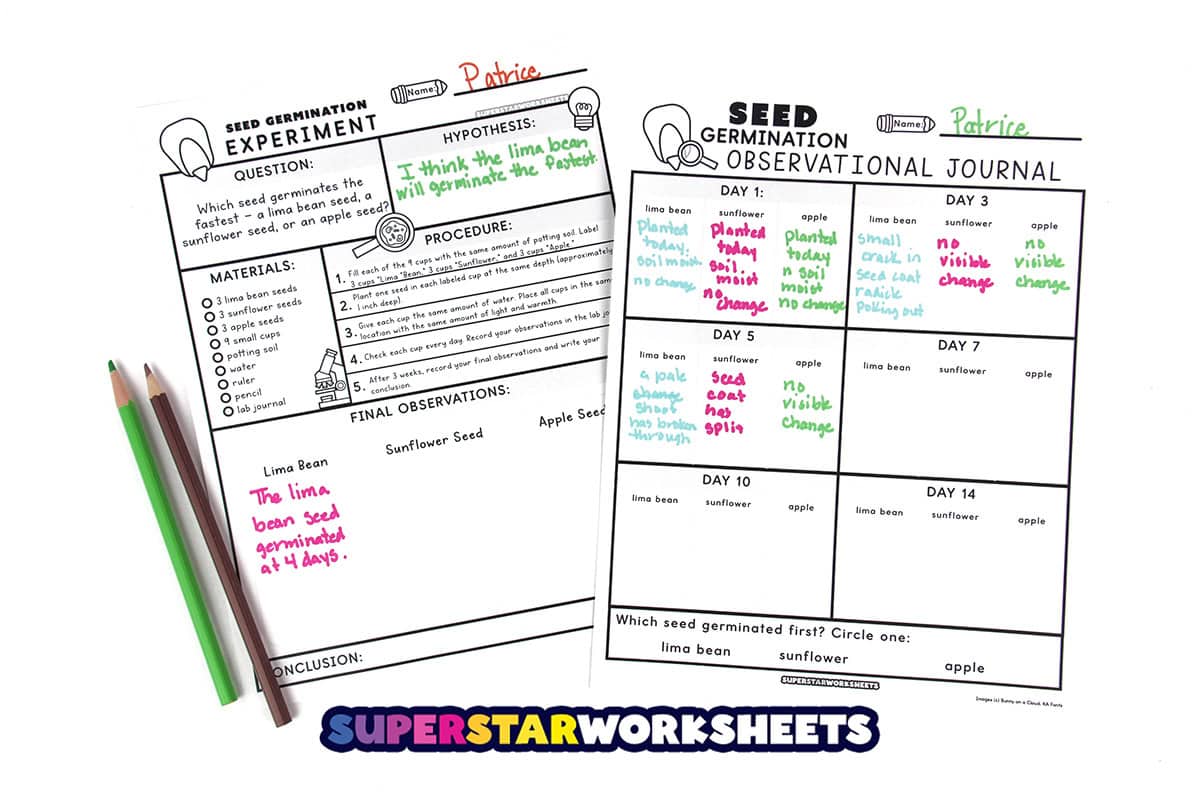
The seed germination experiment gives students a concrete, hands-on experience with one of the most fundamental processes in plant science. By comparing three different seed types side by side, students discover that seeds are not all the same. They have different structures, different amounts of stored energy, and different requirements for when and how they sprout.
Experiment Overview
QUESTION: Which seed germinates the fastest: a lima bean seed, a sunflower seed, or an apple seed?
MATERIALS: 3 lima bean seeds, 3 sunflower seeds, 3 apple seeds, 9 small cups, potting soil, water, ruler, pencil, observational journal
PROCEDURE:
Step 1: Fill each of the 9 cups with the same amount of potting soil. Label 3 cups “Lima Bean,” 3 cups “Sunflower,” and 3 cups “Apple.”
Step 2: Plant one seed in each labeled cup at the same depth (approximately 1 inch deep).
Step 3: Give each cup the same amount of water. Place all cups in the same location with the same amount of light and warmth.
Step 4: Check each cup every day. Record your observations in the lab journal — note which seeds have sprouted, how tall the sprout is, and what it looks like.
Step 5: After 3 weeks, record your final observations and write your conclusion about which seed germinated the fastest.
What to Look For
Lima bean seeds typically show the first signs of germination within 5–7 days. Students will see the seed coat splitting and a small white root (the radicle) pushing through. Sunflower seeds generally germinate in 7–14 days. Apple seeds are the most important teaching moment in this experiment. Apple seeds require a period of cold stratification (a prolonged exposure to cold and moisture) before they will germinate. Without this cold period, most apple seeds will not sprout during the observation window. Rather than a failed experiment, this becomes a rich discussion about dormancy: seeds have built-in timers that prevent them from sprouting at the wrong time of year.
Science Connection
This experiment directly addresses NGSS 2-LS2-1: Plan and conduct an investigation to determine if plants need sunlight and water to grow. The experiment also introduces students to the concept of variables. The seed type changes, but all other conditions (soil, water, light, warmth, planting depth) stay the same. The apple seed’s dormancy connects to the fun fact about seeds waiting for years before sprouting, completing the conceptual arc of the unit.
Teaching Tip: Purchase raw sunflower seeds (not roasted) and dried lima beans from the grocery store bulk section. For apple seeds, collect them from fresh apples in class. Explain to students ahead of time that apple seeds may need a long cold rest before they are ready to grow. Ask students to predict why the apple seed might behave differently from the others.
Germination Vocabulary
germination: The process by which a seed sprouts and begins to grow into a new plant.
hypothesis: A prediction a scientist makes before conducting an experiment.
variable: The one thing that is changed in an experiment to test how it affects the outcome.
observation: What a scientist notices and records during an experiment.
dormancy: A period of rest for a seed during which it does not sprout even when conditions seem right.
radicle: The first root to emerge from a seed when it begins to germinate.
seedling: A very young plant that has just sprouted from a seed.
Leave a Reply